The three vectors are connected by
u×v=w,v×w=u,w=i^+j^−2k^.
The cross-product of two vectors is perpendicular to each of them, so
u⋅v=0,v⋅w=0,w⋅u=0.
Hence the three vectors are pair-wise perpendicular.
Magnitude of w:
∣w∣2=12+12+(−2)2=6.
Using the identity ∣a×b∣2=∣a∣2∣b∣2−(a⋅b)2,
∣w∣2=∣u×v∣2=∣u∣2∣v∣2(∵u⋅v=0)
and
∣u∣2=∣v×w∣2=∣v∣2∣w∣2(∵v⋅w=0).
Let ∣u∣2=a,∣v∣2=b.
Then 6=abanda=6b.
Substituting, 6=(6b)b⟹b2=1⟹b=1.
Therefore
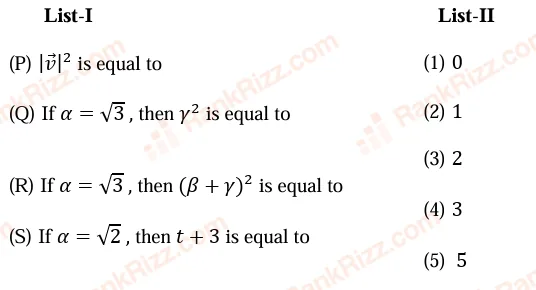
Case P: ∣v∣2=1⇒(P)→(2).
The components of u=αi^+βj^+γk^ obey the three equations
−tα+β+γ=0−(1)
α−tβ+γ=0−(2)
α+β−tγ=0−(3).
For a non-trivial solution, the determinant of the coefficient matrix must vanish:
−t111−t111−t=0⟹−t3+3t+2=0⟹t3−3t−2=0=(t−2)(t+1)2=0.
Thus t=2ort=−1.
We must also satisfy w⋅u=0⇒α+β−2γ=0−(4).
Taking t=−1
Equations (1)-(3) all reduce to α+β+γ=0.
With α=3,
β+γ=−3−(5).
Using (4): 3+β−2γ=0⟹−3γ=0⟹γ=0,β=−3.
Hence
Case Q: γ2=0⇒(Q)→(1).
Case R: (β+γ)2=(−3)2=3⇒(R)→(4).
Taking t=2
From (1): β=2α−γ.
From (2): α−2β+γ=0⟹γ=α.
Therefore β=α.
With α=2 we get t=2, hence
Case S: t+3=2+3=5⇒(S)→(5).
Collecting all matches:
(P)→(2), (Q)→(1), (R)→(4), (S)→(5).
Thus the correct option is
Option A which is: (P)→(2), (Q)→(1), (R)→(4), (S)→(5).