The heating of NHNO at 60-70 C and NHNO at 200-250 C is associated with the formation of nitrogen containing compounds X and Y, respectively. X and Y, respectively, are
- A
N and NO
- B
NH and NO
- C
NO and NO
- D
N and NH
The 16 Chemistry questions of JEE Advanced 2025 Paper 1, numbered across the whole paper. Pick an answer on any question to check it against the key. Free to read, nothing to download.
The heating of NHNO at 60-70 C and NHNO at 200-250 C is associated with the formation of nitrogen containing compounds X and Y, respectively. X and Y, respectively, are
N and NO
NH and NO
NO and NO
N and NH
The correct order of the wavelength maxima of the absorption band in the ultraviolet-visible region for the given complexes is
[Co(CN)] < [Co(NH)] < [Co(NH)(HO)] < [Co(NH)(Cl)]
[Co(NH)(Cl)] < [Co(NH)(HO)] < [Co(NH)] < [Co(CN)]
[Co(CN)] < [Co(NH)(Cl)] < [Co(NH)(HO)] < [Co(NH)]
[Co(NH)] < [Co(CN)] < [Co(NH)(Cl)] < [Co(NH)(HO)]
One of the products formed from the reaction of permanganate ion with iodide ion in neutral aqueous medium is
I
IO
IO
IO
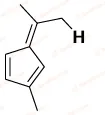
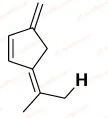
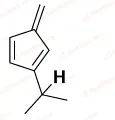
Consider the depicted hydrogen (H) in the hydrocarbons given below. The most acidic hydrogen (H) is


Regarding the molecular orbital (MO) energy levels for homonuclear diatomic molecules, the INCORRECT statement(s) is(are)
Bond order of Ne is zero.
The highest occupied molecular orbital (HOMO) of F is -type.
Bond energy of O is smaller than the bond energy of O.
Bond length of Li is larger than the bond length of B.
The pair(s) of diamagnetic ions is(are)
La, Ce
Yb, Lu
La, Ce
Yb, Lu
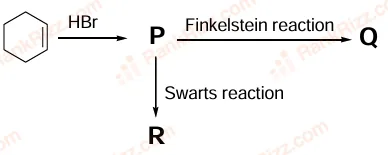
For the reaction sequence given below, the correct statement(s) is(are)

(In the options, X is any atom other than carbon and hydrogen, and it is different in P, Q and R)
C-X bond length in P, Q and R follows the order Q > R > P.
C-X bond enthalpy in P, Q and R follows the order R > P > Q.
Relative reactivity toward S2 reaction in P, Q and R follows the order P > R > Q.
p value of the conjugate acids of the leaving groups in P, Q and R follows the order R > Q > P.
In an electrochemical cell, dichromate ions in aqueous acidic medium are reduced to Cr. The current (in amperes) that flows through the cell for 48.25 minutes to produce 1 mole of Cr is ________.
Use: 1 Faraday = 96500 C mol
At 25 C, the concentration of H ions in M aqueous solution of a weak monobasic acid having acid dissociation constant () of is M. The value of is ________.
Use: Ionic product of water () = at 25 C
Molar volume () of a van der Waals gas can be calculated by expressing the van der Waals equation as a cubic equation with as the variable. The ratio (in mol dm) of the coefficient of to the coefficient of for a gas having van der Waals constants dm atm mol and dm mol at 300 K and 300 atm is ________.
Use: Universal gas constant (R) = 0.082 dm atm mol K
Considering ideal gas behavior, the expansion work done (in kJ) when 144 g of water is electrolyzed completely under constant pressure at 300 K is ________.
Use: Universal gas constant (R) = 8.3 J K mol; Atomic mass (in amu): H = 1, O = 16
The monomer (X) involved in the synthesis of Nylon 6,6 gives positive carbylamine test. If 10 moles of X are analyzed using Dumas method, the amount (in grams) of nitrogen gas evolved is ________.
Use: Atomic mass of N (in amu) = 14
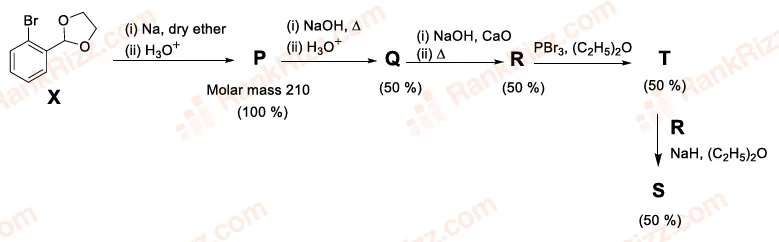
The reaction sequence given below is carried out with 16 moles of X. The yield of the major product in each step is given below the product in parentheses. The amount (in grams) of S produced is ________.
Use: Atomic mass (in amu): H = 1, C = 12, O = 16, Br = 80
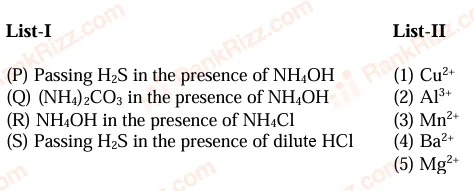
The correct match of the group reagents in List-I for precipitating the metal ion given in List-II from solutions, is

P3; Q4; R2; S1
P4; Q2; R3; S1
P3; Q4; R1; S5
P5; Q3; R2; S4
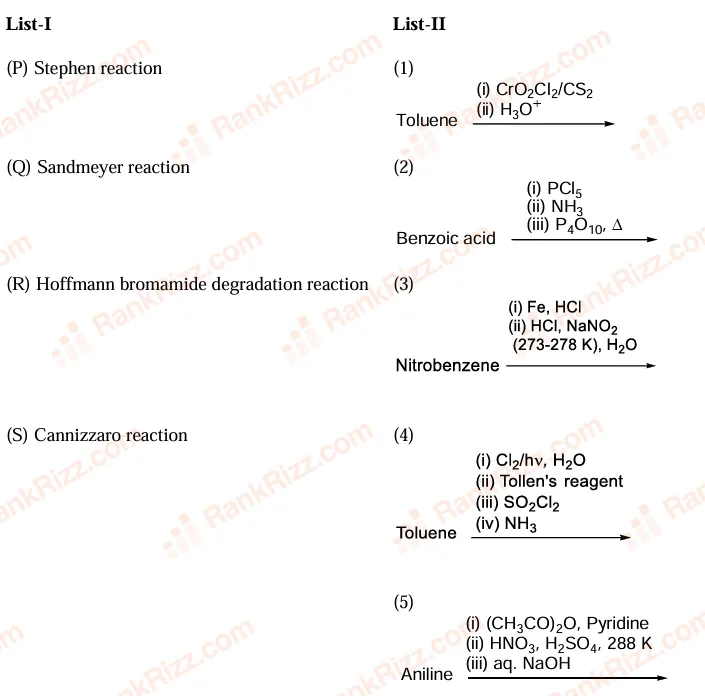
The major products obtained from the reactions in List-II are the reactants for the named reactions mentioned in List-I. Match each entry in List-I with the appropriate entry in List-II and choose the correct option.

P2; Q4; R1; S3
P2; Q3; R4; S1
P5; Q3; R4; S2
P5; Q4; R2; S1
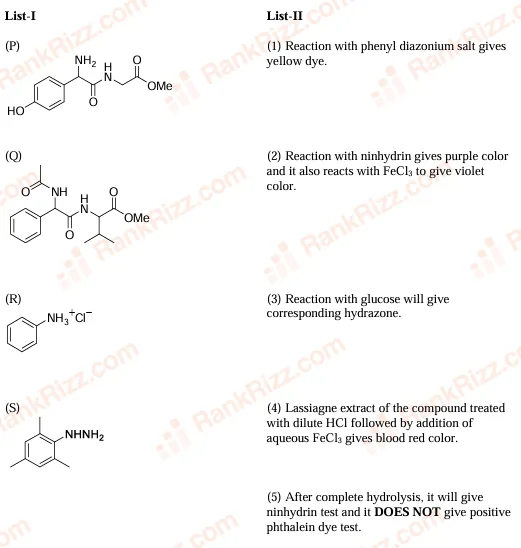
Match the compounds in List-I with the appropriate observations in List-II and choose the correct option.

P1; Q5; R4; S2
P2; Q5; R1; S3
P5; Q2; R1; S4
P2; Q1; R5; S3