RankRizz

JEE Advanced 2023 Paper 1: Chemistry

The 17 Chemistry questions of JEE Advanced 2023 Paper 1, numbered across the whole paper. Pick an answer on any question to check it against the key. Free to read, nothing to download.

Chemistry

Q18Extraction of Fe, Cu, Zn, Al, Ag and AuTRANSCRIBED

The correct statement(s) related to processes involved in the extraction of metals is(are)

  1. A

    Roasting of Malachite produces Cuprite.

  2. B

    Calcination of Calamine produces Zincite.

  3. C

    Copper pyrites is heated with silica in a reverberatory furnace to remove iron.

  4. D

    Impure silver is treated with aqueous KCN in the presence of oxygen followed by reduction with zinc metal.
Q19Hydrogen bonding and intermolecular forcesTRANSCRIBED

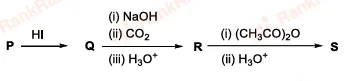
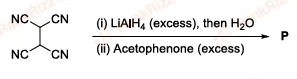
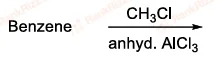
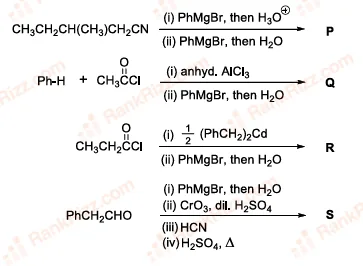
In the following reactions, P, Q, R, and S are the major products.

Figure for JEE Advanced 2023 Chemistry question on Hydrogen bonding and intermolecular forces

The correct statement(s) about P, Q, R, and S is(are)

  1. A

    Both P and Q have asymmetric carbon(s).

  2. B

    Both Q and R have asymmetric carbon(s).

  3. C

    Both P and R have asymmetric carbon(s).

  4. D

    P has asymmetric carbon(s), S does not have any asymmetric carbon.

Q20Hydrogen bonding and intermolecular forcesTRANSCRIBED

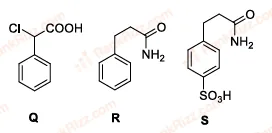
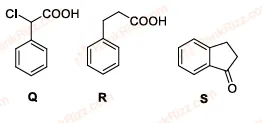
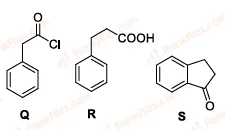
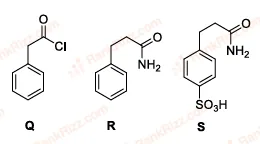
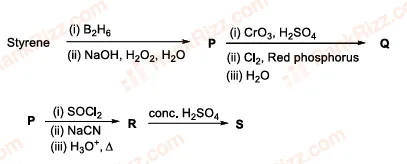
Consider the following reaction scheme and choose the correct option(s) for the major products Q, R and S.

Figure for JEE Advanced 2023 Chemistry question on Hydrogen bonding and intermolecular forces
  1. A
    Figure for JEE Advanced 2023 Chemistry question on Hydrogen bonding and intermolecular forces
  2. B
    Figure for JEE Advanced 2023 Chemistry question on Hydrogen bonding and intermolecular forces
  3. C
    Figure for JEE Advanced 2023 Chemistry question on Hydrogen bonding and intermolecular forces
  4. D
    Figure for JEE Advanced 2023 Chemistry question on Hydrogen bonding and intermolecular forces
Q21Other important compounds of transition metalsTRANSCRIBED

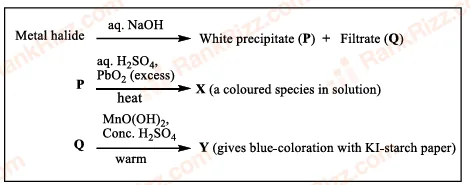
In the scheme given below, X and Y, respectively, are

Figure for JEE Advanced 2023 Chemistry question on Other important compounds of transition metals
  1. A

    CrO42−CrO_4^{2-} and Br2Br_2

  2. B

    MnO42−MnO_4^{2-} and Cl2Cl_2

  3. C

    MnO4−MnO_4^{-} and Cl2Cl_2

  4. D

    MnSO4MnSO_4 and HOCl

Q22Conductance, conductivity and molar conductivityTRANSCRIBED

Plotting 1/Λm1/\Lambda_m against cΛmc\Lambda_m for aqueous solutions of a monobasic weak acid (HX) resulted in a straight line with y-axis intercept of P and slope of S. The ratio P/S is

[Λm\Lambda_m = molar conductivity, Λm∘\Lambda_m^\circ = limiting molar conductivity, c = molar concentration, KaK_a = dissociation constant of HX]

  1. A

    KaΛm∘K_a \Lambda_m^\circ

  2. B

    KaΛm∘/2K_a \Lambda_m^\circ / 2

  3. C

    2KaΛm∘2 K_a \Lambda_m^\circ

  4. D

    1/(KaΛm∘)1 / (K_a \Lambda_m^\circ)

Q23Solubility product and common ion effectTRANSCRIBED

On decreasing the pH from 7 to 2, the solubility of a sparingly soluble salt (MX) of a weak acid (HX) increased from 10−410^{-4} mol L−1^{-1} to 10−310^{-3} mol L−1^{-1}. The pKa_a of HX is:

  1. A

    3

  2. B

    4

  3. C

    5

  4. D

    2

Q24Reactions of phenolsTRANSCRIBED

In the given reaction scheme, P is a phenyl alkyl ether, Q is an aromatic compound; R and S are the major products.

Figure for JEE Advanced 2023 Chemistry question on Reactions of phenols

The correct statement about S is

  1. A

    It primarily inhibits noradrenaline degrading enzymes.

  2. B

    It inhibits the synthesis of prostaglandin.

  3. C

    It is a narcotic drug.

  4. D

    It is ortho-acetylbenzoic acid.

Q25Stoichiometry, limiting reagent and percentage yieldTRANSCRIBED

The stoichiometric reaction of 516 g of dimethyldichlorosilane with water results in a tetrameric cyclic product X in 75% yield. The weight (in g) of X obtained is ____.

[Use, molar mass (g mol−1^{-1}): H = 1, C = 12, O = 16, Si = 28, Cl = 35.5]

Q26Real gases, compressibility factor and van der Waals equationTRANSCRIBED

A gas has a compressibility factor of 0.5 and a molar volume of 0.4 dm3^3 mol−1^{-1} at a temperature of 800 K and pressure x atm. If it shows ideal gas behaviour at the same temperature and pressure, the molar volume will be y dm3^3 mol−1^{-1}. The value of x/y is ____.

[Use: Gas constant, R = 8×10⁻²⁸ \times 10^{-2} L atm K−1^{-1} mol−1^{-1}]

Q27Rate law, order and molecularityTRANSCRIBED

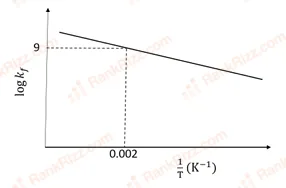
The plot of log kfk_f versus 1/T1/T for a reversible reaction A(g) ⇌\rightleftharpoons P(g) is shown.

Figure for JEE Advanced 2023 Chemistry question on Rate law, order and molecularity

Pre-exponential factors for the forward and backward reactions are 101510^{15} s−1^{-1} and 101110^{11} s−1^{-1}, respectively. If the value of log K for the reaction at 500 K is 6, the value of ∣log⁡kb∣|\log k_b| at 250 K is ______.

[K = equilibrium constant of the reaction,
kfk_f = rate constant of forward reaction,
kbk_b = rate constant of backward reaction]

Q28Gibbs energy and spontaneityTRANSCRIBED

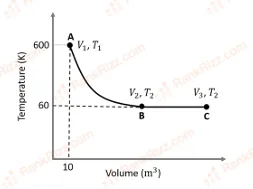
One mole of an ideal monoatomic gas undergoes two reversible processes (A →\to B and B →\to C) as shown in the given figure:

Figure for JEE Advanced 2023 Chemistry question on Gibbs energy and spontaneity

A →\to B is an adiabatic process. If the total heat absorbed in the entire process (A →\to B and B →\to C) is RT2ln⁡10RT_2 \ln 10, the value of 2log⁡V32 \log V_3 is ________.

[Use, molar heat capacity of the gas at constant pressure, Cp,m=52RC_{p,m} = \frac{5}{2}R]

Q29Reaction quotient, degree of dissociation and equilibrium calculationsTRANSCRIBED

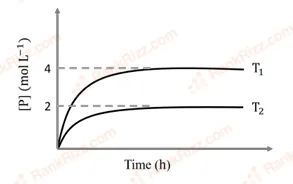
In a one-litre flask, 6 moles of A undergoes the reaction A(g) ⇌\rightleftharpoons P(g). The progress of product formation at two temperatures (in Kelvin), T1T_1 and T2T_2, is shown in the figure:

Figure for JEE Advanced 2023 Chemistry question on Reaction quotient, degree of dissociation and equilibrium calculations


If T1=2T2T_1 = 2T_2 and (ΔG2∘−ΔG1∘)=RT2ln⁡x(\Delta G_2^\circ - \Delta G_1^\circ) = RT_2 \ln x, then the value of x is ______.

[ΔG1∘\Delta G_1^\circ and ΔG2∘\Delta G_2^\circ are standard Gibb's free energy change for the reaction at temperatures T1T_1 and T2T_2, respectively.]

Q30Diazonium saltsTRANSCRIBED

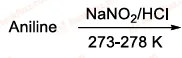
The total number of sp2^2 hybridised carbon atoms in the major product P (a non-heterocyclic compound) of the following reaction is ______.

Figure for JEE Advanced 2023 Chemistry question on Diazonium salts
Q31Phosphorus and its compoundsTRANSCRIBED

Match the reactions (in the given stoichiometry of the reactants) in List-I with one of their products given in List-II and choose the correct option.

List-IList-II
(P)P2O3+3H2O→P_2O_3 + 3H_2O \to(1)P(O)(OCH3)Cl2P(O)(OCH_3)Cl_2
(Q)P4+3NaOH+3H2O→P_4 + 3NaOH + 3H_2O \to(2)H3PO3H_3PO_3
(R)PCl5+CH3COOH→PCl_5 + CH_3COOH \to(3)PH3PH_3
(S)H3PO2+2H2O+4AgNO3→H_3PO_2 + 2H_2O + 4AgNO_3 \to(4)POCl3POCl_3
(5)H3PO4H_3PO_4
  1. A

    P →\to 2; Q →\to 3; R →\to 1; S →\to 5

  2. B

    P →\to 3; Q →\to 5; R →\to 4; S →\to 2

  3. C

    P →\to 5; Q →\to 2; R →\to 1; S →\to 3

  4. D

    P →\to 2; Q →\to 3; R →\to 4; S →\to 5

Q32Colour and magnetic behaviour of complexes from CFTTRANSCRIBED

Match the electronic configurations in List-I with appropriate metal complex ions in List-II and choose the correct option.

[Atomic Number: Fe = 26, Mn = 25, Co = 27]

List-IList-II
(P)t2g6eg0t_{2g}^6 e_g^0(1)[Fe(H2O)6]2+[Fe(H_2O)_6]^{2+}
(Q)t2g3eg2t_{2g}^3 e_g^2(2)[Mn(H2O)6]2+[Mn(H_2O)_6]^{2+}
(R)e2t23e^2 t_2^3(3)[Co(NH3)6]3+[Co(NH_3)_6]^{3+}
(S)t2g4eg2t_{2g}^4 e_g^2(4)[FeCl4]−[FeCl_4]^{-}
(5)[CoCl4]2−[CoCl_4]^{2-}
  1. A

    P →\to 1; Q →\to 4; R →\to 2; S →\to 3

  2. B

    P →\to 1; Q →\to 2; R →\to 4; S →\to 5

  3. C

    P →\to 3; Q →\to 2; R →\to 5; S →\to 1

  4. D

    P →\to 3; Q →\to 2; R →\to 4; S →\to 1

Q33Nucleophilic substitution (SN1 and SN2)TRANSCRIBED

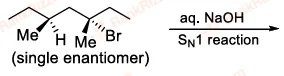
Match the reactions in List-I with the features of their products in List-II and choose the correct option.

List-IList-II
(P)(-)-1-Bromo-2-ethylpentane (single enantiomer) →SN2 reactionaq. NaOH\xrightarrow[S_N2 \text{ reaction}]{\text{aq. NaOH}}(1)Inversion of configuration
(Q)(-)-2-Bromopentane (single enantiomer) →SN2 reactionaq. NaOH\xrightarrow[S_N2 \text{ reaction}]{\text{aq. NaOH}}(2)Retention of configuration
(R)(-)-3-Bromo-3-methylhexane (single enantiomer) →SN1 reactionaq. NaOH\xrightarrow[S_N1 \text{ reaction}]{\text{aq. NaOH}}(3)Mixture of enantiomers
(S)
Figure for JEE Advanced 2023 Chemistry question on Nucleophilic substitution (SN1 and SN2)
(4)Mixture of structural isomers
(5)Mixture of diastereomers
  1. A

    P →\to 1; Q →\to 2; R →\to 5; S →\to 3

  2. B

    P →\to 2; Q →\to 1; R →\to 3; S →\to 5

  3. C

    P →\to 1; Q →\to 2; R →\to 5; S →\to 4

  4. D

    P →\to 2; Q →\to 4; R →\to 3; S →\to 5

Q34Preparation of aldehydes and ketonesTRANSCRIBED

The major products obtained from the reactions in List-II are the reactants for the named reactions mentioned in List-I. Match List-I with List-II and choose the correct option.

List-IList-II
(P)Etard reaction(1)Acetophenone →Zn−Hg,HCl\xrightarrow{Zn-Hg, HCl}
(Q)Gattermann reaction(2)Toluene →(ii) SOCl2(i) KMnO4,KOH,Δ\xrightarrow[\text{(ii) } SOCl_2]{\text{(i) } KMnO_4, KOH, \Delta}
(R)Gattermann-Koch reaction(3)
Figure for JEE Advanced 2023 Chemistry question on Preparation of aldehydes and ketones
(S)Rosenmund reduction(4)
Figure for JEE Advanced 2023 Chemistry question on Preparation of aldehydes and ketones
(5)Phenol →Zn,Δ\xrightarrow{Zn, \Delta}
  1. A

    P →\to 2; Q →\to 4; R →\to 1; S →\to 3

  2. B

    P →\to 1; Q →\to 3; R →\to 5; S →\to 2

  3. C

    P →\to 3; Q →\to 2; R →\to 1; S →\to 4

  4. D

    P →\to 3; Q →\to 4; R →\to 5; S →\to 2

NEXT IN THIS PAPER →Maths, Q35 onwards