JEE Advanced 2023 Chemistry question — Diazonium salts
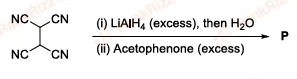
The total number of sp hybridised carbon atoms in the major product P (a non-heterocyclic compound) of the following reaction is ______.
SOLUTION
Step 1: Reduction with (excess)
The starting material is :
Lithium aluminum hydride () is a strong reducing agent that reduces all four nitrile () groups completely into primary amine () groups.
The intermediate tetra-amine formed after workup with is:
Step 2: Reaction with Acetophenone (excess)
Acetophenone () reacts with primary amines () via a nucleophilic addition-elimination reaction to form imines ():
Since acetophenone is in excess, all four primary amine groups will react to form four imine groups in the final product .
Step 3: Counting Hybridised Carbon Atoms
Let's analyze the hybridization of carbons in one attached acetophenone-derived unit ():
- Imine Carbon (): carbon
- Methyl Carbon (): carbons ()
- Phenyl Ring (): All carbons in the benzene ring are hybridised.
Tagged Diazonium salts. Machine-assigned, so read it as a strong shortlist rather than a verdict.