JEE Advanced 2023 Chemistry question — Reactions of phenols
In the given reaction scheme, P is a phenyl alkyl ether, Q is an aromatic compound; R and S are the major products.
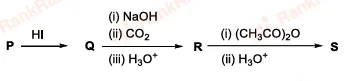
The correct statement about S is
SOLUTION
When one side of an ether is aryl and the other side is alkyl, hot concentrated selectively cleaves the alkyl-oxygen bond (because the aryl-oxygen bond has partial double-bond character). Therefore:
Thus is phenol, .
The Kolbe-Schmitt reaction is the standard industrial route for converting phenol into salicylic acid. The three-step sequence is:
Hence is salicylic acid, commonly written as .
Acetic anhydride acetylates the phenolic -OH of salicylic acid much faster than the -COOH group. The two-step sequence
gives = acetylsalicylic acid, better known as aspirin.
Pharmacologically, aspirin irreversibly acetylates and inactivates cyclo-oxygenase (COX-1 and COX-2). These enzymes catalyse the conversion of arachidonic acid into prostaglandins. By blocking this step, aspirin inhibits the biosynthesis of prostaglandins, which are mediators of pain, fever and inflammation.
Therefore, the correct statement about is:
Option B which is: It inhibits the synthesis of prostaglandin.
Tagged Reactions of phenols. Machine-assigned, so read it as a strong shortlist rather than a verdict.