RankRizz

JEE Advanced 2017 Paper 2: Chemistry

The 18 Chemistry questions of JEE Advanced 2017 Paper 2, numbered across the whole paper. Pick an answer on any question to check it against the key. Free to read, nothing to download.

Chemistry

Q19Depression in freezing pointTRANSCRIBED

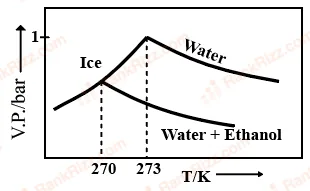
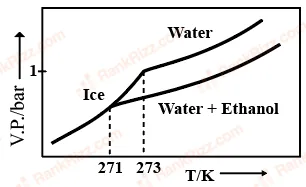
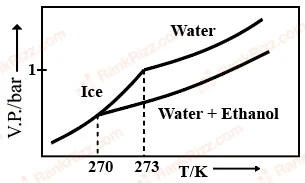
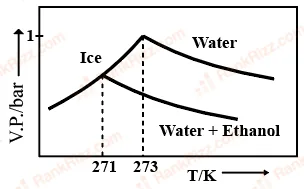
Pure water freezes at 273 K and 1 bar. The addition of 34.5 g of ethanol to 500 g of water changes the freezing point of the solution. Use the freezing point depression constant of water as 2 K kg mol−1mol^{-1} . The figures shown below represent plots of vapour pressure (V.P.) versus temperature (T). [molecular weight of ethanol is 46 g mol−1mol^{-1}] Among the following, the option representing change in the freezing point is

  1. A
    Figure for JEE Advanced 2017 Chemistry question on Depression in freezing point
  2. B
    Figure for JEE Advanced 2017 Chemistry question on Depression in freezing point
  3. C
    Figure for JEE Advanced 2017 Chemistry question on Depression in freezing point
  4. D
    Figure for JEE Advanced 2017 Chemistry question on Depression in freezing point
Q20Electrode potentials, electrochemical series and cell EMFTRANSCRIBED

For the following cell, Zn(s)∣ZnSO4(aq)∥CuSO4(aq)∣Cu(s)Zn(s)\mid ZnSO_{4}(aq)\parallel CuSO_{4}(aq)\mid Cu(s) when the concentration of Zn2+Zn^{2+} is 10 times the concentration of Cu2+Cu^{2+}, the expression for △G\triangle G ((in J mol−1mol^{-1}) is [F is Faraday constant; R is gas constant; T is temperature; E0(cell)=1.1VE^{0}(cell)=1.1V]

  1. A

    1.1F

  2. B

    2.303RT-2.2F

  3. C

    2.303RT+1.1F

  4. D

    -2.2F

Q21Gibbs energy and spontaneityTRANSCRIBED

The standard state Gibbs free energies of formation of C(graphite) and C(diamond) at T = 298 K are
△fG0[C(graphite)]=0kJ mol−1\triangle_{f}G^{0}[C(graphite)]=0 kJ\ mol^{-1}
△fG0[C(diamond)]=2.9kJ mol−1\triangle_{f}G^{0}[C(diamond)]=2.9 kJ\ mol^{-1}
The standard state means that the pressure should be 1 bar, and substance should be pure at a given temperature. The conversion of graphite [C(graphite)] to diamond [C(diamond)] reduces its volume by 2×10⁻⁶m3mol−12\times10^{-6}m^{3}mol^{-1} If C(graphite) is converted to C(diamond) isothermally at T = 298 K, the pressure at which C(graphite) is in equilibrium with
[Useful information: 1 J = 1 kg m2s−2m^{2}s^{-2};1 Pa=1kg m−1s−2m^{-1}s^{-2}; 1bar=105Pa1 bar = 10^{5} Pa] C(diamond), is

  1. A

    14501 bar

  2. B

    58001 bar

  3. C

    1450 bar

  4. D

    29001 bar

Q22Potassium dichromate and potassium permanganateTRANSCRIBED

Which of the following combination will produce H2H_{2} gas?

  1. A

    Fe metal and conc. HNO3HNO_{3}

  2. B

    Cu metal and conc. HNO3HNO_{3}

  3. C

    Zn metal and NaOH(aq)

  4. D

    Au metal and NaCN(aq) in the presence of air

Q23Oxidation numberTRANSCRIBED

The order of the oxidation state of the phosphorus atom in H3PO2,H3PO4,H3PO3H_{3}PO_{2},H_{3}PO_{4},H_{3}PO_{3} and H4P2O6H_{4}P_{2}O_{6} is

  1. A

    H3PO3>H3PO2>H3PO4>H4P2O6H_{3}PO_{3}>H_{3}PO_{2}>H_{3}PO_{4}>H_{4}P_{2}O_{6}

  2. B

    H3PO4>H3PO2>H3PO3>H4P2O6H_{3}PO_{4}>H_{3}PO_{2}>H_{3}PO_{3}>H_{4}P_{2}O_{6}

  3. C

    H3PO4>H4P2O6>H3PO3>H3PO2H_{3}PO_{4}>H_{4}P_{2}O_{6}>H_{3}PO_{3}>H_{3}PO_{2}

  4. D

    H3PO2>H3PO3>H4P2O6>H3PO4H_{3}PO_{2}>H_{3}PO_{3}>H_{4}P_{2}O_{6}>H_{3}PO_{4}

Q25Preparation of aminesTRANSCRIBED

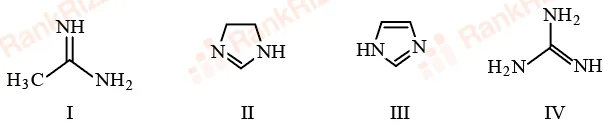
The order of basicity among the following compounds is

Figure for JEE Advanced 2017 Chemistry question on Preparation of amines
  1. A

    II>I>IV>III

  2. B

    IV>II>III>I

  3. C

    IV>I>II>III

  4. D

    I>IV>III>II

Q26Adsorption and adsorption isothermsTRANSCRIBED

The correct statement(s) about surface properties is(are)

  1. A

    Adsorption is accompanied by decrease in enthalpy and decrease in entropy of the system

  2. B

    The critical temperatures of ethane and nitrogen are 563 K and 126 K, respectively. The adsorption of ethane will be more than that of nitrogen on same amount of activated charcoal at a given temperature

  3. C

    Cloud is an emulsion type of colloid in which liquid is dispersed phase and gas is dispersion medium

  4. D

    Brownian motion of colloidal particles does not depend on the size of the particles but depends on viscosity of the solution

Q27Gibbs energy and spontaneityTRANSCRIBED

For a reaction taking place in a container in equilibrium with its surroundings, the effect of temperature on its equilibrium constant K in terms of change in entropy is described by

  1. A

    With increase in temperature, the value of K for exothermic reaction decreases because the entropy change of the system is positive

  2. B

    With increase in temperature, the value of K for endothermic reaction increases because unfavourable change in entropy of the surroundings decreases

  3. C

    With increase in temperature, the value of K for endothermic reaction increases because the entropy change of the system is negative

  4. D

    With increase in temperature, the value of K for exothermic reaction decreases because favourable change in entropy of the surroundings decreases

Q28Collision theory and effect of catalyst on rateTRANSCRIBED

In a bimolecular reaction, the steric factor P was experimentally determined to be 4.5. The correct option(s) among the following is(are)

  1. A

    The activation energy of the reaction is unaffected by the value of the steric factor

  2. B

    Experimentally determined value of frequency factor is higher than that predicted by Arrhenius equation

  3. C

    Since P = 4.5, the reaction will not proceed unless an effective catalyst is used

  4. D

    The value of frequency factor predicted by Arrhenius equation is higher than that determined experimentally

Q29Nucleophilic substitution (SN1 and SN2)TRANSCRIBED

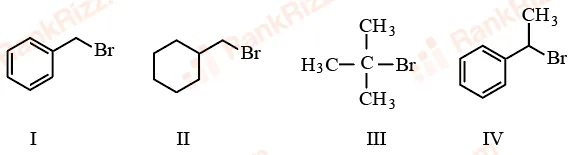
For the following compounds, the correct statement(s) with respect to nucleophilic substitution reactions is(are)

Figure for JEE Advanced 2017 Chemistry question on Nucleophilic substitution (SN1 and SN2)
  1. A

    I and III follow SN1S_{N}1 mechanism

  2. B

    I and II follow SN2S_{N}2 mechanism

  3. C

    Compound IV undergoes inversion of configuration

  4. D

    The order of reactivity for I, III and IV is: IV > I > III

Q30Group 13: general trends and inert pair effectTRANSCRIBED

Among the following, the correct statement(s) is(are)

  1. A

    Al(CH3)3Al(CH_{3})_{3} has the three-centre two-electron bonds in its dimeric structure

  2. B

    BH3BH_{3} has the three-centre two-electron bonds in its dimeric structure

  3. C

    AlCl3AlCl_{3} has the three-centre two-electron bonds in its dimeric structure

  4. D

    The Lewis acidity of BCl3BCl_{3} is greater than that of AlCl3AlCl_{3}

Q31Magnetic moment, colour and catalytic properties of transition metalsTRANSCRIBED

The option(s) with only amphoteric oxides is(are)

  1. A

    Cr2O3,BeO,SnO,SnO2Cr_{2}O_{3},BeO,SnO,SnO_{2}

  2. B

    Cr2O3,CrO,SnO,PbOCr_{2}O_{3},CrO,SnO,PbO

  3. C

    NO,B2O3,PbO,SnO2NO,B_{2}O_{3},PbO,SnO_{2}

  4. D

    ZnO,Al2O3,PbO,PbO2ZnO,Al_{2}O_{3},PbO,PbO_{2}

Q32Aldol condensation, Cannizzaro and related reactionsTRANSCRIBED

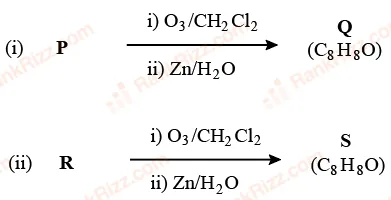
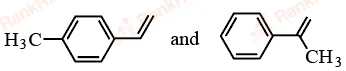
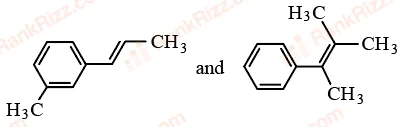
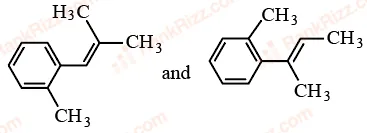
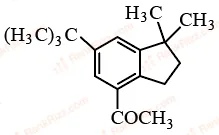
Compounds P and R upon ozonolysis produce Q and S, respectively. The molecular formula of Q and S is C8H8OC_{8}H_{8}O. Q undergoes Cannizzaro reaction but not haloform reaction, whereas S undergoes haloform reaction but not Cannizzaro reaction.

Figure for JEE Advanced 2017 Chemistry question on Aldol condensation, Cannizzaro and related reactions

The option(s) with suitable combination of P and R, respectively, is(are)

  1. A
    Figure for JEE Advanced 2017 Chemistry question on Aldol condensation, Cannizzaro and related reactions
  2. B
    Figure for JEE Advanced 2017 Chemistry question on Aldol condensation, Cannizzaro and related reactions
  3. C
    Figure for JEE Advanced 2017 Chemistry question on Aldol condensation, Cannizzaro and related reactions
  4. D
    Figure for JEE Advanced 2017 Chemistry question on Aldol condensation, Cannizzaro and related reactions
Q33Phosphorus and its compoundsTRANSCRIBED

W and X are, respectively

  1. A

    O3O_{3} and P4O6P_{4}O_{6}

  2. B

    O2O_{2} and P4O6P_{4}O_{6}

  3. C

    O2O_{2} and P4O10P_{4}O_{10}

  4. D

    O3O_{3} and P4O10P_{4}O_{10}

Q34Phosphorus and its compoundsTRANSCRIBED

Y and Z are, respectively

  1. A

    N2O3N_{2}O_{3} and H3PO4H_{3}PO_{4}

  2. B

    N2O5N_{2}O_{5} and HPO3HPO_{3}

  3. C

    N2O4N_{2}O_{4} and HPO3HPO_{3}

  4. D

    N2O4N_{2}O_{4} and H3PO3H_{3}PO_{3}

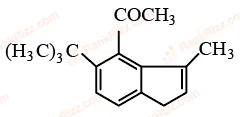
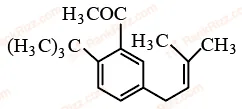
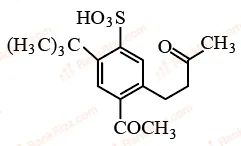
Q36Reactions of carboxylic acidsTRANSCRIBED

The reactions, Q to R and R to S, are

  1. A

    Dehydration and Friedel-Crafts acylation

  2. B

    Aromatic sulfonation and Friedel-Crafts acylation

  3. C

    Friedel-Crafts alkylation, dehydration and Friedel-Crafts acylation

  4. D

    Friedel-Crafts alkylation and Friedel-Crafts acylation

NEXT IN THIS PAPER →Maths, Q37 onwards