JEE ADVANCED 2017 · PAPER 2+3 / −1MEDIUMTRANSCRIBED
JEE Advanced 2017 Chemistry question — Preparation of amines
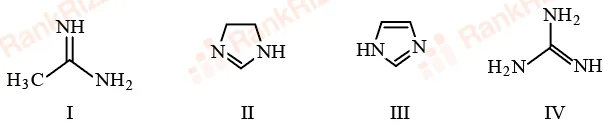
The order of basicity among the following compounds is
SOLUTION
Key idea: Amidines and guanidines are strong bases because their conjugate acids are resonance-stabilised cations. The more N atoms share the positive charge, the stronger the base. Aromatic imidazole is much weaker.
- IV, guanidine: the guanidinium ion spreads the + charge equally over 3 N atoms (Y-shaped resonance). This is the strongest base (p ≈ 13.6).
- I, acetamidine : the amidinium ion shares the charge over 2 N atoms (p ≈ 12.4).
- II, 2-imidazoline: a cyclic amidine, also stabilised over 2 N. It lacks the electron-donating on the central carbon and its ring is constrained, so it is slightly weaker than I.
- III, imidazole: aromatic. Its basic N lone pair is , and protonation gives a cation stabilised only by aromaticity (p ≈ 7). It is the weakest of the four.
- Order: IV > I > II > III, option (C).
Answer: (C)
Tagged Preparation of amines. Machine-assigned, so read it as a strong shortlist rather than a verdict.