RankRizz

JEE Advanced 2017 Paper 2: Maths

The 18 Maths questions of JEE Advanced 2017 Paper 2, numbered across the whole paper. Pick an answer on any question to check it against the key. Free to read, nothing to download.

Maths

Q37Equation of a planeTRANSCRIBED

The equation of the plane passing through the point (1, 1, 1) and perpendicular to the planes 2x+y−2z=52x+y-2z=5 and 3x−6y−2z=73x-6y-2z=7, is

  1. A

    14x+2y−15z=114x+2y-15z=1

  2. B

    14x−2y+15z=2714x-2y+15z=27

  3. C

    14x+2y+15z=3114x+2y+15z=31

  4. D

    −14x+2y+15z=3-14x+2y+15z=3

Q38Scalar (dot) productTRANSCRIBED

Let O be the origin and let PQR be an arbitrary triangle. The point S is such that OP→.OQ→+OR→.OS→=OR→.OP→+OQ→.OS→=OQ→.OR→+OP→.OS→\overrightarrow{OP}.\overrightarrow{OQ}+\overrightarrow{OR}.\overrightarrow{OS}=\overrightarrow{OR}.\overrightarrow{OP}+\overrightarrow{OQ}.\overrightarrow{OS}=\overrightarrow{OQ}.\overrightarrow{OR}+\overrightarrow{OP}.\overrightarrow{OS} Then the triangle PQR has S as its

  1. A

    centroid

  2. B

    circumcentre

  3. C

    incentre

  4. D

    orthocenter

Q39Variable separable equationsTRANSCRIBED

If y=y(x)y=y(x) ) satisfies the differential equation 8x(9+x)dy=(4+9+x)−1dx8\sqrt{x}(\sqrt{9+\sqrt{x}})dy=(\sqrt{4+\sqrt{9+\sqrt{x}}})^{-1}dx, x>0 and Y(0)=7Y(0)=\sqrt{7}, then y(256)=

  1. A

    3

  2. B

    9

  3. C

    16

  4. D

    80

Q40Rolle's theorem and Lagrange's mean value theoremTRANSCRIBED

If f:R→Rf:R\rightarrow Ris a twice differentiable function such that f′′(x)>0f''(x)>0 for all xϵRx\epsilon R, and f(12)=12,f(1)=1f(\frac{1}{2})=\frac{1}{2},f(1)=1, then

  1. A

    f′(1)≤0f'(1)\leq0

  2. B

    0<f′(1)≤120<f'(1)\leq\frac{1}{2}

  3. C

    12<f′(1)≤ 1\frac{1}{2}<f'(1)\leq\ 1

  4. D

    f′(1)>1f'(1)>1

Q41Trace and special matricesTRANSCRIBED

How many 3×33\times3 matrices M with entries from {0,1,2} are there, for which the sum of the diagonal entries of MTMM^{T}M is 5?

  1. A

    126

  2. B

    198

  3. C

    162

  4. D

    135

Q42Combinations and selections with conditionsTRANSCRIBED

Lat S={1,2,3,...,9}. For = 1, 2, … ,5, let NkN_{k} be the number of subsets of S, each containing five elements out of which exactly k are odd, Then N1+N2+N3+N4+N5=N_{1}+N_{2}+N_{3}+N_{4}+N_{5}=

  1. A

    210

  2. B

    252

  3. C

    125

  4. D

    126

Q43Probability using permutations and combinationsTRANSCRIBED

Three randomly chosen nonnegative integers x,y and z are found to satisfy the equation x+y+z=10x+y+z=10. Then the probability that z is even, is

  1. A

    3655\frac{36}{55}

  2. B

    611\frac{6}{11}

  3. C

    12\frac{1}{2}

  4. D

    511\frac{5}{11}

Q44Leibniz rule for differentiating integralsTRANSCRIBED

If g(x)=∫sin⁡xsin⁡(2x)sin⁡−1(t)dtg(x) = \int_{\sin x}^{\sin(2x)} \sin^{-1}(t)dt then

  1. A

    g′(π2)=−2πg'(\frac{\pi}{2})=-2\pi

  2. B

    g′(−π2)=2πg'(-\frac{\pi}{2})=2\pi

  3. C

    g′(π2)=2πg'(\frac{\pi}{2})=2\pi

  4. D

    g′(−π2)=−2πg'(-\frac{\pi}{2})=-2\pi

Q45Multiple and sub-multiple angle formulasTRANSCRIBED

Let α\alpha and β\beta be nonzero real numbers such that 2(cos⁡β−cos⁡α)+cos⁡αcos⁡β=12(\cos\beta-\cos\alpha)+\cos\alpha\cos\beta=1. Then which of the following is/are true?

  1. A

    tan⁡(α2)+3tan(β2)=0\tan(\frac{\alpha}{2})+\sqrt{3} tan(\frac{\beta}{2})=0

  2. B

    3tan⁡(α2)+tan(β2)=0\sqrt{3} \tan(\frac{\alpha}{2})+tan(\frac{\beta}{2})=0

  3. C

    tan⁡(α2)−3tan(β2)=0\tan(\frac{\alpha}{2})-\sqrt{3} tan(\frac{\beta}{2})=0

  4. D

    3tan⁡(α2)−tan(β2)=0\sqrt{3} \tan(\frac{\alpha}{2})-tan(\frac{\beta}{2})=0

Q46Monotonicity and intervals of increase/decreaseTRANSCRIBED

If f:R→Rf:R\rightarrow R is a differentiable function such that f′(x)>2f(x)f'(x)>2f(x) for all xϵRx\epsilon R, and f(0)=1f(0)=1, then

  1. A

    f(x)f(x) is increasing in (0,∞)(0,\infty)

  2. B

    f(x)f(x) is decreasing in (0,∞)(0,\infty)

  3. C

    f(x)>e2xf(x)>e^{2x} in (0,∞)(0,\infty)

  4. D

    f′(x)<e2xf'(x)<e^{2x} in (0,∞)(0,\infty)

Q47Limits of trigonometric functionsTRANSCRIBED

Let f(x)=1−x(1+∣1−x∣)∣1−x∣Cos(11−x)f(x)=\frac{1-x(1+\mid1-x\mid)}{\mid1-x\mid}Cos(\frac{1}{1-x}) for x≠1x\neq1. Then

  1. A

    lim⁡x→1−f(x)=0\lim_{x\rightarrow1^{-}}f(x)=0

  2. B

    lim⁡x→1−f(x)\lim_{x\rightarrow1^{-}}f(x) does not exist

  3. C

    lim⁡x→1+f(x)=0\lim_{x\rightarrow1^{+}}f(x)=0

  4. D

    lim⁡x→1+f(x)\lim_{x\rightarrow1^{+}}f(x) does not exist

Q48Optimization word and geometry problemsTRANSCRIBED

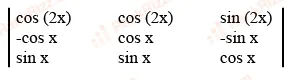
If f(x) = 

Figure for JEE Advanced 2017 Mathematics question on Optimization word and geometry problems

, then

  1. A

    f'(x) = 0 at exactly three points in −π,π-\pi,\pi

  2. B

    f'(x) = 0 at more than three points in −π,π-\pi,\pi

  3. C

    f(x) attains its maximum at x=0

  4. D

    f(x) attains its minimum at x=0

Q49Area between curvesTRANSCRIBED

If the line x=αx=\alpha divides the area of region R=(x,y)ϵR2:x3≤y≤x,0≤x≤1R={(x,y)\epsilon R^{2}:x^{3}\leq y\leq x},0\leq x\leq1 into two equal parts, then

  1. A

    0<α≤120<\alpha \leq\frac{1}{2}

  2. B

    12<α<1\frac{1}{2}<\alpha<1

  3. C

    2α4−4α2+1=02\alpha^{4}-4\alpha^{2}+1=0

  4. D

    α4+4α2−1=0\alpha^{4}+4\alpha^{2}-1=0

Q50Definite integrals: properties and King's ruleTRANSCRIBED

If 1=∑k=198∫kk+1k+1x(x+1)dx1=\sum^{98}_{k=1}\int_{k}^{k+1} \frac{k+1}{x(x+1)}dx, then

  1. A

    1>log⁡e991>\log_{e}{99}

  2. B

    1<log⁡e991<\log_{e}{99}

  3. C

    1<49501<\frac{49}{50}

  4. D

    1>49501>\frac{49}{50}

Q51Vector (cross) product and areaTRANSCRIBED

∣OX→×OY→∣=\mid\overrightarrow{OX}\times\overrightarrow{OY}\mid=

  1. A

    sin⁡(P+Q)\sin(P+Q)

  2. B

    sin⁡2R\sin2R

  3. C

    sin⁡(P+R)\sin(P+R)

  4. D

    sin⁡(Q+R)\sin(Q+R)

Q52Compound angles and conditional identitiesTRANSCRIBED

If the triangle PQRvaries, then the minimum value of cos⁡(P+Q)+cos⁡(Q+R)+cos⁡(R+P)\cos(P+Q)+\cos(Q+R)+\cos(R+P) is

  1. A

    −53-\frac{5}{3}

  2. B

    −32-\frac{3}{2}

  3. C

    32\frac{3}{2}

  4. D

    53\frac{5}{3}

Q53Relation between roots and coefficientsTRANSCRIBED

a12=a_{12}=

  1. A

    a11−a10a_{11}-a_{10}

  2. B

    a11+a10a_{11}+a_{10}

  3. C

    2a11+a102a_{11}+a_{10}

  4. D

    a11+2a10a_{11}+2a_{10}

Q54Relation between roots and coefficientsTRANSCRIBED

If a4=28a_{4}=28, then p+2q=p+2q=

  1. A

    21

  2. B

    14

  3. C

    7

  4. D

    12