JEE ADVANCED 2017 · PAPER 2+3 / −1MEDIUMTRANSCRIBED
JEE Advanced 2017 Chemistry question — Diazonium salts
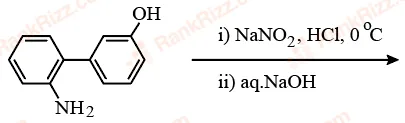
The major product of the following reaction is
SOLUTION
Key idea: The diazonium salt formed on one ring couples intramolecularly with the phenoxide ring (made in aq. NaOH). The new N=N bridge closes a six-membered ring and gives a benzo[c]cinnoline.
- . The phenol is untouched.
- Aq. NaOH turns the OH into , which strongly activates its ring at the ortho/para positions.
- The group sits ortho to the biaryl bond. It can only reach the carbons of the other ring that are ortho to the biaryl bond (C2′ or C6′), forming the 6-membered C–C–C–N=N–C ring.
- C2′ lies between the biaryl bond and OH. It is ortho to but crowded.
- C6′ is para to . It is activated and unhindered, so coupling takes place here.
- The product is benzo[c]cinnoline with the OH para to the new C–N bond, option (C).
- (D) shows coupling at the hindered position ortho to OH.
- (A) and (B) are wrong reaction types (Sandmeyer product / no coupling).
Answer: (C)
Tagged Diazonium salts. Machine-assigned, so read it as a strong shortlist rather than a verdict.