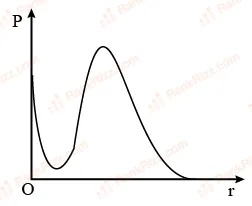
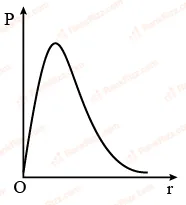
P is the probability of finding the 1s electron of hydrogen atom in a spherical shell of infinitesimal thickness, dr, at a distance r from the nucleus. The volumeof this shell is . The qualitative sketch of the dependence of P on is
- A
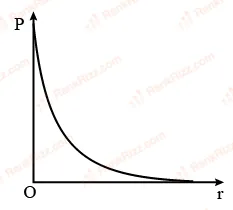
- B
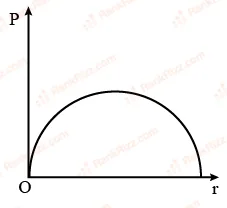
- C
- D
The 18 Chemistry questions of JEE Advanced 2016 Paper 1, numbered across the whole paper. Pick an answer on any question to check it against the key. Free to read, nothing to download.
P is the probability of finding the 1s electron of hydrogen atom in a spherical shell of infinitesimal thickness, dr, at a distance r from the nucleus. The volumeof this shell is . The qualitative sketch of the dependence of P on is


One mole of an ideal gas at 300 K in thermal contact with surroundings expands isothermally from 1.0 L to 2.0 L against a constant pressure of 3.0 atm. In this process, the
changein entropy of surroundings in is (1 Latm = 101.3 d)
5.763
1.013
-1.013
-5.763
The increasing order of atomic radii of the following Group 13 elements is
Al < Ga < In < Tl
Ga < Al < In < Tl
Al < In < Ga < Tl
Al < Ga < Tl < In
Among and , the total numberof paramagnetic compounds is
2
3
4
5
On complete hydrogenation, natural rubber produces
ethylene-propylene copolymer
vulcanised rubber
polypropylene
polybutylene
According to the Arrhenius equation,
a high activation energy usually implies a fast reaction.
rate constant increases with increase in temperature. This is due to a greater number of collisions whose energy exceeds the activation energy.
higher the magnitude of activation energy, stronger 1s the temperature dependence of the rate constant.
the pre-exponential factor is a measure of the rate at which collisions occur, irrespective of their energy.
A plot of the number of neutrons (NV) against the number of protons (P) of stable nuclei exhibits upward deviation from linearity for atomic number, Z > 20. For an unstable nucleus having N/P ratio less than 1, the possible mode(s) of decay is(are)
decay ( emission)
orbital or K-electron capture
neutron emission
decay (positron emission)
The crystalline form of borax has
tetranuclear unit
all boron atoms in the same plane
equal number of and hybridized boron atoms
one terminal hydroxide per boron atom
The compound(s) with TWO lonepairs of electrons on the central atom is(are)
The reagent(s) that can selectively precipitate from a mixture of and in aqueous solution is(are)
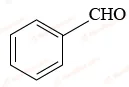
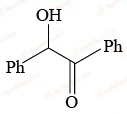
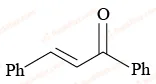
Positive Tollen’s test is observed for


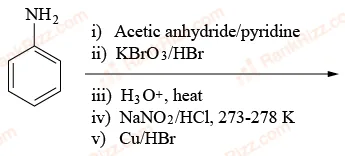
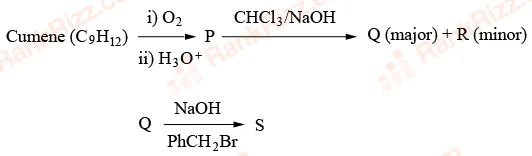
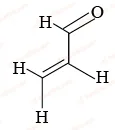
The product(s) of the following reaction sequence is(are)


The correct statement(s) about the following reaction sequence is(are)

R is steam volatile
Q gives dark violet coloration with 1% aqueous solution
S gives yellow precipitate with 2, 4-dinitrophenylhydrazine
S gives dark violet coloration with 1% aqueous solution
The mole fraction of a solute in a solution is 0.1. At 298 K, molarity of this solution is the sameas its molality. Density of this solution at 298 K is 2.0 gcm. Theratio of the molecular weights of the solute and solvent, , is
The diffusion coefficient of an ideal gas is proportional to its mean free path and meanspeed. The absolute temperature of an ideal gas is increased 4 times and its pressure is increased 2 times. As a result, the diffusion coefficient of this gas increases x times. The value of x is
In neutral or faintly alkaline solution, 8 moles of permanganate anion quantitatively oxidize thiosulphate anions to produce X moles of a sulphur containing product. The magnitude of X is
The number of geometric isomers possible for the complex is
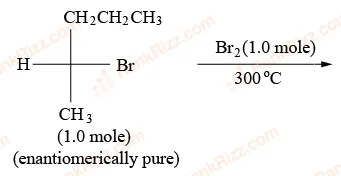
In the following monobromination reaction, the number of possible chiral products is