JEE ADVANCED 2016 · PAPER 1+4 / −2MEDIUMTRANSCRIBED
JEE Advanced 2016 Chemistry question — Distinguishing tests for aldehydes and ketones
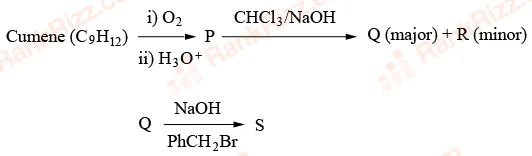
The correct statement(s) about the following reaction sequence is(are)
SOLUTION
Key idea:
- Cumene → phenol (P).
- Reimer–Tiemann on phenol → salicylaldehyde (Q, ortho, major) + p-hydroxybenzaldehyde (R, minor).
- O-benzylation of Q → 2-(benzyloxy)benzaldehyde (S).
- o-HOCHCHO (Q, major) + p-HOCHCHO (R, minor)
- o- (S), formed by Williamson ether synthesis.
- Checking the statements:
- (A) R (para isomer) forms intermolecular H-bonds, so it is not steam volatile. (The ortho isomer Q, with intramolecular H-bonding, is.) False.
- (B) Q has a free phenolic OH, so it gives a violet colour with neutral . True.
- (C) S still has a CHO group, so it forms a yellow/orange 2,4-DNP derivative. True.
- (D) In S the phenolic OH is converted into an ether, so there is no colour. False.
Answer: (B), (C)
Tagged Distinguishing tests for aldehydes and ketones. Machine-assigned, so read it as a strong shortlist rather than a verdict.