RankRizz

JEE Advanced 2016 Paper 1: Maths

The 18 Maths questions of JEE Advanced 2016 Paper 1, numbered across the whole paper. Pick an answer on any question to check it against the key. Free to read, nothing to download.

Maths

Q37Relation between roots and coefficientsTRANSCRIBED

Let −π6<θ<π12-\frac{\pi}{6} < \theta < \frac{\pi}{12} Suppose α1\alpha_1 and β1\beta_1 are the roots of the equation x2−2xsec⁡θ+1x^2 - 2x \sec \theta + 1 and α2\alpha_2 and β2\beta_2 are the roots of the equation x2+2xtan⁡θ−1=0x^2 + 2x \tan \theta - 1 = 0. If α1>β1\alpha_1 > \beta_1 and α2>β2\alpha_2 > \beta_2 then α1+β2\alpha_1 + \beta_2 equals

  1. A

    2(sec⁡θ−tan⁡θ)2(\sec \theta - \tan \theta)

  2. B

    2sec⁡θ2 \sec \theta

  3. C

    −2tan⁡θ-2 \tan \theta

  4. D

    00

Q38Combinations and selections with conditionsTRANSCRIBED

A debate club consists of 6 girls and 4 boys. A team of 4 membersis to be selected from this club including the selection of a captain (from among these 4 members) for the team.If the team hasto include at most one boy, then the numberof waysof selecting the team is

  1. A

    380

  2. B

    320

  3. C

    260

  4. D

    95

Q39Equations with parameters and trigonometric inequalitiesTRANSCRIBED

Let S={xϵ(−π,π):x≠0,±π2}S = \left\{x \epsilon (-\pi, \pi): x \neq 0, \pm \frac{\pi}{2}\right\} The sum of all distinct solutions of the equation 3sec⁡x+cosec⁡x+2(tan⁡x−cot⁡x)=0\sqrt{3} \sec x + \cosec x + 2(\tan x - \cot x) = 0 in the set S is equal to

  1. A

    −7π9-\frac{7 \pi}{9}

  2. B

    −2π9-\frac{2 \pi}{9}

  3. C

    00

  4. D

    5π9\frac{5 \pi}{9}

Q40Bayes' theoremTRANSCRIBED

A computer producing factory has only two plants T1T_1 and T2T_2 Plant T1T_1 produces 20% and plant T2T_2 produces 80% of the total computers produced. 7% of computers produced in the factory turn out to be defective. It is known that P (computer turns out to be defective given that it is produced in plant T1T_1) = 10P (computer turns out to be defective given that it is produced in plant T2T_2), where P(E) denotes the probability of an event E. A computer produced in the factory is randomly selected and it does not turn out to be defective. Then the probability that it is producedin plant T2T_2 is

  1. A

    3673\frac{36}{73}

  2. B

    4779\frac{47}{79}

  3. C

    7893\frac{78}{93}

  4. D

    7583\frac{75}{83}

Q41Optimization word and geometry problemsTRANSCRIBED

The least value of α∈R\alpha \in R for which 4αx2+1x≥14 \alpha x^2 + \frac{1}{x} \geq 1, for all x > 0, is

  1. A

    164\frac{1}{64}

  2. B

    132\frac{1}{32}

  3. C

    127\frac{1}{27}

  4. D

    125\frac{1}{25}

Q42Line and plane: intersection, coplanarity and projectionTRANSCRIBED

Consider a pyramid OPQRS located in the first octant (x≥0,y≥0,z≥0)(x \geq 0, y \geq 0, z \geq 0) with O as origin, and OP and ORalongthe x-axis and the y-axis, respectively. The base OPQR of the pyramid is a square with OP =3. Thepoint S is directly above the mid-point T of diagonal OQ such that TS = 3. Then

  1. A

    the acute angle between OQ and OS is π3\frac{\pi}{3}

  2. B

    the equation of the plane containing the triangle OQS is x - y = 0

  3. C

    the length of the perpendicular from P to the plane containing the triangle OQS is 32\frac{3}{\sqrt{2}}

  4. D

    the perpendicular distance from O to the straight line containing RS is 152\sqrt{\frac{15}{2}}

Q43Linear first-order differential equationsTRANSCRIBED

Let f:(0,∞)→Rf : (0, \infty) \rightarrow R be a differentiable function such that f′(x)=2−f(x)xf'(x) = 2 - \frac{f(x)}{x} for all x∈(0,∞)x \in (0, \infty) and f(x)≠1f(x) \neq 1. Then

  1. A

    lim⁡x→0+f′(1x)=1\lim_{x \rightarrow 0+}f'\left(\frac{1}{x}\right) = 1

  2. B

    lim⁡x→0+xf(1x)=2\lim_{x \rightarrow 0+}xf\left(\frac{1}{x}\right) = 2

  3. C

    lim⁡x→0+x2f′(x)=0\lim_{x \rightarrow 0+}x^2 f'(x) = 0

  4. D

    ∣f(x)∣≤2\mid f(x) \mid \leq 2 for all x∈(0,2)x \in (0, 2)

Q44Adjoint and inverse of a matrixTRANSCRIBED

Let P=[3−1−220α3−50]P = \begin{bmatrix}3 & -1 & -2 \\2 & 0 & \alpha \\3 & -5 & 0 \end{bmatrix} where α∈R\alpha \in R. Suppose Q=[qij]Q = [q_{ij}] is a matrix such that PQ=kIPQ = kI, where k∈R,k≠0k \in R, k \neq 0 and II is the identity matrix of order 3. If q23=−k8q_{23} = -\frac{k}{8} and det(Q)=k22det(Q) = \frac{k^2}{2}, then

  1. A

    α=0,k=8\alpha = 0, k = 8

  2. B

    4α−k+8=04 \alpha - k + 8 = 0

  3. C

    det(Padj(Q))=29det(P adj(Q)) = 2^9

  4. D

    det(Qadj(P))=213det(Q adj(P)) = 2^{13}

Q45Circumradius, inradius, exradii, medians and bisectorsTRANSCRIBED

In a triangle XYZ, let x, y, z be the lengths of sides opposite to the angles X, Y, Z, respectively, and 2s=x+y+z2s = x + y + z. If s−x4=s−y3=s−z2\frac{s - x}{4} = \frac{s - y}{3} = \frac{s - z}{2} andareaofincircle of the triangle XYZ is 8π3\frac{8 \pi}{3}, Then

  1. A

    area of the triangle XYZ is 666\sqrt{6}

  2. B

    the radiusof circumcircle of the triangle XYZ is 3566\frac{35}{6}\sqrt{6}

  3. C

    sin⁡X2sin⁡Y2sin⁡Z2=435\sin\frac{X}{2}\sin\frac{Y}{2}\sin\frac{Z}{2} = \frac{4}{35}

  4. D

    sin⁡2(X+Y2)=35\sin^2\left(\frac{X + Y}{2}\right) = \frac{3}{5}

Q46Variable separable equationsTRANSCRIBED

A solution curve of the differential equation (x2+xy+4x+2y+4)dydx−y2=0,x>0(x^2 + xy + 4x + 2y + 4)\frac{dy}{dx} - y^2 = 0, x > 0, passes through the point (1, 3). Then the solution curve

  1. A

    intersects y = x + 2 exactly at one point

  2. B

    intersects y = x + 2 exactly at two points

  3. C

    intersects y=(x+2)2y = (x + 2)^2

  4. D

    does NOT intersects y=(x+3)2y = (x + 3)^2

Q47Derivatives of standard and composite functionsTRANSCRIBED

Let f:R→R,g:R→Rf : R \rightarrow R, g : R \rightarrow R and h:R→Rh : R \rightarrow R be differentiable functions such that f(x)=x3+3x+2,g(f(x))=xf(x) = x^3 + 3x + 2, g(f(x)) = x and h(g(g(x)))=xh(g(g(x))) = x for all x∈Rx \in R. Then

  1. A

    g′(2)=115g'(2) = \frac{1}{15}

  2. B

    h′(1)=666h'(1) = 666

  3. C

    h(0)=16h(0) = 16

  4. D

    h(g(3))=36h(g(3)) = 36

Q48Tangents, pair of tangents and chord of contactTRANSCRIBED

The circle C1:x2+y2=3C_1: x^2 + y^2 = 3, with centre at O, intersects the parabola x2=2yx^2 = 2y at the point P in the first quadrant. Let the tangent to the circle C1C_1, at P touches other two circles C2C_2 and C3C_3 at R2R_2 and R3R_3, respectively. Suppose C2C_2 and C3C_3 have equal radii 232\sqrt{3} and centres Q2Q_2, and Q3Q_3, respectively. If Q2Q_2 and Q3Q_3 lie on the y-axis, then

  1. A

    Q1Q3=12Q_1Q_3 = 12

  2. B

    R2R3=46R_2R_3 = 4\sqrt{6}

  3. C

    area of the triangle OR2R3OR_2R_3 is 626\sqrt{2}

  4. D

    area of the triangle PQ2Q3PQ_2Q_3 is 424\sqrt{2}

Q49Tangents and normals to a circleTRANSCRIBED

Let RS be the diameter of the circle x2+y2=1x^2 + y^2 = 1, where S is the point (1,0). Let P be a variable point (other than R and S) on thecircle and tangents to the circle at S and P meet at the point Q@. The normal to the circle at P intersects a line drawn through Q parallel to RS at point £. Then thelocus of £ passes through the point(s)

  1. A

    (13,13)\left(\frac{1}{3}, \frac{1}{\sqrt{3}}\right)

  2. B

    (14,12)\left(\frac{1}{4}, \frac{1}{2}\right)

  3. C

    (13,−13)\left(\frac{1}{3}, -\frac{1}{\sqrt{3}}\right)

  4. D

    (14,−12)\left(\frac{1}{4}, -\frac{1}{2}\right)

Q50Evaluation of determinantsTRANSCRIBED

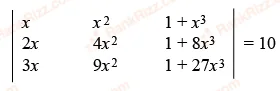
The total number of distinct x∈Rx \in R for which

Figure for JEE Advanced 2016 Mathematics question on Evaluation of determinants
Q51Products of coefficients and calculus-based sumsTRANSCRIBED

Let m be the smallest positive integer such that the coefficient of x2x^2 in the expansion of (1+x)2+(1+x)3+.......+(1+x)49+(1+mx)50(1 + x)^2 + (1 + x)^3 + ....... + (1 + x)^{49} + (1 + mx)^{50} is (3n+1)51C3(3n + 1)^{51}C_3 for some positive integer n. Then the value of n is

Q52Leibniz rule for differentiating integralsTRANSCRIBED

The total number of distinct x∈[0,1]x \in [0, 1] for which ∫0xt21+t4dt=2x−1\int_{0}^{x} \frac{t^2}{1 + t^4}dt = 2x - 1 is

Q53Limits of trigonometric functionsTRANSCRIBED

Let α,β∈R\alpha, \beta \in R be such that lim⁡x→0x2sin⁡(βx)αx−sin⁡x=1\lim_{x \rightarrow 0}\frac{x^2 \sin (\beta x)}{\alpha x - \sin x} = 1. Then 6(α+β)6(\alpha + \beta) equals

Q54Types of matrices and matrix algebraTRANSCRIBED

Let z=−1+3i2z = \frac{-1 + \sqrt{3}i}{2}, where i=−1i = \sqrt{-1}, and r,s∈{1,2,3}r, s \in \left\{1, 2, 3\right\}. Let P=[(−z)rz2sz2szr]P = \begin{bmatrix}(-z)^r & z^{2s} \\z^{2s} & z^r \end{bmatrix} and I be the identity matrix of order 2. Then the total number of ordered pairs (r,s)(r, s) for which P2=−IP^2 = -I is