RankRizzStart free

Wave Optics — JEE Main Previous Year Questions

Every Wave Optics question JEE Main has set, grouped by the idea it tests rather than the order of the syllabus. 198 questions across 6 distinct ideas. Free to read, answer key on every one.

Questions

198

Distinct ideas

6

Share of marks

4.8%

Difficulty

MEDIUM

The ideas inside Wave Optics

A chapter is not one subject — it is a handful of procedures the examiner reuses. These are the ones Wave Optics questions actually test.

01Wavefronts and Huygens' principleset 50×
02Young's double slit experiment: fringe width and intensityset 68×
03YDSE with slabs, white light and modified setupsset 1×
04Single slit diffractionset 29×
05Resolving power of microscopes and telescopesset 12×
06Polarisation: Malus's law and Brewster's lawset 38×

Every Wave Optics question

141–160 OF 198 · NEWEST FIRST

JEE MAIN 2019 · 10 JAN S1Wavefronts and Huygens' principleTRANSCRIBED

In a Young's double slit experiment slit separation 0.1 mm, one observes a bright fringe at angle rad by using light of wavelength . When the light of wavelength is used a bright fringe is seen at the same angle in the same set up. Given that and are in visible range (380 nm to 740 nm), their values are:

  1. A

    400 nm, 500 nm

  2. B

    380 nm, 525 nm

  3. C

    625 nm, 500 nm

  4. D

    380 nm, 500 nm

JEE MAIN 2019 · 12 APR S1Resolving power of microscopes and telescopesTRANSCRIBED

The value of numerical aperture of the objective lens of a microscope is 1.25. If light of wavelength 5000 Å is used, the minimum separation between two points, to be seen as distinct, will be:

  1. A

    0.48 μm

  2. B

    0.24 μm

  3. C

    0.38 μm

  4. D

    0.12 μm

JEE MAIN 2019 · 08 APR S1Wavefronts and Huygens' principleTRANSCRIBED

In an interference experiment the ratio of amplitudes of coherent waves is . The ratio of maximum and minimum intensities of fringes will be:

  1. A

    4

  2. B

    9

  3. C

    2

  4. D

    18

JEE MAIN 2019 · 09 APR S1Young's double slit experiment: fringe width and intensityTRANSCRIBED

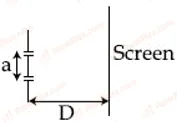
The figure shows a Young's double slit experimental setup. It is observed that when a thin transparent sheet of thickness t and refractive index is put in front of one of the slits, the central maximum gets shifted by a distance equal to n fringe width. If the wavelength of light used is then t will be:

  1. A

  2. B

  3. C

  4. D

JEE MAIN 2019 · 12 APR S1Young's double slit experiment: fringe width and intensityTRANSCRIBED

In a double slit experiment, when a thin film of thickness t having refractive index μ is introduced in front of one of the slits, the maximum at the centre of the fringe pattern shifts by one fringe width. The value of t is ( is the wavelength of the light used):

  1. A

  2. B

  3. C

  4. D

JEE MAIN 2019 · 10 JAN S2Young's double slit experiment: fringe width and intensityTRANSCRIBED

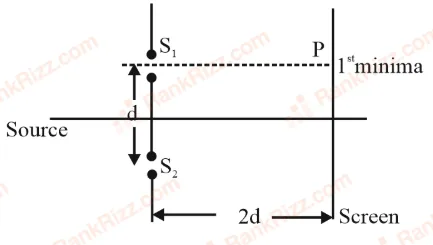
Consider a Young's double slit experiment as shown in figure. What should be the slit separation in terms of wavelength such that the first minima occurs directly in front of the slit ()?

image
  1. A

  2. B

  3. C

  4. D

JEE MAIN 2019 · 09 APR S2Resolving power of microscopes and telescopesTRANSCRIBED

Diameter of the objective lens of a telescope is 250 cm. For light of wavelength 600 nm coming from a distant object, the limit of resolution of the telescope is close to:

  1. A

    rad

  2. B

    rad

  3. C

    rad

  4. D

    rad

JEE MAIN 2019 · 09 JAN S1Wavefronts and Huygens' principleTRANSCRIBED

Two coherent sources produce waves of different intensities which interfere. After interference, the ratio of the maximum intensity to the minimum intensity is 16. The intensity of the waves are in the ratio:

  1. A

    25 : 9

  2. B

    16 : 9

  3. C

    5 : 3

  4. D

    4 : 1

JEE MAIN 2019 · 09 JAN S1Polarisation: Malus's law and Brewster's lawTRANSCRIBED

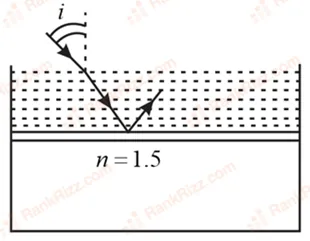
Consider a tank made of glass (refractive index 1.5) with a thick bottom. It is filled with a liquid of refractive index . A student finds that, irrespective of what the incident angle (see figure) is for a beam of light entering the liquid, the light reflected from the liquid glass interface is never completely polarized. For this to happen, the minimum value of is:

  1. A

  2. B

  3. C

  4. D

JEE MAIN 2018 · 15 APR S1Single slit diffractionTRANSCRIBED

Light of wavelength 550 nm falls normally on a slit of width cm. The angular position of the second minima from the central maximum will be (in radians):

  1. A

  2. B

  3. C

  4. D

JEE MAIN 2018 · 08 APR OFFLINEPolarisation: Malus's law and Brewster's lawTRANSCRIBED

Unpolarized light of intensity I passes through an ideal polariser A. Another identical polariser B is placed behind A. The intensity of light beyond B is found to be . Now another identical polariser C is placed between A and B. The intensity beyond B is now found to be . The angle between polariser A and C is:

  1. A

    60

  2. B

    0

  3. C

    30

  4. D

    45

JEE MAIN 2018 · 15 APR S2Polarisation: Malus's law and Brewster's lawTRANSCRIBED

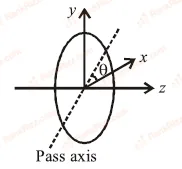
A plane polarized light is incident on a polariser with its pass axis making angle with x-axis, as shown in the figure. At four different values of , = 8, 38, 188 and 218, the observed intensities are same. What is the angle between the direction of polarization and x-axis?

  1. A

    203

  2. B

    45

  3. C

    98

  4. D

    128

JEE MAIN 2018 · 16 APR ONLINEPolarisation: Malus's law and Brewster's lawTRANSCRIBED

Unpolarized light of intensity I is incident on a system of two polarizers, A followed by B. The intensity of emergent light is . If a third polarizer C is placed between A and B, the intensity of emergent light is reduced to . The angle between the polarizers A and C is , then:

  1. A

  2. B

  3. C

  4. D

JEE MAIN 2018 · 08 APR OFFLINEPolarisation: Malus's law and Brewster's lawTRANSCRIBED

The angular width of the central maximum in a single slit diffraction pattern is 60. The width of the slit is 1 m. The slit is illuminated by monochromatic plane waves. If another slit of the same width is made near it, Young's fringes can be observed on a screen placed at a distance 50 cm from the slits. If the observed fringe width is 1 cm, what is slit separation distance? (i.e., the distance between the centres of each slit.)

  1. A

    100 m

  2. B

    25 m

  3. C

    50 m

  4. D

    75 m

JEE MAIN 2017 · 08 APR ONLINESingle slit diffractionTRANSCRIBED

A single slit of width is illuminated by a coherent monochromatic light of wavelength . If the second and fourth minima in the diffraction pattern at a distance 1 cm from the slit are at 3 cm and 6 cm respectively from the central maximum, what is the width of the central maximum? (i.e. distance between first minimum on either side of the central maximum)

  1. A

    4.5 cm

  2. B

    1.5 cm

  3. C

    6.0 cm

  4. D

    3.0 cm

JEE MAIN 2017 · 02 APR OFFLINEYoung's double slit experiment: fringe width and intensityTRANSCRIBED

In a Young's double slit experiment, slits are separated by 0.5 mm, and the screen is placed 150 cm away. A beam of light consisting of two wavelengths, 650 nm and 520 nm, is used to obtain interference fringes on the screen. The least distance from the common central maximum to the point where the bright fringes due to both the wavelengths coincide is:

  1. A

    15.6 mm

  2. B

    1.56 mm

  3. C

    7.8 mm

  4. D

    9.75 mm

JEE MAIN 2017 · 09 APR ONLINESingle slit diffractionTRANSCRIBED

A single slit of width 0.1 mm is illuminated by a parallel beam of light of wavelength 6000 Å and diffraction bands are observed on a screen 0.5 m from the slit. The distance of the third dark band from the central bright band is:

  1. A

    9 mm

  2. B

    3 mm

  3. C

    4.5 mm

  4. D

    1.5 mm

JEE MAIN 2016 · 03 APR OFFLINESingle slit diffractionTRANSCRIBED

The box of a pin hole camera, of length L, has a hole of radius a. It is assumed that when the hole is illuminated by a parallel beam of light of wavelength the spread of the spot (obtained on the opposite wall of the camera) is the sum of its geometrical spread and the spread due to diffraction. The spot would then have its minimum size (say ) when:

  1. A

    and

  2. B

    and

  3. C

    and

  4. D

    and

JEE MAIN 2016 · 09 APR ONLINEYoung's double slit experiment: fringe width and intensityTRANSCRIBED

In Young's double-slit experiment, the distance between slits and the screen is 1 m and monochromatic light of wavelength 600 nm is being used. A person standing near the slits is looking at the fringe pattern. When the separation between the slits is varied, the interference pattern disappears for a particular distance between the slits. If the angular resolution of the eye is , then the value of is close to

  1. A

    1 mm

  2. B

    3 mm

  3. C

    2 mm

  4. D

    4 mm

JEE MAIN 2016 · 10 APR ONLINEResolving power of microscopes and telescopesTRANSCRIBED

Two stars are 10 light years away from the earth. They are seen through a telescope of objective diameter 30 cm. The wavelength of light is 600 nm. To see the stars just resolved by the telescope, the minimum distance between them should be (1 light year = m) of the order of: 

  1. A

    km

  2. B

    km

  3. C

    km

  4. D

    km