RankRizzStart free

Wave Optics — JEE Main Previous Year Questions

Every Wave Optics question JEE Main has set, grouped by the idea it tests rather than the order of the syllabus. 198 questions across 6 distinct ideas. Free to read, answer key on every one.

Questions

198

Distinct ideas

6

Share of marks

4.8%

Difficulty

MEDIUM

The ideas inside Wave Optics

A chapter is not one subject — it is a handful of procedures the examiner reuses. These are the ones Wave Optics questions actually test.

01Wavefronts and Huygens' principleset 50×
02Young's double slit experiment: fringe width and intensityset 68×
03YDSE with slabs, white light and modified setupsset 1×
04Single slit diffractionset 29×
05Resolving power of microscopes and telescopesset 12×
06Polarisation: Malus's law and Brewster's lawset 38×

Every Wave Optics question

81–100 OF 198 · NEWEST FIRST

JEE MAIN 2023 · 01 FEB S2Young's double slit experiment: fringe width and intensityTRANSCRIBED

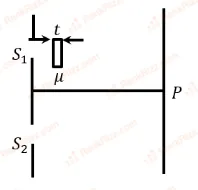
As shown in the figure, in Young's double slit experiment, a thin plate of thickness m and refractive index is inserted infront of slit . The experiment is conducted in air () and uses a monochromatic light of wavelength nm. Due to the insertion of the plate, central maxima is shifted by a distance of . is the fringe-width before the insertion of the plate. The value of is ______.
image
JEE MAIN 2023 · 31 JAN S2Young's double slit experiment: fringe width and intensityTRANSCRIBED

Two light waves of wavelengths 800 and 600 nm are used in Young's double slit experiment to obtain interference fringes on a screen placed 7 m away from plane of slits. If the two slits are separated by 0.35 mm, then shortest distance from the central bright maximum to the point where the bright fringes of the two wavelength coincide will be ______ mm.

JEE MAIN 2023 · 10 APR S1Polarisation: Malus's law and Brewster's lawTRANSCRIBED

Unpolarised light of intensity 32 W m passes through the combination of three polaroids such that the pass axis of the last polaroid is perpendicular to that of the pass axis of first polaroid. If intensity of emerging light is 3 W m, then the angle between pass axis of first two polaroids is _______ .

JEE MAIN 2023 · 30 JAN S2Young's double slit experiment: fringe width and intensityTRANSCRIBED

In a Young's double slit experiment, the intensities at two points, for the path difference and ( being the wavelength of light used) are and respectively. If denotes the intensity produced by each one of the individual slits, then ______.

JEE MAIN 2023 · 06 APR S2Young's double slit experiment: fringe width and intensityTRANSCRIBED

A beam of light consisting of two wavelengths 7000 and 5500 is used to obtain interference pattern in Young's double slit experiment. The distance between the slits is 2.5 mm and the distance between the plane of slits and the screen is 150 cm. The least distance from the central fringe, where the bright fringes due to both the wavelengths coincide, is m. The value of is ______.

JEE MAIN 2022 · 26 JUN S2Single slit diffractionTRANSCRIBED

For a specific wavelength nm of light coming from a galaxy moving with velocity , the observed wavelength is nm. The value of is

  1. A

    m s

  2. B

    m s

  3. C

    m s

  4. D

    m s

JEE MAIN 2022 · 24 JUN S2Wavefronts and Huygens' principleTRANSCRIBED

Two light beams of intensities in the ratio of are allowed to interfere. The ratio of the intensity of maxima and minima will be :

  1. A

  2. B

  3. C

  4. D

JEE MAIN 2022 · 28 JUN S1Resolving power of microscopes and telescopesTRANSCRIBED

The aperture of the objective is cm. The resolving power of this telescope, if a light of wavelength Å is used to see the object will be

  1. A

  2. B

  3. C

  4. D

JEE MAIN 2022 · 25 JUN S2Young's double slit experiment: fringe width and intensityTRANSCRIBED

The interference pattern is obtained with two coherent light sources of intensity ratio . And the ratio is . Then, the value of will be equal to :

  1. A

    3

  2. B

    4

  3. C

    2

  4. D

    1

JEE MAIN 2022 · 25 JUN S1Wavefronts and Huygens' principleTRANSCRIBED

The two light beams having intensities and interfere to produce a fringe pattern on a screen. The phase difference between the beams is at point and at point . Then the difference between the resultant intensities at and will be :

  1. A

  2. B

  3. C

  4. D

JEE MAIN 2022 · 25 JUN S2Polarisation: Malus's law and Brewster's lawTRANSCRIBED

A light whose electric field vectors are completely removed by using a good polaroid, allowed to incident on the surface of the prism at Brewster's angle. Choose the most suitable option for the phenomenon related to the prism.

  1. A

    Reflected and refracted rays will be perpendicular to each other.

  2. B

    Wave will propagate along the surface of prism.

  3. C

    No refraction, and there will be total reflection of light.

  4. D

    No reflection. and there will be total transmission of light.

JEE MAIN 2022 · 28 JUN S2Wavefronts and Huygens' principleTRANSCRIBED

In young's double slit experiment performed using a monochromatic light of wavelength , when a glass plate () of thickness is introduced in the path of the one of the interfering beams, the intensity at the position where the central maximum occurred previously remains unchanged. The value of will be

  1. A

    3

  2. B

    2

  3. C

    1.5

  4. D

    0.5

JEE MAIN 2022 · 26 JUL S1Young's double slit experiment: fringe width and intensityTRANSCRIBED

In Young's double slit experiment, the fringe width is . If the entire arrangement is placed in water of refractive index , then the fringe width becomes (in mm)

  1. A

  2. B

  3. C

  4. D

JEE MAIN 2022 · 27 JUL S1Resolving power of microscopes and telescopesTRANSCRIBED

A microscope was initially placed in air (refractive index 1). It is then immersed in oil (refractive index 2). For a light whose wavelength in air is , calculate the change of microscope's resolving power due to oil

  1. A

    Resolving power will be in the oil than it was in the air

  2. B

    Resolving power will be twice in the oil than it was in the air

  3. C

    Resolving power will be four times in the oil than it was in the air

  4. D

    Resolving power will be in the oil than it was in the air

JEE MAIN 2022 · 27 JUL S2Wavefronts and Huygens' principleTRANSCRIBED

Two coherent sources of light interfere. The intensity ratio of two sources is . For this interference pattern if the value of is equal to , then will be

  1. A

    1.5

  2. B

    2

  3. C

    0.5

  4. D

    1

JEE MAIN 2022 · 29 JUN S1Wavefronts and Huygens' principleTRANSCRIBED

Using Young's double slit experiment, a monochromatic light of wavelength 5000 A produces fringes of fringe width 0.5 mm. If another monochromatic light of wavelength 6000 A is used and the separation between the slits is doubled, then the new fringe width will be

  1. A

    0.5 mm

  2. B

    1.0 mm

  3. C

    0.6 mm

  4. D

    0.3 mm

JEE MAIN 2022 · 29 JUL S2Polarisation: Malus's law and Brewster's lawTRANSCRIBED

An unpolarised light beam of intensity is passed through a polaroid P and then through another polaroid Q which is oriented in such a way that its passing axis makes an angle of 30° relative to that of P. The intensity of the emergent light is

  1. A

  2. B

  3. C

  4. D

JEE MAIN 2022 · 29 JUL S1Wavefronts and Huygens' principleTRANSCRIBED

Two light beams of intensities 4I and 9I interfere on a screen. The phase difference between these beams on the screen at point A is zero and at point B is . The difference of resultant intensities, at the point A and B, will be _____ I.

JEE MAIN 2022 · 29 JUN S2Wavefronts and Huygens' principleTRANSCRIBED

In a double slit experiment with monochromatic light, fringes are obtained on a screen placed at some distance from the plane of slits. If the screen is moved by m towards the slits, the change in fringe width is cm. If the distance between the slits is 1 mm, then the wavelength of the light will be ______ nm.

JEE MAIN 2022 · 24 JUN S1Single slit diffractionTRANSCRIBED

Sodium light of wavelengths nm and nm is used to study diffraction at a single slit of aperture mm. The distance between the slit and the screen is m. The separation between the positions of the first maxima of diffraction pattern obtained in the two cases is ______ m.