RankRizz

Wavefronts and Huygens' principle — JEE Main Previous Year Questions

Every JEE Main question on Wavefronts and Huygens' principle, one of the ideas inside Wave Optics: 50 questions from 2010–2026, 29 of them in the last five years. Newest first, answer key on every one. Free to read.

Questions

50

Years asked

8

Since

2010

Of the chapter

25%

Every Wavefronts and Huygens' principle question

21–40 OF 50 · NEWEST FIRST

JEE MAIN 2022 · 25 JUN S1Wavefronts and Huygens' principleTRANSCRIBED

The two light beams having intensities II and 9I9I interfere to produce a fringe pattern on a screen. The phase difference between the beams is π2\frac{\pi}{2} at point PP and π\pi at point QQ. Then the difference between the resultant intensities at PP and QQ will be :

  1. A

    2I2I

  2. B

    6I6I

  3. C

    5I5I

  4. D

    7I7I

JEE MAIN 2022 · 28 JUN S2Wavefronts and Huygens' principleTRANSCRIBED

In young's double slit experiment performed using a monochromatic light of wavelength λ\lambda, when a glass plate (μ=1.5\mu = 1.5) of thickness xλx\lambda is introduced in the path of the one of the interfering beams, the intensity at the position where the central maximum occurred previously remains unchanged. The value of xx will be

  1. A

    3

  2. B

    2

  3. C

    1.5

  4. D

    0.5

JEE MAIN 2022 · 27 JUL S2Wavefronts and Huygens' principleTRANSCRIBED

Two coherent sources of light interfere. The intensity ratio of two sources is 1:41 : 4. For this interference pattern if the value of Imax+IminImax−Imin\frac{I_{max}+I_{min}}{I_{max}-I_{min}} is equal to 2α+1β+3\frac{2\alpha+1}{\beta+3}, then αβ\frac{\alpha}{\beta} will be

  1. A

    1.5

  2. B

    2

  3. C

    0.5

  4. D

    1

JEE MAIN 2022 · 29 JUN S1Wavefronts and Huygens' principleTRANSCRIBED

Using Young's double slit experiment, a monochromatic light of wavelength 5000 A produces fringes of fringe width 0.5 mm. If another monochromatic light of wavelength 6000 A is used and the separation between the slits is doubled, then the new fringe width will be

  1. A

    0.5 mm

  2. B

    1.0 mm

  3. C

    0.6 mm

  4. D

    0.3 mm

JEE MAIN 2022 · 29 JUL S1Wavefronts and Huygens' principleTRANSCRIBED

Two light beams of intensities 4I and 9I interfere on a screen. The phase difference between these beams on the screen at point A is zero and at point B is π\pi. The difference of resultant intensities, at the point A and B, will be _____ I.

JEE MAIN 2022 · 29 JUN S2Wavefronts and Huygens' principleTRANSCRIBED

In a double slit experiment with monochromatic light, fringes are obtained on a screen placed at some distance from the plane of slits. If the screen is moved by 5×10⁻²⁵ \times 10^{-2} m towards the slits, the change in fringe width is 3×10⁻³³ \times 10^{-3} cm. If the distance between the slits is 1 mm, then the wavelength of the light will be ______ nm.

JEE MAIN 2022 · 27 JUN S1Wavefronts and Huygens' principleTRANSCRIBED

In Young's double slit experiment the two slits are 0.60.6 mm distance apart. Interference pattern is observed on a screen at a distance 8080 cm from the slits. The first dark fringe is observed on the screen directly opposite to one of the slits. The wavelength of light will be ______ nm.

JEE MAIN 2022 · 28 JUN S2Wavefronts and Huygens' principleTRANSCRIBED

In a Young's double slit experiment, an angular width of the fringe is 0.35° on a screen placed at 2 m away for particular wavelength of 450 nm. The angular width of the fringe, when whole system is immersed in a medium of refractive index 75\frac{7}{5}, is 1α\frac{1}{\alpha}. The value of α\alpha is ______.

JEE MAIN 2022 · 28 JUL S1Wavefronts and Huygens' principleTRANSCRIBED

In a Young's double slit experiment, a laser light of 560 nm produces an interference pattern with consecutive bright fringes' separation of 7.2 mm. Now another light is used to produce an interference pattern with consecutive bright fringes' separation of 8.1 mm. The wavelength of second light is _____ nm.

JEE MAIN 2021 · 24 FEB S2Wavefronts and Huygens' principleTRANSCRIBED

If the source of light used in a Young's double slit experiment is changed from red to violet:

  1. A

    consecutive fringe lines will come closer.

  2. B

    the fringes will become brighter.

  3. C

    the central bright fringe will become a dark fringe.

  4. D

    the intensity of minima will increase.

JEE MAIN 2021 · 25 FEB S1Wavefronts and Huygens' principleTRANSCRIBED

Two coherent light sources having intensity in the ratio 2x2x produce an interference pattern. The ratio Imax−IminImax+Imin\frac{I_{max} - I_{min}}{I_{max} + I_{min}} will be:

  1. A

    22xx+1\frac{2\sqrt{2x}}{x+1}

  2. B

    2x2x+1\frac{\sqrt{2x}}{2x+1}

  3. C

    22x2x+1\frac{2\sqrt{2x}}{2x+1}

  4. D

    2xx+1\frac{\sqrt{2x}}{x+1}

JEE MAIN 2021 · 24 FEB S1Wavefronts and Huygens' principleTRANSCRIBED

In a Young's double slit experiment, the width of the one of the slit is three times the other slit. The amplitude of the light coming from a slit is proportional to the slit-width. Find the ratio of the maximum to the minimum intensity in the interference pattern.

  1. A

    1 : 4

  2. B

    2 : 1

  3. C

    3 : 1

  4. D

    4 : 1

JEE MAIN 2021 · 01 SEP S2Wavefronts and Huygens' principleTRANSCRIBED

The width of one of the two slits in a Young's double slit experiment is three times the other slit. If the amplitude of the light coming from a slit is proportional to the slit-width, the ratio of minimum to maximum intensity in the interference pattern is x:4x : 4 where xx is _________.

JEE MAIN 2021 · 16 MAR S1Wavefronts and Huygens' principleTRANSCRIBED

A fringe width of 6 mm was produced for two slits separated by 1 mm apart. The screen is placed 10 m away. The wavelength of light used is xx nm. The value of xx to the nearest integer is ________.

JEE MAIN 2021 · 27 JUL S2Wavefronts and Huygens' principleTRANSCRIBED

The difference in the number of waves when yellow light propagates through air and vacuum columns of the same thickness is one. The thickness of the air column is _________ mm. [Refractive index of air = 1.0003, the wavelength of yellow light in vacuum = 6000 Å]

JEE MAIN 2021 · 31 AUG S2Wavefronts and Huygens' principleTRANSCRIBED

In a Young's double slit experiment, the slits are separated by 0.3 mm and the screen is 1.5 m away from the plane of slits. Distance between fourth bright fringes on both sides of central bright fringe is 2.4 cm. The frequency of light used is x×1014x \times 10^{14} Hz.

JEE MAIN 2021 · 26 AUG S1Wavefronts and Huygens' principleTRANSCRIBED

White light is passed through a double slit and interference is observed on a screen 1.5 m away. The separation between the slits is 0.3 mm. The first violet and red fringes are formed 2.0 mm and 3.5 mm away from the central white fringes. The difference in wavelengths of red and violet light is (in nm).

JEE MAIN 2020 · 03 SEP S1Wavefronts and Huygens' principleTRANSCRIBED

In a Young's double slit experiment, light of 500 nm is used to produce and interference pattern. When the distance between the slits is 0.05 mm, the angular width (in degree) of the fringes formed on the distance screen is close to:

  1. A

    0.17°

  2. B

    0.57°

  3. C

    1.7°

  4. D

    0.07°

JEE MAIN 2020 · 06 SEP S1Wavefronts and Huygens' principleTRANSCRIBED

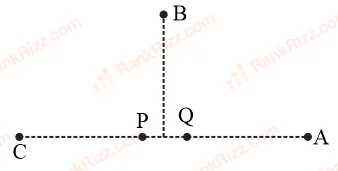
In the figure below, PP and QQ are two equally intense coherent sources emitting radiation of wavelength 20 m20\,\text{m}. The separation between P and Q is 5 m5\,\text{m} and the phase of P is ahead of that of Q by 90∘90^\circ. A, B and C are three distinct point of observation, each equidistant from the midpoint of PQ. The intensities of radiation at A, B, C will be in the ratio:

Figure for JEE Main 2020 Physics question on Wavefronts and Huygens' principle
  1. A

    0 : 1 : 4

  2. B

    2 : 1 : 0

  3. C

    0 : 1 : 2

  4. D

    4 : 1 : 0

JEE MAIN 2020 · 02 SEP S2Wavefronts and Huygens' principleTRANSCRIBED

In a Young's double slit experiment, 16 fringes are observed in a certain segment of the screen when light of wavelength 700 nm is used. If the wavelength of light is changed to 400 nm, the number of fringes observed in the same segment of the screen would be:

  1. A

    24

  2. B

    30

  3. C

    18

  4. D

    28