RankRizz

Refraction at plane surfaces, Snell's law and apparent depth — JEE Main Previous Year Questions

Every JEE Main question on Refraction at plane surfaces, Snell's law and apparent depth, one of the ideas inside Ray Optics & Optical Instruments: 96 questions from 2010–2026, 60 of them in the last five years. Newest first, answer key on every one. Free to read.

Questions

96

Years asked

16

Since

2010

Of the chapter

35%

Every Refraction at plane surfaces, Snell's law and apparent depth question

81–96 OF 96 · NEWEST FIRST

JEE MAIN 2019 · 11 JAN S2Refraction at plane surfaces, Snell's law and apparent depthTRANSCRIBED

A monochromatic light is incident at a certain angle on an equilateral triangular prism and suffers minimum deviation. If the refractive index of the material of the prism is 3\sqrt{3}, then the angle of incidence is:

  1. A

    90°90°

  2. B

    30°30°

  3. C

    60°60°

  4. D

    45°45°

JEE MAIN 2019 · 12 APR S1Refraction at plane surfaces, Snell's law and apparent depthTRANSCRIBED

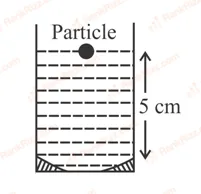
A concave mirror has radius of curvature of 40 cm. It is at the bottom of a glass that has water filled up to 5 cm (see figure). If a small particle is floating on the surface of water, its image as seen, from directly above the glass, is at a distance d from the surface of water. The value of d is close to: (Refractive index of water = 1.33)

Figure for JEE Main 2019 Physics question on Refraction at plane surfaces, Snell's law and apparent depth
  1. A

    13.4 cm

  2. B

    8.8 cm

  3. C

    6.7 cm

  4. D

    11.7 cm

JEE MAIN 2018 · 16 APR ONLINERefraction at plane surfaces, Snell's law and apparent depthTRANSCRIBED

A ray of light is incident at an angle of 60∘^\circ on one face of a prism of angle 30∘^\circ. The emergent ray of light makes an angle of 30∘^\circ with incident ray. The angle made by the emergent ray with second face of prism will be:

  1. A

    0∘^\circ

  2. B

    90∘^\circ

  3. C

    30∘^\circ

  4. D

    45∘^\circ

JEE MAIN 2017 · 08 APR ONLINERefraction at plane surfaces, Snell's law and apparent depthTRANSCRIBED

Let the refractive index of a denser medium with respect to a rarer medium be n12n_{12} and its critical angle be θC\theta_C. At an angle of incidence AA when light is travelling from denser medium to rarer medium, a part of the light is reflected and the rest is refracted and the angle between reflected and refracted rays is 90°. Angle AA is given by:

  1. A

    tan⁡−1(sin⁡θC)\tan^{-1}(\sin \theta_C)

  2. B

    1tan⁡−1(sin⁡θC)\frac{1}{\tan^{-1}(\sin \theta_C)}

  3. C

    cos⁡−1(sin⁡θC)\cos^{-1}(\sin \theta_C)

  4. D

    1cos⁡−1(sin⁡θC)\frac{1}{\cos^{-1}(\sin \theta_C)}

JEE MAIN 2016 · 03 APR OFFLINERefraction at plane surfaces, Snell's law and apparent depthTRANSCRIBED

In an experiment for determination of refractive index of glass of a prism by i v/s δ\delta plot, it was found that a ray incident at angle 35°, suffers a deviation of 40° and that it emerges at angle 79°. In that case which of the following is closest to the maximum possible value of the refractive index?

  1. A

    1.7

  2. B

    1.8

  3. C

    1.5

  4. D

    1.6

JEE MAIN 2016 · 10 APR ONLINERefraction at plane surfaces, Snell's law and apparent depthTRANSCRIBED

To determine refractive index of glass slab using a travelling microscope, minimum number of readings required are:

  1. A

    Two

  2. B

    Four

  3. C

    Three

  4. D

    Five

JEE MAIN 2015 · 04 APR OFFLINERefraction at plane surfaces, Snell's law and apparent depthTRANSCRIBED

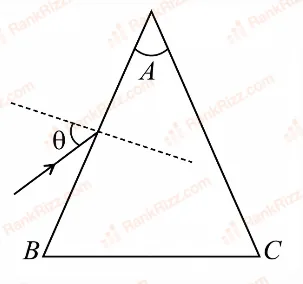
Monochromatic light is incident on a glass prism of angle A. If the refractive index of the material of the prism is μ\mu, a ray, incident at an angle θ\theta, on the face AB would get transmitted through the face AC of the prism provided:

Figure for JEE Main 2015 Physics question on Refraction at plane surfaces, Snell's law and apparent depth
  1. A

    θ<cos⁡−1[μsin⁡(A+sin⁡−1(1μ))]\theta < \cos^{-1}\left[\mu \sin\left(A + \sin^{-1}\left(\frac{1}{\mu}\right)\right)\right]

  2. B

    θ>sin⁡−1[μsin⁡(A−sin⁡−1(1μ))]\theta > \sin^{-1}\left[\mu \sin\left(A - \sin^{-1}\left(\frac{1}{\mu}\right)\right)\right]

  3. C

    θ<sin⁡−1[μsin⁡(A−sin⁡−1(1μ))]\theta < \sin^{-1}\left[\mu \sin\left(A - \sin^{-1}\left(\frac{1}{\mu}\right)\right)\right]

  4. D

    θ>cos⁡−1[μsin⁡(A+sin⁡−1(1μ))]\theta > \cos^{-1}\left[\mu \sin\left(A + \sin^{-1}\left(\frac{1}{\mu}\right)\right)\right]

JEE MAIN 2014 · 09 APR ONLINERefraction at plane surfaces, Snell's law and apparent depthTRANSCRIBED

A diver looking up through the water sees the outside world contained in a circular horizon. The refractive index of water is 43\frac{4}{3}, and the diver's eyes are 15 cm below the surface of the water. Then the radius of the circle is:

  1. A

    15×73\frac{15 \times \sqrt{7}}{3} cm

  2. B

    15×37\frac{15 \times 3}{\sqrt{7}} cm

  3. C

    15×3715 \times 3\sqrt{7} cm

  4. D

    15×3×515 \times 3 \times \sqrt{5} cm

JEE MAIN 2014 · 06 APR OFFLINERefraction at plane surfaces, Snell's law and apparent depthTRANSCRIBED

A green light is incident from the water to the air-water interface at the critical angle (θc\theta_c). Select the correct statement.

  1. A

    The entire spectrum of visible light will come out of the water at an angle of 90° to the normal

  2. B

    The spectrum of visible light whose frequency is less than that of green light will come out to the air medium

  3. C

    The spectrum of visible light whose frequency is more than that of green light will come out to the air medium

  4. D

    The entire spectrum of visible light will come out of the water at various angles to the normal

JEE MAIN 2013 · 25 APR ONLINERefraction at plane surfaces, Snell's law and apparent depthTRANSCRIBED

A printed page is pressed by a glass of water. The refractive index of the glass and water is 1.5 and 1.33, respectively. If the thickness of the bottom of glass is 1 cm and depth of water is 5 cm, how much the page will appear to be shifted if viewed from the top?

  1. A

    1.033 cm

  2. B

    3.581 cm

  3. C

    1.3533 cm

  4. D

    1.90 cm

JEE MAIN 2013 · 07 APR ONLINERefraction at plane surfaces, Snell's law and apparent depthTRANSCRIBED

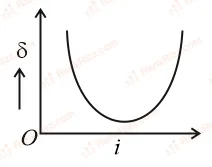
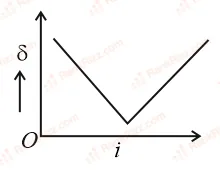
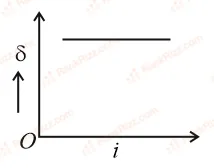
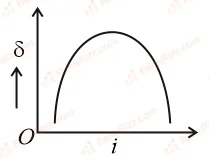
The graph between angle of deviation (δ\delta) and angle of incidence (ii) for a triangular prism is represented by :

  1. A
    Figure for JEE Main 2013 Physics question on Refraction at plane surfaces, Snell's law and apparent depth
  2. B
    Figure for JEE Main 2013 Physics question on Refraction at plane surfaces, Snell's law and apparent depth
  3. C
    Figure for JEE Main 2013 Physics question on Refraction at plane surfaces, Snell's law and apparent depth
  4. D
    Figure for JEE Main 2013 Physics question on Refraction at plane surfaces, Snell's law and apparent depth
JEE MAIN 2013 · 09 APR ONLINERefraction at plane surfaces, Snell's law and apparent depthTRANSCRIBED

Light is incident from a medium into air at two possible angles of incidence (A) 20° and (B) 40°. In the medium light travels 3.0 cm in 0.2 ns. The ray will :

  1. A

    suffer total internal reflection in both cases (A) and (B)

  2. B

    suffer total internal reflection in case (B) only

  3. C

    have partial reflection and partial transmission in case (B)

  4. D

    have 100% transmission in case (A)

JEE MAIN 2013 · 23 APR ONLINERefraction at plane surfaces, Snell's law and apparent depthTRANSCRIBED

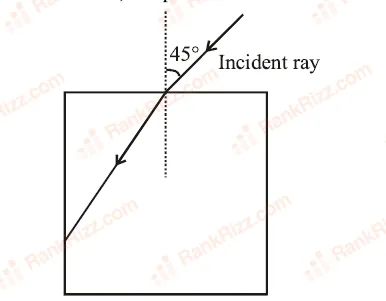
A light ray falls on a square glass slab as shown in the diagram. The index of refraction of the glass, if total internal reflection is to occur at the vertical face, is equal to :

Figure for JEE Main 2013 Physics question on Refraction at plane surfaces, Snell's law and apparent depth
  1. A

    (2+1)2\frac{(\sqrt{2}+1)}{2}

  2. B

    52\sqrt{\frac{5}{2}}

  3. C

    32\frac{3}{2}

  4. D

    32\sqrt{\frac{3}{2}}

JEE MAIN 2011Refraction at plane surfaces, Snell's law and apparent depthTRANSCRIBED

Let the x−zx-z plane be the boundary between two transparent media. Medium 1 in z≥0z \geq 0 has a refractive index of 2\sqrt{2} and medium 2 with z<0z < 0 has a refractive index of 3\sqrt{3}. A ray of light in medium 1 given by the vector A⃗=63 i^+83 j^−10k^\vec{A} = 6\sqrt{3}\,\hat{i} + 8\sqrt{3}\,\hat{j} - 10\hat{k} is incident on the plane of separation. The angle of refraction in medium 2 is:

  1. A

    45∘45^\circ

  2. B

    60∘60^\circ

  3. C

    75∘75^\circ

  4. D

    30∘30^\circ

JEE MAIN 2010Refraction at plane surfaces, Snell's law and apparent depthTRANSCRIBED

An initially parallel cylindrical beam travels in a medium of refractive index μ(I)=μ0+μ2I\mu(I) = \mu_0 + \mu_2 I, where μ0\mu_0 and μ2\mu_2 are positive constants and II is the intensity of the light beam. The intensity of the beam is decreasing with increasing radius. As the beam enters the medium, it will

  1. A

    diverge

  2. B

    converge

  3. C

    diverge near the axis and converge near the periphery

  4. D

    travel as a cylindrical beam

JEE MAIN 2010Refraction at plane surfaces, Snell's law and apparent depthTRANSCRIBED

An initially parallel cylindrical beam travels in a medium of refractive index μ(I)=μ0+μ2I\mu(I) = \mu_0 + \mu_2 I, where μ0\mu_0 and μ2\mu_2 are positive constants and II is the intensity of the light beam. The intensity of the beam is decreasing with increasing radius. The speed of light in the medium is

  1. A

    minimum on the axis of the beam

  2. B

    the same everywhere in the beam

  3. C

    directly proportional to the intensity II

  4. D

    maximum on the axis of the beam