RankRizz

Connected bodies, pulleys and constraint relations — JEE Main Previous Year Questions

Every JEE Main question on Connected bodies, pulleys and constraint relations, one of the ideas inside Laws of Motion & Friction: 23 questions from 2013–2026, 19 of them in the last five years. Newest first, answer key on every one. Free to read.

Questions

23

Years asked

7

Since

2013

Of the chapter

15%

Every Connected bodies, pulleys and constraint relations question

21–23 OF 23 · NEWEST FIRST

JEE MAIN 2018 · 08 APR OFFLINEConnected bodies, pulleys and constraint relationsTRANSCRIBED

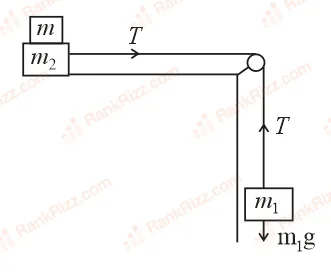
Two masses m1=5m_1 = 5 kg and m2=10m_2 = 10 kg, connected by an inextensible string over a frictionless pulley, are moving as shown in the figure. The coefficient of friction of horizontal surface is 0.15. The minimum weight m that should be put on top of m2m_2 to stop the motion is:
Figure for JEE Main 2018 Physics question on Connected bodies, pulleys and constraint relations

  1. A

    10.3 kg

  2. B

    18.3 kg

  3. C

    27.3 kg

  4. D

    43.3 kg

JEE MAIN 2013 · 22 APR ONLINEConnected bodies, pulleys and constraint relationsTRANSCRIBED

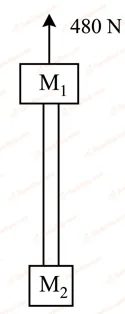
Two blocks of mass M1=20M_1 = 20 kg and M2=12M_2 = 12 kg are connected by a metal rod of mass 8 kg. The system is pulled vertically up by applying a force of 480 N as shown. The tension at the mid-point of the rod is:

Figure for JEE Main 2013 Physics question on Connected bodies, pulleys and constraint relations
  1. A

    144 N

  2. B

    96 N

  3. C

    240 N

  4. D

    192 N

JEE MAIN 2013 · 25 APR ONLINEConnected bodies, pulleys and constraint relationsTRANSCRIBED

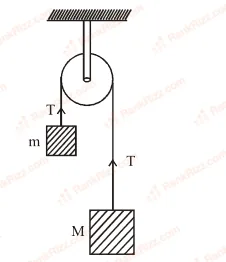
Two blocks of masses m and M are connected by means of a metal wire of cross-sectional area A passing over a frictionless fixed pulley as shown in the figure. The system is then released. If M = 2m, then the stress produced in the wire is:

Figure for JEE Main 2013 Physics question on Connected bodies, pulleys and constraint relations
  1. A

    2mg3A\frac{2mg}{3A}

  2. B

    4mg3A\frac{4mg}{3A}

  3. C

    mgA\frac{mg}{A}

  4. D

    3mg4A\frac{3mg}{4A}