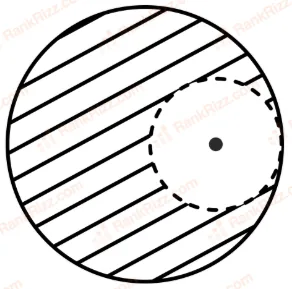
From a solid sphere of mass and radius , a spherical portion of radius is removed as shown in the figure. Taking gravitational potential at , the potential at the centre of the cavity thus formed is ( = gravitational constant)
- A
- B
- C
- D
Every JEE Main question on Gravitational potential energy of systems, one of the ideas inside Gravitation: 25 questions from 2004–2026, 13 of them in the last five years. Newest first, answer key on every one. Free to read.
Questions
25
Years asked
11
Since
2004
Of the chapter
12%
21–25 OF 25 · NEWEST FIRST
From a solid sphere of mass and radius , a spherical portion of radius is removed as shown in the figure. Taking gravitational potential at , the potential at the centre of the cavity thus formed is ( = gravitational constant)

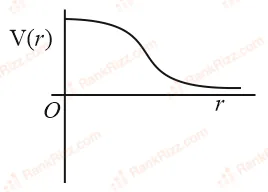
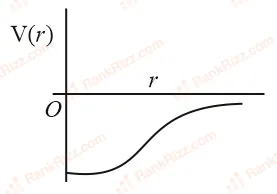
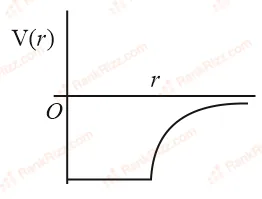
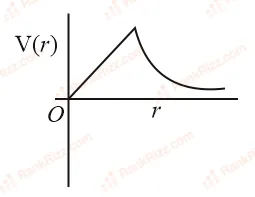
Which of the following most closely depicts the correct variation of the gravitation potential, with distance due to a large planet of radius and uniform mass density? (figures are not drawn to scale)


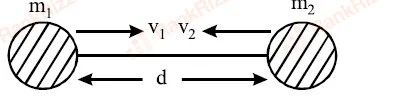
Two hypothetical planets of masses m and m are at rest when they are infinite distance apart. Because of the gravitational force they move towards each other along the line joining their centres. What is their speed when their separation is 'd'? (Speed of m is v and that of m is v)

,
,
,
A particle of mass g is kept on the surface of a uniform sphere of mass kg and radius cm. Find the work to be done against the gravitational force between them to take the particle far away from the sphere (you may take Nm/kg)
J
J
J
J
If is the acceleration due to gravity on the earth's surface, the gain in the potential energy of object of mass raised from the surface of the earth to a height equal to the radius of the earth is