RankRizz
JEE MAIN 2014 · 12 APR ONLINE+4 / −1MEDIUMTRANSCRIBED

JEE Main 2014 Physics question — Gravitational potential energy of systems

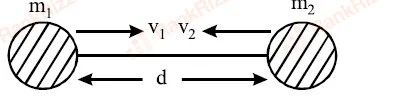
Two hypothetical planets of masses m1_1 and m2_2 are at rest when they are infinite distance apart. Because of the gravitational force they move towards each other along the line joining their centres. What is their speed when their separation is 'd'? (Speed of m1_1 is v1_1 and that of m2_2 is v2_2)

Figure for JEE Main 2014 Physics question on Gravitational potential energy of systems
SOLUTION

Since no external force acts on the two-planet system, the net linear momentum is conserved. Initially, both planets are at rest at infinite separation, so the total initial momentum is zero.

From conservation of linear momentum, m1v1−m2v2=0m_1 v_1 - m_2 v_2 = 0, v2=m1v1m2…(1)v_2 = \frac{m_1 v_1}{m_2} \quad \dots(1)

As gravity is a conservative force, the total mechanical energy of the system remains constant.

Total initial energy at r=∞r = \infty is Ei=0E_i = 0.

At separation dd, the total energy is Ef=Kf+Uf=12m1v12+12m2v22−Gm1m2dE_f = K_f + U_f = \frac{1}{2}m_1 v_1^2 + \frac{1}{2}m_2 v_2^2 - \frac{Gm_1 m_2}{d}

Equating Ei=EfE_i = E_f: 12m1v12+12m2v22=Gm1m2d\frac{1}{2}m_1 v_1^2 + \frac{1}{2}m_2 v_2^2 = \frac{Gm_1 m_2}{d}

Substituting the value of v2v_2 from equation (1):

12m1v12+12m2(m1v1m2)2=Gm1m2d\frac{1}{2}m_1 v_1^2 + \frac{1}{2}m_2 \left( \frac{m_1 v_1}{m_2} \right)^2 = \frac{Gm_1 m_2}{d}

12m1v12(1+m1m2)=Gm1m2d\frac{1}{2}m_1 v_1^2 \left( 1 + \frac{m_1}{m_2} \right) = \frac{Gm_1 m_2}{d}

12m1v12(m1+m2m2)=Gm1m2d\frac{1}{2}m_1 v_1^2 \left( \frac{m_1 + m_2}{m_2} \right) = \frac{Gm_1 m_2}{d}

v12=2Gm22d(m1+m2)v_1^2 = \frac{2Gm_2^2}{d(m_1 + m_2)}

v1=m22Gd(m1+m2)v_1 = m_2 \sqrt{\frac{2G}{d(m_1 + m_2)}}

By symmetry or by substituting v1v_1 back into equation (1):

v2=m12Gd(m1+m2)v_2 = m_1 \sqrt{\frac{2G}{d(m_1 + m_2)}}

Tagged Gravitational potential energy of systems. Machine-assigned, so read it as a strong shortlist rather than a verdict.

SubjectPhysics
TopicGravitational potential energy of systems
TypeMultiple choice