An ideal battery of emf 4V and resistance R are connected in series in the primary circuit of a potentiometer of length 1 m and resistance . The value of R, to give a potential difference of 5 mV across 10 cm of potentiometer wire, is:
- A
- B
- C
- D
Every JEE Main question on Potentiometer, one of the ideas inside Current Electricity: 29 questions from 2005–2026, 13 of them in the last five years. Newest first, answer key on every one. Free to read.
Questions
29
Years asked
12
Since
2005
Of the chapter
8%
21–29 OF 29 · NEWEST FIRST
An ideal battery of emf 4V and resistance R are connected in series in the primary circuit of a potentiometer of length 1 m and resistance . The value of R, to give a potential difference of 5 mV across 10 cm of potentiometer wire, is:
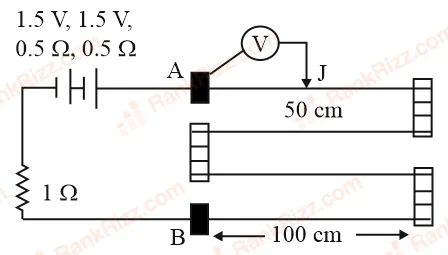
In the circuit shown, a four-wire potentiometer is made of a 400 cm long wire, which extends between A and B. The resistance per unit length of the potentiometer wire is r = 0.01 /cm. If an ideal voltmeter is connected as shown with jockey J at 50 cm from end A, the expected reading of the voltmeter will be:

0.50 V
0.25 V
0.75 V
0.20 V
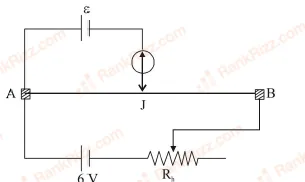
The resistance of the meter bridge AB in given figure is . With a cell of emf V and rheostat resistance the null point is obtained at some point J. When the cell is replaced by another one of emf the same null point J is found for . The emf is:

0.4 V
0.3 V
0.6 V
0.5 V
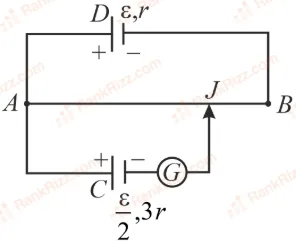
A potentiometer wire AB having length and resistance is joined to a cell D of emf and internal resistance . A cell C having EMF and internal resistance is connected. The length AJ, at which the galvanometer, as shown in the figure, shows no deflection is:

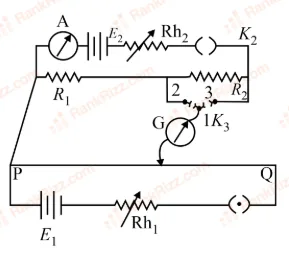
A potentiometer is set up to compare two resistances, as shown in the figure. The ammeter in the circuit reads 1.0 A when the two-way key is open. The balance point is at a length cm from when the two-way key is plugged in between 2 and 1, while the balance point is at a length cm from when the key is plugged in between 3 and 1. The ratio of two resistances , is found to be:

In the experiment of calibration of voltmeter, a standard cell of e.m.f. 1.1 volt is balanced against 440 cm of potential wire. The potential difference across the ends of resistance is found to balance against 220 cm of the wire. The corresponding reading of voltmeter is 0.5 volt. The error in the reading of volmeter will be:
volt
0.15 volt
0.5 volt
volt
In an experiment of potentiometer for measuring the internal resistance of primary cell a balancing length is obtained on the potentiometer wire when the cell is open circuit. Now the cell is short circuited by a resistance . If is to be equal to the internal resistance of the cell the balancing length on the potentiometer wire will be
It is preferable to measure the e.m.f. of a cell by potentiometer than by a voltmeter because of the following possible reasons. (i) In case of potentiometer, no current flows through the cell. (ii) The length of the potentiometer allows greater precision. (iii) Measurement by the potentiometer is quicker. (iv) The sensitivity of the galvanometer, when using a potentiometer is not relevant. Which of these reasons are correct?
(i),(iii),(iv)
(i),(iii),(iv) only
(i),(ii)
(i),(ii),(iii),(iv)
In a potentiometer experiment the balancing with a cell is at length cm. On shunting the cell with a resistance of the balancing length becomes cm. The internal resistance of the cell is
RELATED CURRENT ELECTRICITY TOPICS