JEE MAIN 2020 · 02 SEP S1Modulation and demodulationTRANSCRIBED
An amplitude modulated wave is represented by expression V. The minimum and maximum amplitudes of the amplitude modulated wave are, respectively:
- A
V, 5 V
- B
V, 8 V
- C
5 V, 8 V
- D
3 V, 5 V
Every JEE Main question on Modulation and demodulation, one of the ideas inside Communication Systems (older syllabus): 60 questions from 2012–2023, 47 of them in the last five years. Newest first, answer key on every one. Free to read.
Questions
60
Years asked
11
Since
2012
Of the chapter
57%
41–60 OF 60 · NEWEST FIRST
An amplitude modulated wave is represented by expression V. The minimum and maximum amplitudes of the amplitude modulated wave are, respectively:
V, 5 V
V, 8 V
5 V, 8 V
3 V, 5 V
A 100V carrier wave is made to vary between 160 V and 40 V by a modulating signal. What is the modulation index?
0.3
0.6
0.4
0.5
An amplitude modulated signal is given by . Here t is in seconds. The sideband frequencies (in kHz) are, [Given ]
1785 and 1715
178.5 and 171.5
91 and 84
892.5 and 857.5
A message signal of frequency 100 MHz and peak voltage 100 V is used to execute amplitude modulation on a carrier wave of frequency 300 GHz and peak voltage 400 V. The modulation index and difference between the two side band frequencies are:
4; Hz
0.25; Hz
4; Hz
0.25; Hz
An amplitude modulated signal is plotted below. Which one of the following best describes the above signal?
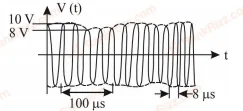
V
V
V
V
A signal A cost is transmitted using as carrier wave. The correct amplitude modulated (AM) signal is:
The modulation frequency of an AM radio station is 250 kHz, which is 10% of the carrier wave. If another AM station approaches you for license what broadcast frequency will you allot?
2750 kHz
2000 kHz
2250 kHz
2900 kHz
The number of amplitude modulated broadcast stations that can be accommodated in a 300 kHz band width for the highest modulating frequency 15 kHz will be:
20
10
8
15
The carrier frequency of a transmitter is provided by a tank circuit of a coil of inductance 49H and a capacitance of 2.5 nF. It is modulated by an audio signal of 12 kHz. The frequency range occupied by the side bands is:
18 kHz - 30 kHz
63 kHz - 75 kHz
442 kHz - 466 kHz
13482 kHz - 13494 kHz
A carrier wave of peak voltage 14 V is used for transmitting a message signal. The peak voltage of the modulating signal given to achieve a modulation index of 80% will be:
22.4 V
7 V
11.2 V
28 V
In amplitude modulation, the sinusoidal carrier frequency used is denoted by and the signal frequency is denoted by . The bandwidth of the signal is such that . Which of the following frequencies is not contained in the modulated wave?
A signal of frequency 20 kHz and peak voltage of 5 Volt is used to modulate a carrier wave of frequency 1.2 MHz and peak voltage 25 Volts. Choose the correct statement.
Modulation index = 5, side frequency bands are at 1400 kHz and 1000 kHz.
Modulation index = 5, side frequency bands are at 21.2 kHz and 18.8 kHz.
Modulation index = 0.2, side frequency bands are at 1220 kHz and 1180 kHz.
Modulation index = 5, side frequency bands are at 24.2 kHz and 18.8 kHz.
Choose the correct statement:
In frequency modulation the amplitude of the high frequency carrier wave is made to vary in proportion to the amplitude of the audio signal.
In frequency modulation the amplitude of the high frequency carrier wave is made to vary in proportion to the frequency of the audio signal.
In amplitude modulation the amplitude of the high frequency carrier wave is made to vary in proportion to the amplitude of the audio signal.
In amplitude modulation the frequency of the high frequency carrier wave is made to vary in proportion to the amplitude of the audio signal.
An audio signal consists of two distinct sounds: one a human speech signal in the frequency band of 200 Hz to 2700 Hz, while the other is a high frequency music signal in the frequency band of 10200 Hz to 15200 Hz. The ratio of the AM signal band width required to send both the signals together to the AM signal band width required to send just the human speech is:
3
5
6
2
A modulated signal has the form . The carrier frequency , the modulating frequency (message frequency) and the modulation index are respectively given by:
Hz; Hz;
Hz; Hz;
Hz; Hz;
Hz; Hz;
A signal of 5 kHz frequency is amplitude modulated on a carrier wave of frequency 2 MHz. The frequencies of the resultant signal is/are:
2000 kHz and 1995 kHz
2 MHz only
2005 kHz and 1995 kHz
2005 kHz, 2000 kHz and 1995 kHz
A diode detector is used to detect an amplitude modulated wave of 60% modulation by using a condenser of capacity 250 pico farad in parallel with a load resistance of 100 kilo ohm. Find the maximum modulated frequency which could be detected by it.
5.31 MHz
5.31 kHz
10.62 MHz
10.62 kHz
If a carrier wave is amplitude modulated by a modulator signal then the equation of modulated signal and its modulation index are respectively
and 2
and 1
and 1
and 2
Which of the following modulated signal has the best noise-tolerance?
Long-wave
Short-wave
Medium-wave
Amplitude-modulated
Given the electric field of a complete amplitude modulated wave as $ Where the subscript c stands for the carrier wave and m for the modulating signal. The frequencies present in the modulated wave are
and
and
and
and
RELATED COMMUNICATION SYSTEMS (OLDER SYLLABUS) TOPICS