JEE MAIN 2023 · 29 JAN S2Modulation and demodulationTRANSCRIBED
The modulation index for an A.M. wave having maximum and minimum peak to peak voltages of mV and mV respectively is:
- A
- B
- C
- D
Every JEE Main question on Modulation and demodulation, one of the ideas inside Communication Systems (older syllabus): 60 questions from 2012–2023, 47 of them in the last five years. Newest first, answer key on every one. Free to read.
Questions
60
Years asked
11
Since
2012
Of the chapter
57%
Questions on Modulation and demodulation in each year it was asked.
1–20 OF 60 · NEWEST FIRST
The modulation index for an A.M. wave having maximum and minimum peak to peak voltages of mV and mV respectively is:
Match List I with List II
| List I | List II |
|---|---|
| A. Attenuation | I. Combination of a receiver and transmitter |
| B. Transducer | II. Process of retrieval of information from the carrier wave at receiver |
| C. Demodulation | III. Converts one form of energy into another |
| D. Repeater | IV. Loss of strength of a signal while propagating through a medium |
A-I, B-II, C-III, D-IV
A-II, B-III, C-IV, D-I
A-IV, B-III, C-I, D-II
A-IV, B-III, C-II, D-I
A message signal of frequency 3 kHz is used to modulate a carrier signal of frequency 1.5 MHz. The bandwidth of the amplitude modulated wave is
6 MHz
6 kHz
3 MHz
3 kHz
A modulating signal is a square wave, as shown in the figure. If the carrier wave is given as volts, the modulation index is:
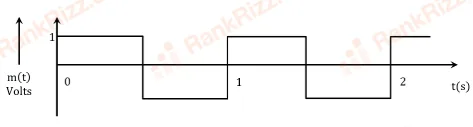
1
A modulating signal is a square wave, as shown in the figure.
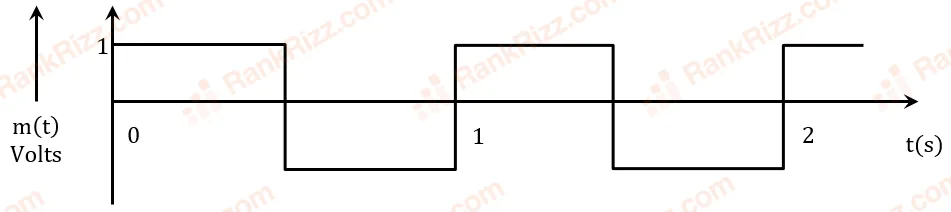
If the carrier wave is given as volts, the modulation index is:
1
The amplitude of 15sin(1000) is modulated by 10sin(4) signal. The amplitude modulated signal contains frequency(ies) of
(A) 500 Hz
(B) 2 Hz
(C) 250 Hz
(D) 498 Hz
(E) 502 Hz
Choose the correct answer from the options given below:
A only
A, D and E only
B only
A and B only
In an amplitude modulation, a modulating signal having amplitude of V is superimposed with a carrier signal of amplitude V in first case. Then, in second case, the same modulating signal is superimposed with different carrier signal of amplitude V. The ratio of modulation index in the two case respectively wil be:
The amplitude of is modulated by signal. The amplitude modulated signal contains frequencies of
A. 500 Hz
B. 2 Hz
C. 250 Hz
D. 498 Hz
E. 502 Hz
Choose the correct answer from the options given below
A and B only
A and C only
A and D only
A, D and E only
Given below are two statements
Statement I: For transmitting a signal, size of antenna () should be comparable to wavelength of signal (at least in dimension).
Statement II: In amplitude modulation, amplitude of carrier wave remains constant (unchanged).
In the light of the above statements, choose the most appropriate answer from the options given below
Both Statement I and Statement II are correct
Both Statement I and Statement II are incorrect
Statement I is incorrect but Statement II is correct
Statement I is correct but Statement II is incorrect
A message signal of frequency 5 kHz is used to modulate a carrier signal of frequency 2 MHz. The bandwidth for amplitude modulation is:
5 kHz
20 kHz
10 kHz
2.5 kHz
A sinusoidal carrier voltage is amplitude modulated. The resultant amplitude modulated wave has maximum and minimum amplitude of V and V respectively. The amplitude of each side band is:
V
V
V
V
For an amplitude modulated wave the minimum amplitude is 3 V, while the modulation index is 60%. The maximum amplitude of the modulated wave is:
5 V
15 V
12 V
10 V
A carrier wave of amplitude 15 V is modulated by a sinusoidal base band signal of amplitude 3 V. The ratio of maximum amplitude to minimum amplitude in an amplitude modulated wave is
2
1
5
Find the modulation index of an AM wave having 8 V variation where maximum amplitude of the AM wave is 9 V.
0.8
0.5
0.2
0.1
A radio can tune to any station in to band. The value of corresponding wavelength bandwidth will be
The maximum and minimum voltage of an amplitude modulated signal are and respectively. The percentage modulation index will be
A baseband signal of MHz frequency is modulated with a carrier signal of GHz frequency using amplitude modulation method. What should be the minimum size of antenna required to transmit the modulated signal?
42.8 m
42.8 mm
21.4 mm
21.4 m
Match List I with List II
| List I | List II |
|---|---|
| (A) Facsimile | (I) Static Document Image |
| (B) Guided media Channel | (II) Local Broadcast Radio |
| (C) Frequency Modulation | (III) Rectangular wave |
| (D) Digital Signal | (IV) Optical Fiber |
A - IV, B - III, C - II, D - I
A - I, B - IV, C - II, D - III
A - IV, B - II, C - III, D - I
A - I, B - II, C - III, D - IV
Choose the correct statement for amplitude modulation
Amplitude of modulating signal is varied in accordance with the information signal.
Amplitude of modulated signal is varied in accordance with the information signal.
Amplitude of carrier signal is varied in accordance with the information signal.
Amplitude of modulated signal is varied in accordance with the modulating signal.
A sinusoidal wave is amplitude modulated by another sinusoidal wave . The amplitude of minimum frequency component of modulated signal is
RELATED COMMUNICATION SYSTEMS (OLDER SYLLABUS) TOPICS