JEE MAIN 2022 · 25 JUN S2Group 15: trends and hydridesTRANSCRIBED
Find number of ionisable hydrogen in B
Every JEE Main question on Group 15: trends and hydrides, one of the ideas inside p-Block Elements: Groups 15 to 18: 73 questions from 2009–2026, 41 of them in the last five years. Newest first, answer key on every one. Free to read.
Questions
73
Years asked
16
Since
2009
Of the chapter
42%
41–60 OF 73 · NEWEST FIRST
Find number of ionisable hydrogen in B
A group 15 element, which is a metal and forms a hydride with strongest reducing power among group 15 hydrides. The element is:
Sb
P
As
Bi
Which one of the following is formed (mainly) when red phosphorus is heated in a sealed tube at 803 K?
-Black phosphorus
White phosphorus
Yellow phosphorus
-Black phosphorus
The oxide without nitrogen-nitrogen bond is:
NO
NO
NO
NO
Match List-I with List-II:
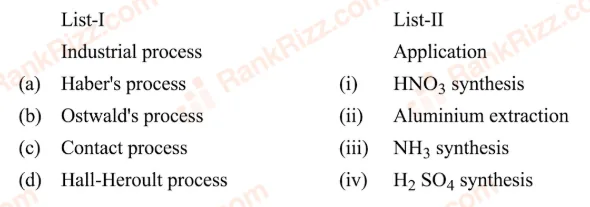
Choose the correct answer from the options given below:
(a)-(ii), (b)-(iii), (c)-(iv), (d)-(i)
(a)-(iii), (b)-(iv), (c)-(i), (d)-(ii)
(a)-(iii), (b)-(i), (c)-(iv), (d)-(ii)
(a)-(iv), (b)-(i), (c)-(ii), (d)-(iii)
Chemical nature of the nitrogen oxide compound obtained from a reaction of concentrated nitric acid and PO (in 4 : 1 ratio) is:
acidic
basic
amphoteric
neutral
The number of non-ionisable hydrogen atoms present in the final product obtained from the hydrolysis of PCl is:
0
1
2
3
Match List-I with List-II:
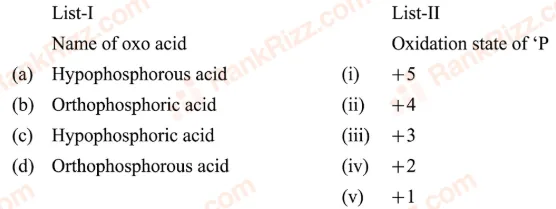
Choose the correct answer from the options given below:
(a)-(v), (b)-(i), (c)-(ii), (d)-(iii)
(a)-(iv), (b)-(i), (c)-(ii), (d)-(iii)
(a)-(iv), (b)-(v), (c)-(ii), (d)-(iii)
(a)-(v), (b)-(iv), (c)-(ii), (d)-(iii)
The set that represents the pair of neutral oxides of nitrogen is:
NO and NO
NO and NO
NO and NO
NO and NO
Which one of the following group-15 hydride is the strongest reducing agent?
AsH
BiH
PH
SbH
The reaction of white phosphorus on boiling with alkali in inert atmosphere resulted in the formation of product A. The reaction 1 mol of A with excess of AgNO in aqueous medium gives ________ mole(s) of Ag. (Round off to the Nearest Integer).
On heating, lead (II) nitrate gives a brown gas (A). The gas (A) on cooling changes to a colourless solid/liquid (B). (B) on heating with NO changes to a blue solid (C). The oxidation number of nitrogen in solid (C) is:
+5
+2
+3
+4
On heating compound (A) gives a gas (B) which is constituent of air. This gas when treated with in the presence of a catalyst gives another gas (C) which is basic in nature. (A) should not be:
The reaction of NO with at 250 K gives:
The correct statement with respect to dinitrogen is:
is paramagnetic in nature
it can combine with dioxygen at
liquid dinitrogen is not used in cryosurgery
it can be used as an inert diluent for reactive chemicals
Aqua regia is used for dissolving noble metals (Au, Pt, etc.). The gas evolved in this process is
NO
White phosphorus on reaction with concentrated NaOH solution in an inert atmosphere of CO gives phosphine and compound (X). (X) on acidification with HCl gives compound (Y). The basicity of compound (Y) is:
2
1
4
3
In a molecule of pyrophosphoric acid, the number of P - O - H, P = O and P - O - P bonds/moiety(ies) respectively are:
2, 4 and 1
3, 3 and 3
4, 2 and 0
4, 2 and 1
Reaction of ammonia with excess gives:
and
and
and
and
A metal (A) on heating in nitrogen gas gives compound B. B on treatment with HO gives a colourless gas which when passed through CuSO solution gives a dark blue-violet coloured solution. A and B respectively, are:
Na and NaNO
Na and MgN
Mg and MgN
Mg and Mg(NO)
RELATED P-BLOCK ELEMENTS: GROUPS 15 TO 18 TOPICS