Arrange the following compounds according to increasing order of boiling points.
n-CHOH (A), n-CHNH (B), n-CH (C) and CHNHCH (D).
- A
C < B < A < D
- B
D < C < B < A
- C
C < D < B < A
- D
D < B < A < C
Every JEE Main question on Hydrogen bonding and intermolecular forces, one of the ideas inside Chemical Bonding and Molecular Structure: 31 questions from 2006–2026, 12 of them in the last five years. Newest first, answer key on every one. Free to read.
Questions
31
Years asked
17
Since
2006
Of the chapter
10%
Questions on Hydrogen bonding and intermolecular forces in each year it was asked, the latest 12 of 17.
1–20 OF 31 · NEWEST FIRST
Arrange the following compounds according to increasing order of boiling points.
n-CHOH (A), n-CHNH (B), n-CH (C) and CHNHCH (D).
C < B < A < D
D < C < B < A
C < D < B < A
D < B < A < C
Given below are two statements:
Statement I: Wet cotton clothes made of cellulose based carbohydrate takes comparatively longer time to get dried than wet nylon polymer based clothes.
Statement II: Intermolecular hydrogen bonding with water molecule is more in nylon-based clothes than in the case of cotton clothes.
In the light of above statements, choose the answer from the options given below
Statement I is false but Statement II is true
Statement I is true but Statement II is false
Both Statement I and Statement II are true
Both Statement I and Statement II are false
Given below are two statements: one is labelled as Assertion A and the other is labelled as Reason R. Assertion A: has lower boiling point than . Reason R: In liquid state molecules are associated through Vander Waal's forces, but molecules are associated through hydrogen bonding. In the light of the above statements, choose the most appropriate answer from the options given below:
Both A and R are correct and R is not the correct explanation of A
A is not correct but R is correct
Both A and R are correct but R is the correct explanation of A
A is correct but R is not correct
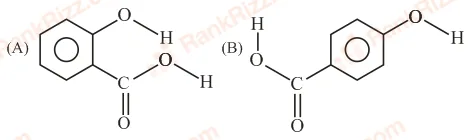
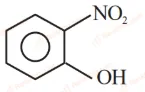
Select the compound from the following that will show intramolecular hydrogen bonding.

The correct statement/s about Hydrogen bonding is/are: A. Hydrogen bonding exists when H is covalently bonded to the highly electronegative atom. B. Intermolecular H bonding is present in o-nitrophenol. C. Intramolecular H bonding is present in HF. D. The magnitude of H bonding depends on the physical state of the compound. E. H-bonding has powerful effect on the structure and properties of compounds. Choose the correct answer from the options given below:
A, B, D only
A, D, E only
A only
A, B, C only
Which among the following has highest boiling point?
Number of molecules from the following which can exhibit hydrogen bonding is _______ (nearest integer):

Decreasing order of the hydrogen bonding in following forms of water is correctly represented by
A. Liquid water
B. Ice
C. Impure water
A = B > C
B > A > C
C > B > A
A > B > C
Decreasing order of the hydrogen bonding in following forms of water is correctly represented by
A. Liquid water
B. Ice
C. Impure water
A = B > C
B > A > C
C > B > A
A > B > C
In an ice crystal, each water molecule is hydrogen bonded to ______ neighbouring molecules.
The correct order of increasing intermolecular hydrogen bond strength is
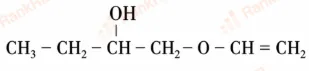
The number of hybridised carbons in an acyclic neutral compound with molecular formula is ______.
The interaction energy of London forces between two particles is proportional to , where r is the distance between the particles. The value of x is:
6
3
In the following sequence of reactions a compound A, (molecular formula CHO) with a straight chain structure gives a C carboxylic acid. A is:

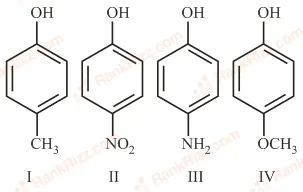
The increasing order of boiling points of the following compounds is:

I < III < IV < II
I < IV < II < III
IV < I < II < III
III < I < II < IV
Consider the following molecules and statements related to them:
(a) (B) is more likely to be crystalline than (A)
(b) (B) has higher boiling point than (A)
(c) (B) dissolves more readily than (A) in water
Identify the correct option from below:
(a) and (b) are true
(a) and (c) are true
only (a) is true
(b) and (c) are true
The predominant intermolecular forces present in ethyl acetate, a liquid, are:
London dispersion and dipole-dipole
hydrogen bonding and London dispersion
Dipole-dipole and hydrogen bonding
London dispersion, dipole-dipole and hydrogen bonding
Match the type of interaction in column A with the distance dependence of their interaction energy in column B:
A B
(i) ion - ion (a)
(ii) Dipole - dipole (b)
(iii) London dispersion (c)
(iv)
(i)-(b); (ii)-(d); (iii)-(c)
(i)-(a); (ii)-(b); (iii)-(d)
(i)-(a); (ii)-(b); (iii)-(c)
(i)-(a); (ii)-(c); (iii)-(d)
The relative strength of the interionic/ intermolecular forces in a decreasing order is:
dipole-dipole > ion-dipole > ion-ion
ion-dipole > ion-ion > dipole-dipole
ion-dipole > dipole-dipole > ion-ion
ion-ion > ion-dipole > dipole-dipole
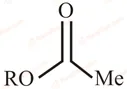
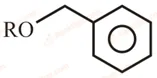
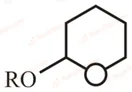
Which of the following derivatives of alcohols is unstable in an aqueous base?


RELATED CHEMICAL BONDING AND MOLECULAR STRUCTURE TOPICS