JEE MAIN 2026Radial and angular nodes and orbital energiesTRANSCRIBED
The orbital having one radial node as well one angular node is:
- A
3p
- B
4f
- C
4d
- D
5d
Every JEE Main question on Radial and angular nodes and orbital energies, one of the ideas inside Atomic Structure: 23 questions from 2005–2026, 14 of them in the last five years. Newest first, answer key on every one. Free to read.
Questions
23
Years asked
12
Since
2005
Of the chapter
10%
Questions on Radial and angular nodes and orbital energies in each year it was asked.
1–20 OF 23 · NEWEST FIRST
The orbital having one radial node as well one angular node is:
3p
4f
4d
5d
Match the LIST-I with LIST-II
| List-I Orbital | List-II Radial nodes and nodal plane | ||
|---|---|---|---|
| A. | 2s | I. | 1 Radial node + two nodal planes |
| B. | 3s | II. | 1 Radial node + one nodal plane |
| C. | 3p | III. | 2 Radial nodes + No nodal plane |
| D. | 4d | IV. | 1 Radial node + No nodal plane |
Choose the correct answer from the options given below:
A-IV, B-I, C-III, D-II
A-IV, B-II, C-III, D-I
A-III, B-I, C-IV, D-II
A-IV, B-III, C-II, D-I
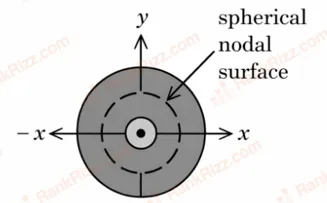
Figure 1. electron probability density for 2s orbital
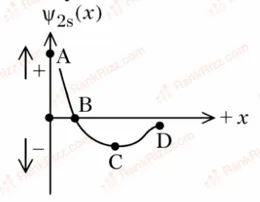
Figure 2. wave function for 2s orbital
Which of the following point in Figure 2 most accurately represents the nodal surface as shown in Figure 1?
B
D
C
A
Consider the ground state of chromium atom (Z = 24). How many electrons are with Azimuthal quantum number and respectively?
12 and 4
16 and 4
12 and 5
16 and 5
Correct statements for an element with atomic number 9 are :
A. There can be 5 electrons for which and 4 electrons for which
B. There is only one electron in orbital
C. The last electron goes to orbital with and
D. The sum of angular nodes of all the atomic orbitals is 1.
Choose the correct answer from the options given below:
C and D Only
A and C Only
A, C and D Only
A and B Only
The extra stability of half-filled subshell is due to :
(A) Symmetrical distribution of electrons
(B) Smaller coulombic repulsion energy
(C) The presence of electrons with the same spin in non-degenerate orbitals
(D) Larger exchange energy
(E) Relatively smaller shielding of electrons by one another
Identify the correct statements
(B), (D) and (E) only
(A), (B), (D) and (E) only
(B), (C) and (D) only
(A), (B) and (D) only
The number of radial node/s for 3p orbital is:
1
4
2
3
Which one of the following sets of ions represents a collection of isoelectronic species?
(Given: Atomic Number: F: 9, Cl: 17, Na = 11, Mg = 12, Al = 13, K = 19, Ca = 20, Sc = 21)
The wave function of is given by
At , radial node is formed. Thus, in terms of
The number of atomic orbitals from the following having 5 radial nodes is
7s, 7p, 6s, 8p, 8d
The number of s-electrons present in an ion with 55 protons in its unipositive state is
8
9
12
10
The pair, in which ions are isoelectronic with is
and
and
and
and
The number of radial and angular nodes in orbital are, respectively
&
&
&
&
Consider an imaginary ion . The nucleus contains '' more neutrons than the number of electrons in the ion. The value of '' is ______.
Hydrogen has three isotopes (A), (B) and (C). If the number of neutron(s) in (A), (B) and (C) respectively, are (x), (y) and (z), the sum of (x), (y) and (z) is
3
2
4
1
The isoelectronic set of ions is:
F, Li, Na and Mg
N, Li, Mg and O
N, O, F and Na
Li, Na, O and F
Aqueous solution of which of the following salts will not contain ions with the electronic configuration ?
NaF
KBr
NaCl
If the principal quantum number n = 6, the correct sequence of filling of electrons will be:
ns (n-1) d (n-2) f np
ns np (n-1)d (n-2)f
ns (n-2)f np (n-1)d
ns (n-2)f (n-1)d np
The electrons identified by quantum numbers and : (a) (b) (c) (d) Can be placed in order of increasing energy as:
(c) < (d) < (b) < (a)
(d) < (b) < (c) < (a)
(b) < (d) < (a) < (c)
(a) < (c) < (b) < (d)
The following sets of quantum numbers represent four electrons in an atom. (i) (ii) (iii) (iv) . The sequence representing increasing order of energy, is
(iii) < (i) < (iv) < (ii)
(iv) < (ii) < (iii) < (i)
(i) < (iii) < (ii) < (iv)
(ii) < (iv) < (i) < (iii)
RELATED ATOMIC STRUCTURE TOPICS