RankRizz

Electromagnetic radiation, Planck's quantum theory and photoelectric effect — JEE Main Previous Year Questions

Every JEE Main question on Electromagnetic radiation, Planck's quantum theory and photoelectric effect, one of the ideas inside Atomic Structure: 34 questions from 2010–2026, 16 of them in the last five years. Newest first, answer key on every one. Free to read.

Questions

34

Years asked

12

Since

2010

Of the chapter

15%

Every Electromagnetic radiation, Planck's quantum theory and photoelectric effect question

21–34 OF 34 · NEWEST FIRST

JEE MAIN 2021 · 16 MAR S1Electromagnetic radiation, Planck's quantum theory and photoelectric effectTRANSCRIBED

When light of wavelength 248 nm falls on a metal of threshold energy 3.0 eV, the de-Broglie wavelength of emitted electrons is ________ A˚\mathring{A} (angstrom). (Round off to the Nearest Integer).
[Use: 3=1.73\sqrt{3} = 1.73, h=6.63×10⁻³⁴h = 6.63 \times 10^{-34} Js; me=9.1×10⁻³¹m_e = 9.1 \times 10^{-31} kg; c=3.0×10⁸c = 3.0 \times 10^{8} ms−1^{-1}; 11 eV =1.6×10−19= 1.6 \times 10^{-19} J]

JEE MAIN 2021 · 25 FEB S2Electromagnetic radiation, Planck's quantum theory and photoelectric effectTRANSCRIBED

Among the following, number of metal/s which can be used as electrodes in the photoelectric cell is ______. (Integer answer)
(A) Li (B) Na (C) Rb (D) Cs

JEE MAIN 2021 · 26 AUG S2Electromagnetic radiation, Planck's quantum theory and photoelectric effectTRANSCRIBED

A metal surface is exposed to 500 nm radiation. The threshold frequency of the metal for photoelectric current is 4.3×10144.3 \times 10^{14} Hz. The velocity of ejected electron is _________ ×105\times 10^5 ms−1^{-1} (Nearest integer)
[Use: h = 6.63×10−346.63 \times 10^{-34} Js, me_e = 9.0×10−319.0 \times 10^{-31} kg]

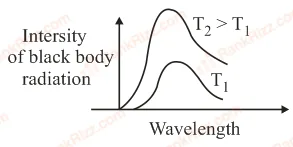
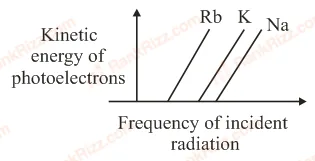
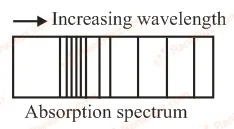
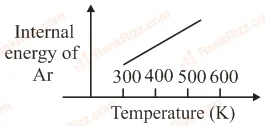
JEE MAIN 2020 · 02 SEP S1Electromagnetic radiation, Planck's quantum theory and photoelectric effectTRANSCRIBED

The figure that is not a direct manifestation of the quantum nature of atom is:

  1. A
    Figure for JEE Main 2020 Chemistry question on Electromagnetic radiation, Planck's quantum theory and photoelectric effect
  2. B
    Figure for JEE Main 2020 Chemistry question on Electromagnetic radiation, Planck's quantum theory and photoelectric effect
  3. C
    Figure for JEE Main 2020 Chemistry question on Electromagnetic radiation, Planck's quantum theory and photoelectric effect
  4. D
    Figure for JEE Main 2020 Chemistry question on Electromagnetic radiation, Planck's quantum theory and photoelectric effect
JEE MAIN 2020 · 02 SEP S2Electromagnetic radiation, Planck's quantum theory and photoelectric effectTRANSCRIBED

The work function of sodium metal is 4.41×10−194.41 \times 10^{-19} J. If photons of wavelength 300 nm are incident on the metal, the kinetics energy of the ejected electrons will be (h=6.63×10⁻³⁴(h = 6.63 \times 10^{-34} J s; c=3×10⁸c = 3 \times 10^8 m s−1)^{-1}) ___________ ×10−21\times 10^{-21} J.

JEE MAIN 2019 · 10 JAN S1Electromagnetic radiation, Planck's quantum theory and photoelectric effectTRANSCRIBED

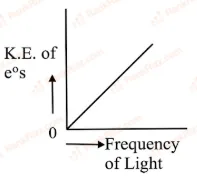
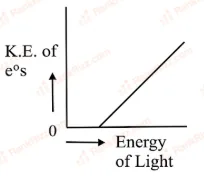
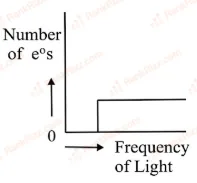
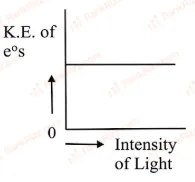
Which of the graphs shown below does not represent the relationship between incident light and the electron ejected from metal surface?

  1. A
    Figure for JEE Main 2019 Chemistry question on Electromagnetic radiation, Planck's quantum theory and photoelectric effect
  2. B
    Figure for JEE Main 2019 Chemistry question on Electromagnetic radiation, Planck's quantum theory and photoelectric effect
  3. C
    Figure for JEE Main 2019 Chemistry question on Electromagnetic radiation, Planck's quantum theory and photoelectric effect
  4. D
    Figure for JEE Main 2019 Chemistry question on Electromagnetic radiation, Planck's quantum theory and photoelectric effect
JEE MAIN 2019 · 12 JAN S1Electromagnetic radiation, Planck's quantum theory and photoelectric effectTRANSCRIBED

What is the work function of the metal if the light of wavelength 4000 A˚\mathring{A} generates photoelectrons of velocity 6×1056 \times 10^5 ms−1^{-1} from it? (Mass of electron =9×10−31= 9 \times 10^{-31} kg, velocity of light =3×108= 3 \times 10^8 ms−1^{-1}, Planck's constant =6.626×10−34= 6.626 \times 10^{-34} Js,1 eV=1.602×10⁻¹⁹ J1\ \text{eV} = 1.602 \times 10^{-19}\ \text{J})

  1. A

    0.9 eV

  2. B

    4.0 eV

  3. C

    3.1 eV

  4. D

    2.1 eV

JEE MAIN 2019 · 11 JAN S2Electromagnetic radiation, Planck's quantum theory and photoelectric effectTRANSCRIBED

The de Broglie wavelength (λ)(\lambda) associated with a photoelectron varies with the frequency (ν)(\nu) of the incident radiation as, [ν0\nu_0 is threshold frequency]:

  1. A

    λ∝1(ν−ν0)\lambda \propto \frac{1}{(\nu - \nu_0)}

  2. B

    λ∝1(ν−ν0)14\lambda \propto \frac{1}{(\nu - \nu_0)^{\frac{1}{4}}}

  3. C

    λ∝1(ν−ν0)32\lambda \propto \frac{1}{(\nu - \nu_0)^{\frac{3}{2}}}

  4. D

    λ∝1(ν−ν0)12\lambda \propto \frac{1}{(\nu - \nu_0)^{\frac{1}{2}}}

JEE MAIN 2019 · 08 APR S2Electromagnetic radiation, Planck's quantum theory and photoelectric effectTRANSCRIBED

If p is the momentum of the fastest electron ejected from a metal surface after the irradiation of light having wavelength λ\lambda, then for 1.5 p momentum of the photoelectron, the wavelength of the light should be: (Assume kinetic energy of ejected photoelectron to be very high in comparison to work function)

  1. A

    49λ\frac{4}{9}\lambda

  2. B

    34λ\frac{3}{4}\lambda

  3. C

    23λ\frac{2}{3}\lambda

  4. D

    12λ\frac{1}{2}\lambda

JEE MAIN 2018 · 15 APR S1Electromagnetic radiation, Planck's quantum theory and photoelectric effectTRANSCRIBED

Ejection of the photoelectron from metal in the photoelectric effect experiment can be stopped by applying 0.5 V when the radiation of 250 nm is used. The work function of the metal is:

  1. A

    4 eV

  2. B

    5.5 eV

  3. C

    4.5 eV

  4. D

    5 eV

JEE MAIN 2014 · 19 APR ONLINEElectromagnetic radiation, Planck's quantum theory and photoelectric effectTRANSCRIBED

The ionization energy of gaseous Na atoms is 495.5 kJ mol−1^{-1}. The lowest possible frequency of light that ionizes a sodium atom is (h = 6.626×10−346.626 \times 10^{-34} Js, NA_A = 6.022×10236.022 \times 10^{23} mol−1^{-1})

  1. A

    1.24×10151.24 \times 10^{15} s−1^{-1}

  2. B

    7.50×1047.50 \times 10^4 s−1^{-1}

  3. C

    4.76×10144.76 \times 10^{14} s−1^{-1}

  4. D

    3.15×10153.15 \times 10^{15} s−1^{-1}

JEE MAIN 2014 · 11 APR ONLINEElectromagnetic radiation, Planck's quantum theory and photoelectric effectTRANSCRIBED

If λ0\lambda_0 and λ\lambda be threshold wavelength and wavelength of incident light, the velocity of photoelectron ejected from the metal surface is:

  1. A

    2hm(λ0−λ)\sqrt{\frac{2h}{m}(\lambda_0 - \lambda)}

  2. B

    2hcm(λ0−λ)\sqrt{\frac{2hc}{m}(\lambda_0 - \lambda)}

  3. C

    2hcm(λ0−λλλ0)\sqrt{\frac{2hc}{m}\left(\frac{\lambda_0 - \lambda}{\lambda \lambda_0}\right)}

  4. D

    2hm(1λ0−1λ)\sqrt{\frac{2h}{m}\left(\frac{1}{\lambda_0} - \frac{1}{\lambda}\right)}

JEE MAIN 2011Electromagnetic radiation, Planck's quantum theory and photoelectric effectTRANSCRIBED

A gas absorbs a photon of 355 nm355 \, \text{nm} and emits at two wavelengths. If one of the emissions is at 680 nm680 \, \text{nm}, the other is at:

  1. A

    325 nm325 \, \text{nm}

  2. B

    743 nm743 \, \text{nm}

  3. C

    518 nm518 \, \text{nm}

  4. D

    1035 nm1035 \, \text{nm}

JEE MAIN 2010Electromagnetic radiation, Planck's quantum theory and photoelectric effectTRANSCRIBED

The energy required to break one mole of Cl−-Cl bonds in Cl2\text{Cl}_2 is 242242 kJ mol−1^{-1}. The longest wavelength of light capable of breaking a single Cl−-Cl bond is (c=3×10⁸c = 3 \times 10^8 ms−1^{-1} and NA=6.02×10²³N_A = 6.02 \times 10^{23} mol−1^{-1})

  1. A

    594594 nm

  2. B

    640640 nm

  3. C

    700700 nm

  4. D

    494494 nm