RankRizz

JEE Main 02 Apr 2026, Shift 1: Chemistry

The 25 Chemistry questions of JEE Main 02 Apr 2026, Shift 1, numbered across the whole paper. Pick an answer on any question to check it against the key. Free to read, nothing to download.

Chemistry

Q26Stoichiometry, limiting reagent and percentage yieldTRANSCRIBED

The mass of iron converted into Fe3_3O4_4 by the action of 18 g of steam is : (Given : Molar mass of H, O and Fe are 1, 16 and 56 g mol−1^{-1} respectively) Assume iron is present in excess :

  1. A

    2.12.1 g

  2. B

    4.24.2 g

  3. C

    2121 g

  4. D

    4242 g

Q27Bohr model of hydrogen-like speciesTRANSCRIBED

What is the energy (in J atom−1^{-1}) required for the following process? Li2+(g)→Li3+(g)+e−\text{Li}^{2+}(g) \rightarrow \text{Li}^{3+}(g) + e^- (Take the ionization energy for the H atom in the ground state as 2.18×10−182.18 \times 10^{-18} J atom−1^{-1})

  1. A

    8.72×10−188.72 \times 10^{-18}

  2. B

    1.962×10−181.962 \times 10^{-18}

  3. C

    1.962×10−171.962 \times 10^{-17}

  4. D

    6.54×10−176.54 \times 10^{-17}

Q28Molecular orbital theory of diatomic speciesTRANSCRIBED

Given below are two statements : **Statement (I) :** The correct sequence of bond lengths in the following species is : O2+<O2<O2−<O22−O_2^+ < O_2 < O_2^- < O_2^{2-} **Statement (II) :** The correct sequence of number of unpaired electrons in the following species is : O2>O2+>O2−>O22−O_2 > O_2^+ > O_2^- > O_2^{2-} In the light of the above statements, choose the correct answer from the options given below :

  1. A

    Both Statement I and Statement II are true

  2. B

    Both Statement I and Statement II are false

  3. C

    Statement I is true but Statement II is false

  4. D

    Statement I is false but Statement II is true

Q29Enthalpies of reaction and Hess's lawTRANSCRIBED

Consider the following data.
(i) 2Al(s) + 6HCl(aq) →\rightarrow Al2_2Cl6_6(aq) + 3H2_2(g) + 1200 kJ/mol
(ii) H2_2(g) + Cl2_2(g) →\rightarrow 2HCl(g) + 164 kJ/mol.
(iii) HCl(g) + aq →\rightarrow HCl(aq) + 83 kJ/mol.
(iv) Al2_2Cl6_6(s) + aq →\rightarrow Al2_2Cl6_6(aq) + 663 kJ/mol
The enthalpy of formation of anhydrous solid Al2_2Cl6_6 is :

  1. A

    −648-648 kJ mol−1^{-1}

  2. B

    −1350-1350 kJ mol−1^{-1}

  3. C

    −2002-2002 kJ mol−1^{-1}

  4. D

    −1527-1527 kJ mol−1^{-1}

Q30Abnormal molar mass and van't Hoff factorTRANSCRIBED

19.5 g of fluoro acetic acid (molar mass = 78 g mol−1^{-1}) is dissolved in 500 g of water at 298 K. The depression in the freezing point was 1°C. What is Ka_a of fluoro acetic acid? (For water, Kf_f = 1.86 K kg mol−1^{-1}). Assume molarity and molality to have same values.

  1. A

    10−610^{-6}

  2. B

    4×10−44 \times 10^{-4}

  3. C

    3×10−53 \times 10^{-5}

  4. D

    3×10⁻³³ \times 10^{-3}

Q31Solubility product and common ion effectTRANSCRIBED

The solubility product constants of Ag2_2CrO4_4 and AgBr are 32x and 4y respectively at 298 K. The value of (molarity of Ag2CrO4molarity of AgBr)\left(\frac{\text{molarity of Ag}_2\text{CrO}_4}{\text{molarity of AgBr}}\right) can be expressed as :

  1. A

    2x3y\frac{2\sqrt[3]{x}}{y}

  2. B

    2xy2\sqrt{\frac{x}{y}}

  3. C

    xy\sqrt{\frac{x}{y}}

  4. D

    x3y\frac{\sqrt[3]{x}}{\sqrt{y}}

Q32Electrode potentials, electrochemical series and cell EMFTRANSCRIBED

An electrochemical cell is constructed using half cells in the direction of spontaneous change
Fe(OH)2_2(s) + 2e−^- →\rightarrow Fe(s) + 2OH−^-(aq)       E0^0 = −0.88 V
and AgBr(s) + e−^- →\rightarrow Ag(s) + Br−^-(aq)                 E0^0 = +0.07 V
Which of the following option is correct?

  1. A

    Overall reaction Fe(s)+2OH−^-(aq)+2AgBr(s) ⇌\rightleftharpoons Fe(OH)2_2(s)+2Ag(s)+2Br−^-(aq)

  2. B

    Ecell0=−0.95E^0_{cell} = -0.95 V

  3. C

    Fe is reduced in the electrochemical cell

  4. D

    Ecell0E^0_{cell} is an extensive property

Q33Integrated rate laws and half-life (zero and first order)TRANSCRIBED

t100%t_{100\%} is the time required for the 100% completion of the reaction while t1/2t_{1/2} is the time required for 50% of the reaction to be completed. Which of the following option correctly represents the relation between t100%t_{100\%} and t1/2t_{1/2} for zero and first order reactions respectively?

  1. A

    t100%=(t1/2)2t_{100\%} = (t_{1/2})^2 and t100%=(t1/2)−∞t_{100\%} = (t_{1/2})^{-\infty}

  2. B

    t100%=2t1/2t_{100\%} = 2t_{1/2} and t100%=(t1/2)∞t_{100\%} = (t_{1/2})^{\infty}

  3. C

    t100%=2t1/2t_{100\%} = 2t_{1/2} and t100%=(2t1/2)2t_{100\%} = (2t_{1/2})^2

  4. D

    t100%=(t1/2)∞t_{100\%} = (t_{1/2})^{\infty} and t100%=2t1/2t_{100\%} = 2t_{1/2}

Q34Ionisation enthalpyTRANSCRIBED

Given below are two statements :

 Statement (I)
: The first ionisation enthalpy of the elements Na, Mg, Cl and Ar follows the order Na > Mg > Cl > Ar.

 Statement (II) :
Among Ca, Al, Fe and B, the third ionisation enthalpy is very high for Ca. In the light of the above statements, choose the correct answer from the options given below :

  1. A

    Both Statement I and Statement II are true

  2. B

    Both Statement I and Statement II are false

  3. C

    Statement I is true but Statement II is false

  4. D

    Statement I is false but Statement II is true

Q35Oxidising/reducing agents and types of redox reactionsTRANSCRIBED

Given below are two statements : 

Statement (I) : Oxidising power of halogens decreases in the order F2_2 > Cl2_2 > Br2_2 > I2_2, which is the basis of "Layer test". 

Statement (II) : "Layer test" to identify Br2_2 and I2_2 in aqueous solution involves the oxidation of bromide or iodide into Br2_2 or I2_2 respectively with Cl2_2, which is a type of displacement redox reaction. 

In the light of the above statements, choose the correct answer from the options given below :

  1. A

    Both Statement I and Statement II are true

  2. B

    Both Statement I and Statement II are false

  3. C

    Statement I is true but Statement II is false

  4. D

    Statement I is false but Statement II is true

Q36Other important compounds of transition metalsTRANSCRIBED

Which of the following sets includes all the species that will change the orange colour of K2_2Cr2_2O7_7 in acidic medium?

  1. A

    Fe2+^{2+}, Sn2+^{2+}, I−^-, S2−^{2-}

  2. B

    S2−^{2-}, Fe3+^{3+}, I−^-, C2_2O42−_4^{2-}

  3. C

    Fe2+^{2+}, NO2−_2^-, SO2_2, Sn4+^{4+}

  4. D

    Fe3+^{3+}, SO42−_4^{2-}, S2−^{2-}, Sn4+^{4+}

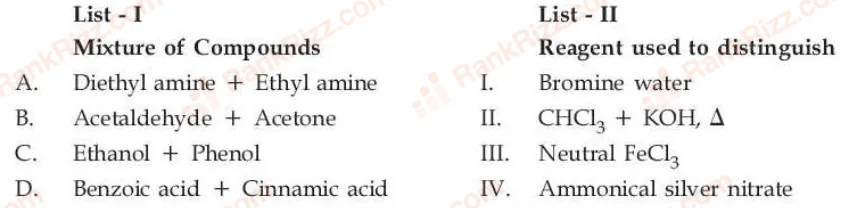
Q37Detection of functional groupsTRANSCRIBED

Match List - I with List - II. 

Figure for JEE Main 2026 Chemistry question on Detection of functional groups

Choose the correct answer from the options given below :

  1. A

    A-I, B-II, C-III, D-IV

  2. B

    A-II, B-III, C-IV, D-I

  3. C

    A-III, B-IV, C-I, D-II

  4. D

    A-IV, B-I, C-II, D-III

Q38ChromatographyTRANSCRIBED

Given below are two statements :
Statement (I) :1,2,3-Trihydroxypropane can be separated from water by simple distillation.
Statement (II) :An azeotropic mixture cannot be separated by fractional distillation.
In the light of the above statements, choose the correct answer from the options given below :

  1. A

    Both Statement I and Statement II are true

  2. B

    Both Statement I and Statement II are false

  3. C

    Statement I is true but Statement II is false

  4. D

    Statement I is false but Statement II is true

Q39Nucleophilic substitution (SN1 and SN2)TRANSCRIBED

Given below are two statements :
**Statement (I) :** Benzyl chloride reacts faster in SN_N1 mechanism than ethyl chloride.
**Statement (II) :** Ethyl carbocation intermediate is less stabilized by hyperconjugation than benzyl carbocation by resonance.
In the light of the above statements, choose the correct answer from the options given below :

  1. A

    Both Statement I and Statement II are true

  2. B

    Both Statement I and Statement II are false

  3. C

    Statement I is true but Statement II is false

  4. D

    Statement I is false but Statement II is true

Q40IUPAC nomenclature of organic compoundsTRANSCRIBED

In IUPAC nomenclature, the correct order of decreasing priority of functional group is :

  1. A

    −CONH2,>C=O,−CHO,−NH2,−C≡C−-\text{CONH}_2, >\text{C=O}, -\text{CHO}, -\text{NH}_2, -\text{C} \equiv \text{C}-

  2. B

    −CONH2,−COOCH3,−CHO,−NH2,−OH-\text{CONH}_2, -\text{COOCH}_3, -\text{CHO}, -\text{NH}_2, -\text{OH}

  3. C

    −CONH2,−CHO,>C=O,−NH2,−C≡C−-\text{CONH}_2, -\text{CHO}, >\text{C=O}, -\text{NH}_2, -\text{C} \equiv \text{C}-

  4. D

    −CONH2,−CHO,−CN,−NH2,−C≡C−-\text{CONH}_2, -\text{CHO}, -\text{CN}, -\text{NH}_2, -\text{C} \equiv \text{C}-

Q41Directive influence of substituentsTRANSCRIBED

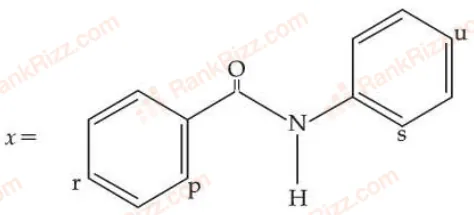
For the given molecule, "x", the preferred site for the attack of the electrophile is :

Figure for JEE Main 2026 Chemistry question on Directive influence of substituents
  1. A

    Predominantly at "r"

  2. B

    "r" and "u"

  3. C

    "p" and "s"

  4. D

    Predominantly at "u"

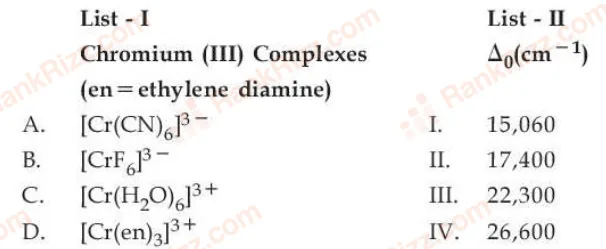
Q42Crystal field splitting, CFSE and spectrochemical seriesTRANSCRIBED

Match List - I with List - II. 

Figure for JEE Main 2026 Chemistry question on Crystal field splitting, CFSE and spectrochemical series

Choose the correct answer from the options given below :

  1. A

    A-IV, B-II, C-I, D-III

  2. B

    A-IV, B-II, C-III, D-I

  3. C

    A-II, B-IV, C-I, D-III

  4. D

    A-II, B-IV, C-III, D-I

Q43Diazonium saltsTRANSCRIBED

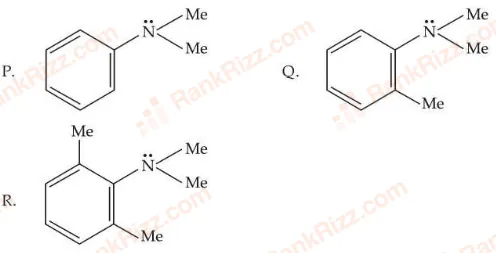
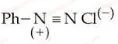
Consider the three aromatic molecules (P, Q and R) whose structures have been given below :

Figure for JEE Main 2026 Chemistry question on Diazonium salts


The correct order regarding the reactivity of these compounds with 

Figure for JEE Main 2026 Chemistry question on Diazonium salts

under optimum but slightly acidic medium is :

  1. A

    P > Q > R

  2. B

    R > P > Q

  3. C

    R > Q > P

  4. D

    P > R > Q

Q44Vitamins and hormonesTRANSCRIBED

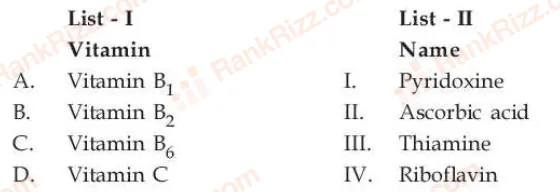
Match List - I with List - II. 

Figure for JEE Main 2026 Chemistry question on Vitamins and hormones

Choose the correct answer from the options given below :

  1. A

    A-II, B-I, C-III, D-IV

  2. B

    A-IV, B-III, C-II, D-I

  3. C

    A-III, B-IV, C-I, D-II

  4. D

    A-I, B-III, C-II, D-IV

Q45Group analysis and confirmatory tests of cationsTRANSCRIBED

A salt with few drops of conc. HCl gives apple green colour in flame test. The group precipitate of the salt is dissolved in acetic acid and treated with K2_2CrO4_4 to give yellow precipitate. When the sodium carbonate extract of the salt solution is heated with conc. HNO3_3 and ammonium molybdate, it resulted a canary yellow precipitate. The cation and anion present in the salt are respectively,

  1. A

    Ca2+^{2+} and SO42−_4^{2-}

  2. B

    Ba2+^{2+} and PO43−_4^{3-}

  3. C

    Mn2+^{2+} and PO43−_4^{3-}

  4. D

    Ba2+^{2+} and SO42−_4^{2-}

Q46Valence bond theory of complexesTRANSCRIBED

5.33 g of CrCl3_3·6H2_2O, which is a 1 : 3 electrolyte, is dissolved in water and is passed through a cation exchanger. The chloride ions in the eluted solution, on treatment with AgNO3_3 results in 8.61 g of AgCl. The ratio of moles of complex reacted and moles of AgCl formed is __________ × 10−2^{-2}. (Nearest integer) [Molar mass in g mol−1^{-1} Cr : 52, Ag : 108, Cl : 35.5, H : 1, O : 16]

Q47Reactions of alkanesTRANSCRIBED

Consider the isomers of hydrocarbon with molecular formula C5_5H10_{10}. These isomers do not decolourise KMnO4_4 solution. These isomers are subjected to chlorination with chlorine in presence of light to give monochloro compounds. The total number of monochloro compounds (structural isomers only) formed is __________.

Q48Reactions of alkanesTRANSCRIBED

One mole of an alkane (x) requires 8 mole oxygen for complete combustion. Sum of number of carbon and hydrogen atoms in the alkane (x) is __________.

Q49Arrhenius equation and activation energyTRANSCRIBED

For reaction A →\rightarrow P, rate constant k = 1.5 × 10³^3 s−1^{-1} at 27°C. If activation energy for the above reaction is 60 kJ mol−1^{-1}, then the temperature (in °C) at which rate constant, k = 4.5 × 10³^3 s−1^{-1} is __________. (Nearest integer) Given : log 2 = 0.30, log 3 = 0.48, R = 8.3 J K−1^{-1} mol−1^{-1}, ln 10 = 2.3

Q50Gibbs energy and spontaneityTRANSCRIBED

At the transition temperature T, A ⇌\rightleftharpoons B and ΔG0^0 = 105 − 35 log T where A and B are two states of substance X. The transition temperature in °C when pressure is 1 atm is __________. (Nearest integer)

NEXT IN THIS PAPER →Maths, Q51 onwards