JEE MAIN 2026 · 02 APR S1+4 / −1MEDIUMTRANSCRIBED
JEE Main 2026 Chemistry question — Directive influence of substituents
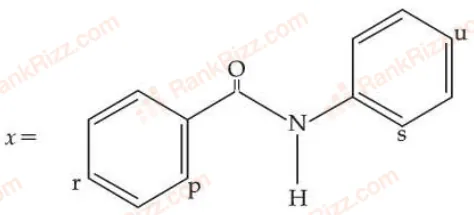
For the given molecule, "x", the preferred site for the attack of the electrophile is :
SOLUTION
In N-phenylbenzamide, the two benzene rings are connected through an amide linkage .
- The benzene ring attached directly to the carbonyl carbon is deactivated due to the strong electron-withdrawing and effects of the carbonyl group. Hence, this ring is less reactive towards electrophilic aromatic substitution.
- The benzene ring attached to the nitrogen atom receives electron density through resonance from the lone pair present on nitrogen. Although this lone pair is partially involved in resonance with the carbonyl group, the ring attached to nitrogen remains more electron-rich than the ring attached to the carbonyl carbon.
The group acts as an ortho/para-directing group. Therefore, electrophilic substitution occurs preferentially at the ortho and para positions of the ring attached to nitrogen.
Between the ortho and para positions:
- The ortho position ('s') experiences steric hindrance due to the bulky amide group.
- The para position ('u') is less sterically hindered and is therefore the preferred site for attack.
Hence, electrophilic substitution occurs predominantly at position 'u'.
Therefore, the correct option is (D).
Tagged Directive influence of substituents. Machine-assigned, so read it as a strong shortlist rather than a verdict.