JEE Main 2026 Chemistry question — Diazonium salts
Consider the three aromatic molecules (P, Q and R) whose structures have been given below :
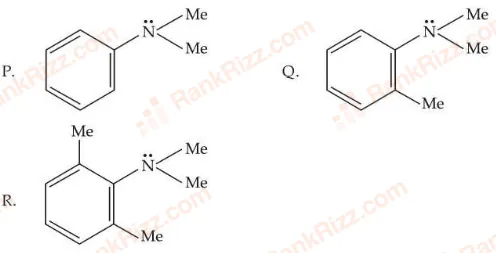
The correct order regarding the reactivity of these compounds with
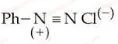
under optimum but slightly acidic medium is :
SOLUTION
The reaction described is an azo-coupling reaction (electrophilic aromatic substitution) with a benzenediazonium ion. For this reaction to occur efficiently, the benzene ring must be highly activated with high electron density, primarily provided by the strong mesomeric () donating effect of the nitrogen's lone pair.
- Compound P (N,N-dimethylaniline): There is no steric hindrance around the group. The lone pair on the nitrogen atom is fully coplanar with the benzene ring, allowing for maximum resonance ( effect). This strongly activates the ring, making it the most reactive.
- Compound Q (2-methyl-N,N-dimethylaniline): The single bulky methyl group at the ortho-position introduces steric crowding, pushing the group slightly out of the benzene ring's plane. This decreases the overlap of the nitrogen lone pair with the -system (partial SIR effect), lowering its reactivity compared to P.
- Compound R (2,6-dimethyl-N,N-dimethylaniline): With two bulky methyl groups flanking the group on both sides, the steric crowding is extreme. To minimize repulsion, the group rotates completely out of the plane of the benzene ring. Because it is perpendicular, resonance is entirely inhibited (Steric Inhibition of Resonance / SIR effect). The lone pair cannot activate the ring at all, making it the least reactive.
As the number of ortho-methyl groups increases, resonance decreases, dropping the electron density on the ring and reducing its reactivity toward electrophiles:
Therefore, the correct choice is [A] P > Q > R.
Tagged Diazonium salts. Machine-assigned, so read it as a strong shortlist rather than a verdict.