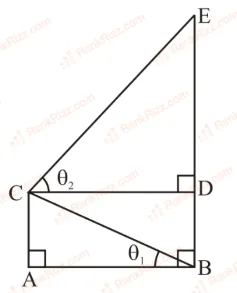
From the figure:
C D CD C D A B AB A B B E BE B E C D = A B CD = AB C D = A B In △ C A B \triangle CAB △ C A B A C = A B tan θ 1 AC = AB \tan \theta_1 A C = A B tan θ 1
Area ( △ C A B ) = 1 2 ⋅ A B ⋅ A C = 1 2 ( A B ) 2 tan θ 1 = 2 3 − 3 (\triangle CAB) = \frac{1}{2} \cdot AB \cdot AC = \frac{1}{2} (AB)^2 \tan \theta_1 = 2\sqrt{3} - 3 ( △ C A B ) = 2 1 ⋅ A B ⋅ A C = 2 1 ( A B ) 2 tan θ 1 = 2 3 − 3
In △ C E D \triangle CED △ C E D E D = C D tan θ 2 = A B tan θ 2 ED = CD \tan \theta_2 = AB \tan \theta_2 E D = C D tan θ 2 = A B tan θ 2
We are given θ 1 + θ 2 = π 2 \theta_1 + \theta_2 = \frac{\pi}{2} θ 1 + θ 2 = 2 π θ 2 = π 2 − θ 1 \theta_2 = \frac{\pi}{2} - \theta_1 θ 2 = 2 π − θ 1
Therefore, tan θ 2 = cot θ 1 \tan \theta_2 = \cot \theta_1 tan θ 2 = cot θ 1
You are given that 3 B E = 4 A B \sqrt{3}BE = 4AB 3 B E = 4 A B B E = 4 3 A B BE = \frac{4}{\sqrt{3}}AB B E = 3 4 A B
From the geometry, B E = B D + D E BE = BD + DE B E = B D + D E
Since B D = A C BD = AC B D = A C A C D B ACDB A C D B
B E = A B tan θ 1 + A B cot θ 1 BE = AB \tan \theta_1 + AB \cot \theta_1 B E = A B tan θ 1 + A B cot θ 1
4 3 A B = A B ( tan θ 1 + cot θ 1 ) \frac{4}{\sqrt{3}}AB = AB (\tan \theta_1 + \cot \theta_1) 3 4 A B = A B ( tan θ 1 + cot θ 1 )
4 3 = sin θ 1 cos θ 1 + cos θ 1 sin θ 1 = sin 2 θ 1 + cos 2 θ 1 sin θ 1 cos θ 1 = 1 sin θ 1 cos θ 1 \frac{4}{\sqrt{3}} = \frac{\sin \theta_1}{\cos \theta_1} + \frac{\cos \theta_1}{\sin \theta_1} = \frac{\sin^2 \theta_1 + \cos^2 \theta_1}{\sin \theta_1 \cos \theta_1} = \frac{1}{\sin \theta_1 \cos \theta_1} 3 4 = c o s θ 1 s i n θ 1 + s i n θ 1 c o s θ 1 = s i n θ 1 c o s θ 1 s i n 2 θ 1 + c o s 2 θ 1 = s i n θ 1 c o s θ 1 1
sin ( 2 θ 1 ) = 2 sin θ 1 cos θ 1 = 2 ( 3 4 ) = 3 2 \sin(2\theta_1) = 2 \sin \theta_1 \cos \theta_1 = 2 \left( \frac{\sqrt{3}}{4} \right) = \frac{\sqrt{3}}{2} sin ( 2 θ 1 ) = 2 sin θ 1 cos θ 1 = 2 ( 4 3 ) = 2 3
This gives two possible values for 2 θ 1 2\theta_1 2 θ 1 60 ∘ 60^\circ 6 0 ∘ 120 ∘ 120^\circ 12 0 ∘
If 2 θ 1 = 60 ∘ ⟹ θ 1 = 30 ∘ 2\theta_1 = 60^\circ \implies \theta_1 = 30^\circ 2 θ 1 = 6 0 ∘ ⟹ θ 1 = 3 0 ∘ θ 2 = 60 ∘ \theta_2 = 60^\circ θ 2 = 6 0 ∘
If 2 θ 1 = 120 ∘ ⟹ θ 1 = 60 ∘ 2\theta_1 = 120^\circ \implies \theta_1 = 60^\circ 2 θ 1 = 12 0 ∘ ⟹ θ 1 = 6 0 ∘ θ 2 = 30 ∘ \theta_2 = 30^\circ θ 2 = 3 0 ∘
The problem states θ 2 θ 1 \frac{\theta_2}{\theta_1} θ 1 θ 2 largest , so we choose θ 1 = 30 ∘ \theta_1 = 30^\circ θ 1 = 3 0 ∘ θ 2 = 60 ∘ \theta_2 = 60^\circ θ 2 = 6 0 ∘
Using the area of △ C A B \triangle CAB △ C A B
1 2 ( A B ) 2 tan 30 ∘ = 2 3 − 3 \frac{1}{2} (AB)^2 \tan 30^\circ = 2\sqrt{3} - 3 2 1 ( A B ) 2 tan 3 0 ∘ = 2 3 − 3
1 2 ( A B ) 2 ( 1 3 ) = 2 3 − 3 \frac{1}{2} (AB)^2 \left( \frac{1}{\sqrt{3}} \right) = 2\sqrt{3} - 3 2 1 ( A B ) 2 ( 3 1 ) = 2 3 − 3
( A B ) 2 = 2 3 ( 2 3 − 3 ) = 4 ( 3 ) − 6 3 = 12 − 6 3 (AB)^2 = 2\sqrt{3}(2\sqrt{3} - 3) = 4(3) - 6\sqrt{3} = 12 - 6\sqrt{3} ( A B ) 2 = 2 3 ( 2 3 − 3 ) = 4 ( 3 ) − 6 3 = 12 − 6 3
Using the identity 12 − 6 3 = ( 3 − 3 ) 2 12 - 6\sqrt{3} = (3 - \sqrt{3})^2 12 − 6 3 = ( 3 − 3 ) 2
A B = 3 − 3 AB = 3 - \sqrt{3} A B = 3 − 3
In △ C E D \triangle CED △ C E D 30 ∘ − 60 ∘ − 90 ∘ 30^\circ-60^\circ-90^\circ 3 0 ∘ − 6 0 ∘ − 9 0 ∘ θ 2 = 60 ∘ \theta_2 = 60^\circ θ 2 = 6 0 ∘
C D = A B = 3 − 3 CD = AB = 3 - \sqrt{3} C D = A B = 3 − 3 E D = C D tan 60 ∘ = ( 3 − 3 ) 3 = 3 3 − 3 ED = CD \tan 60^\circ = (3 - \sqrt{3})\sqrt{3} = 3\sqrt{3} - 3 E D = C D tan 6 0 ∘ = ( 3 − 3 ) 3 = 3 3 − 3 C E = C D cos 60 ∘ = 2 ( 3 − 3 ) = 6 − 2 3 CE = \frac{CD}{\cos 60^\circ} = 2(3 - \sqrt{3}) = 6 - 2\sqrt{3} C E = c o s 6 0 ∘ C D = 2 ( 3 − 3 ) = 6 − 2 3
Perimeter = C D + E D + C E = CD + ED + CE = C D + E D + C E
( 3 − 3 ) + ( 3 3 − 3 ) + ( 6 − 2 3 ) (3 - \sqrt{3}) + (3\sqrt{3} - 3) + (6 - 2\sqrt{3}) ( 3 − 3 ) + ( 3 3 − 3 ) + ( 6 − 2 3 )
3 − 3 + 6 − 3 + 3 3 − 2 3 3 - 3 + 6 - \sqrt{3} + 3\sqrt{3} - 2\sqrt{3} 3 − 3 + 6 − 3 + 3 3 − 2 3
6 + 0 3 = 6 6 + 0\sqrt{3} = 6 6 + 0 3 = 6
Final Answer: 6