Q31Real gases, compressibility factor and van der Waals equationTRANSCRIBED
The unit of the van der Waals gas equation parameter 'a' in is:
- A
dm mol
- B
kg ms
- C
atm dm mol
- D
kg ms
The 30 Chemistry questions of JEE Main 27 Aug 2021, Shift 1, numbered across the whole paper. Pick an answer on any question to check it against the key. Free to read, nothing to download.
The unit of the van der Waals gas equation parameter 'a' in is:
dm mol
kg ms
atm dm mol
kg ms
In polythionic acid, HSO ( = 3 to 5) the oxidation state(s) of sulphur is/are:
+6 only
+5 only
0 and +5 only
+3 and +5 only
Deuterium resembles hydrogen in properties but:
reacts vigorously than hydrogen
reacts just as hydrogen
emits particles
reacts slower than hydrogen
The number of water molecules in gypsum, dead burnt plaster and plaster of Paris, respectively are:
2, 0 and 0.5
0.5, 0 and 2
2, 0 and 1
5, 0 and 0.5
In which one of the following molecules strongest back donation of an electron pair from halide to boron is expected?
BI
BBr
BCl
BF
The gas 'A' is having very low reactivity reaches to stratosphere. It is non-toxic and non-flammable but dissociated by UV-radiations in stratosphere. The intermediates formed initially from the gas 'A' are:
Match List - I with List - II:
List-I (Property) List-II (Example)
(a) Diamagnetism (i) MnO
(b) Ferrimagnetism (ii) O
(c) Paramagnetism (iii) NaCl
(d) Antiferromagnetism (iv) FeO
Choose the most appropriate answer from the options given below:
(a) - (iv), (b) - (ii), (c) - (i), (d) - (iii)
(a) - (ii), (b) - (i), (c) - (iii), (d) - (iv)
(a) - (i), (b) - (iii), (c) - (iv), (d) - (ii)
(a) - (iii), (b) - (iv), (c) - (ii), (d) - (i)
Tyndall effect is more effectively shown by:
lyophilic colloid
suspension
lyophobic colloid
true solution
Which refining process is generally used in the purification of low melting metals?
Chromatographic method
Electrolysis
Zone refining
Liquation
Match List - I with List - II:
List-I (Species) List-II (Number of lone pairs of electrons on the central atom)
(a) XeF (i) 0
(b) XeOF (ii) 1
(c) XeOF (iii) 2
(d) XeF (iv) 3
Choose the most appropriate answer from the options given below:
(a) - (iii), (b) - (iv), (c) - (ii), (d) - (i)
(a) - (iv), (b) - (i), (c) - (ii), (d) - (iii)
(a) - (iii), (b) - (ii), (c) - (iv), (d) - (i)
(a) - (iv), (b) - (ii), (c) - (i), (d) - (iii)
The nature of oxides VO and CrO is indexed as 'X' and 'Y' type respectively. The correct set of X and Y is:
X = acidic, Y = acidic
X = basic, Y = amphoteric
X = basic, Y = basic
X = amphoteric, Y = basic
Acidic ferric chloride solution on treatment with excess of potassium ferrocyanide gives a Prussian blue coloured colloidal species. It is:
HFe[Fe(CN)]
KFe[Fe(CN)]
Fe[Fe(CN)]
KFe[Fe(CN)]
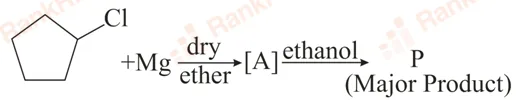
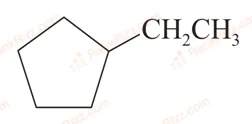
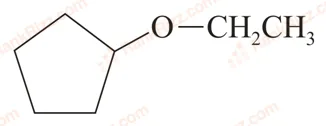
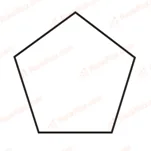
In the following sequence of reactions the P is:
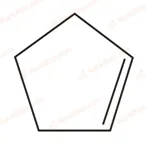
Given below are two statements : one is labelled as Assertion (A) and the other is labelled as Reason (R).
Assertion (A) : Synthesis of ethyl phenyl ether may be achieved by Williamson synthesis.
Reason (R): Reaction of bromobenzene with sodium ethoxide yields ethyl phenyl ether.
In the light of the above statements, choose the most appropriate answer from the options given below.
Both (A) and (R) are correct but (R) is NOT the correct explanation of (A)
(A) is correct but (R) is not correct
(A) is not correct but (R) is correct
Both (A) and (R) are correct and (R) is the correct explanation of (A)
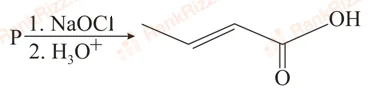
The structure of the starting compound P used in the reaction given below is:
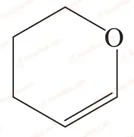
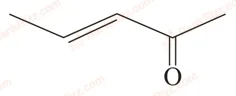
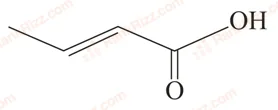
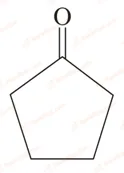
The major product of the following reaction is:
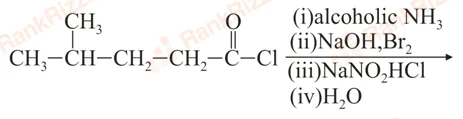
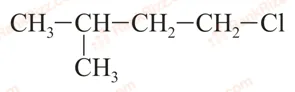
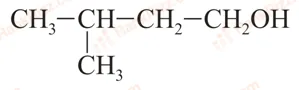
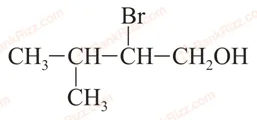
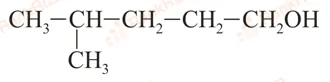
In the following sequence of reactions, the final product D is:

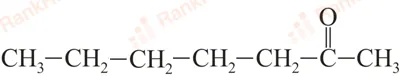


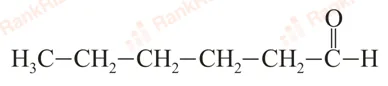
Which of the following is not a correct statement for primary aliphatic amines?
Primary amines can be prepared by the Gabriel phthalimide synthesis.
Primary amines are less basic than the secondary amines.
The intermolecular association in primary amines is less than the intermolecular association in secondary amines.
Primary amines on treating with nitrous acid solution form corresponding alcohols except methyl amine.
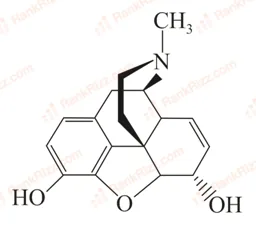
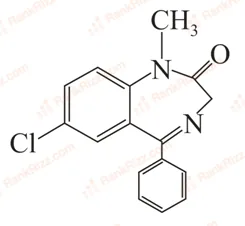
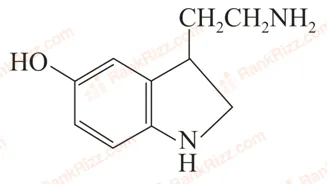
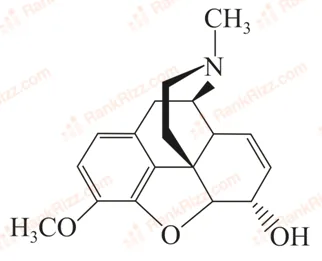
(B) and (C) are tranquillizers
(B), (C) and (D) are tranquillizers
(A) and (D) are tranquillizers
(A), (B) and (C) are narcotic analgesics
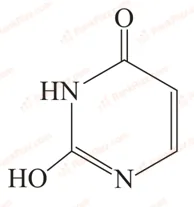
Out of following isomeric forms of uracil, which one is present in RNA?
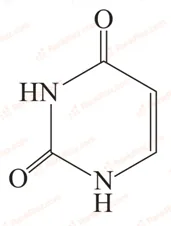
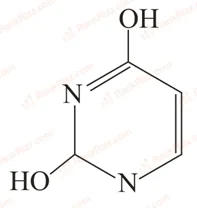
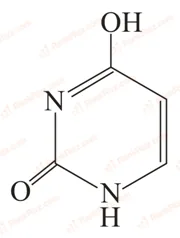
The reaction that occurs in a breath analyser, a device used to determine the alcohol level in a person's blood stream is
If the rate of appearance of is 2.67 mol min at a particular time, the rate of disappearance of at the same time is _________ mol min. (Nearest integer)
1 kg of 0.75 molal aqueous solution of sucrose can be cooled up to C before freezing. The amount of ice (in g) that will be separated out is _________. (Nearest integer) [Given : K kg mol]
The number of electrons in the ground state electronic configuration of Np (Z = 93) is _________. (Integer answer)
The number of moles of NH, that must be added to 2 L of 0.80 M AgNO in order to reduce the concentration of Ag ions to M ( for ) is _________. (Nearest integer)
[Assume no volume change on adding NH]
When 10 mL of an aqueous solution of KMnO was titrated in acidic medium, equal volume of 0.1M of an aqueous solution of ferrous sulphate was required for complete discharge of colour. The strength of KMnO in grams per litre is _________ . (Nearest integer) [Atomic mass of K = 39, Mn = 55, O = 16]
The number of moles of CuO, that will be utilized in Dumas method for estimating nitrogen in a sample of 57.5 g of N, N-dimethylaminopentane is _________ . (Nearest integer)
200 mL of 0.2 M HCl is mixed with 300 mL of 0.1 M NaOH. The molar heat of neutralization of this reaction is -57.1 kJ. The increase in temperature in °C of the system on mixing is . The value of x is _________. (Nearest integer)
[Given: Specific heat of water = 4.18 J g K
Density of water = 1.00 g cm]
(Assume no volume change on mixing)
The kinetic energy of an electron in the second Bohr orbit of a hydrogen atom is equal to . The value of 10x is _________. ( is radius of Bohr's orbit)
(Nearest integer)
[Given: ]
In Carius method for estimation of halogens, 0.2 g of an organic compound gave 0.188 g of AgBr. The percentage of bromine in the compound is _________. (Nearest integer)
[Atomic mass: Ag = 108, Br = 80]
1 mol of an octahedral metal complex with formula MCl . 2L on reaction with excess of AgNO gives 1 mol of AgCl. The denticity of Ligand L is _________. (Integer answer)