JEE Main 2021 Chemistry question — Reactions and tests of amines
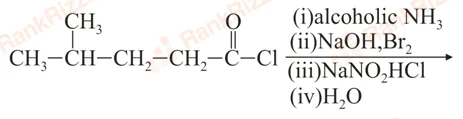
The major product of the following reaction is:
SOLUTION
The reaction sequence can be understood by following the transformation of the functional group at each stage.
In the first step, 4-methylpentanoyl chloride reacts with alcoholic ammonia.
This is a nucleophilic acyl substitution reaction in which ammonia attacks the carbonyl carbon and replaces the chloride ion, producing the corresponding primary amide.
Thus, the first intermediate formed is
which is 4-methylpentanamide.
In the second step, the amide is treated with
These reagents carry out the Hoffmann bromamide degradation, converting a primary amide into a primary amine containing one carbon atom less than the original amide.
The carbonyl carbon is eliminated during the reaction.
Hence, the second intermediate is
which is 3-methylbutan-1-amine.
In the third step, the primary aliphatic amine is treated with
which generates nitrous acid in situ.
The amine undergoes diazotization to form an unstable aliphatic diazonium salt. This intermediate immediately loses nitrogen gas to produce a carbocation.
In the presence of water, the carbocation is attacked by a water molecule, resulting in hydrolysis to the corresponding alcohol.
Therefore, the final product obtained is
which is 3-methylbutan-1-ol.
Hence, the correct answer is
Tagged Reactions and tests of amines. Machine-assigned, so read it as a strong shortlist rather than a verdict.