RankRizz

JEE Main 26 Aug 2021, Shift 2: Maths

The 30 Maths questions of JEE Main 26 Aug 2021, Shift 2, numbered across the whole paper. Pick an answer on any question to check it against the key. Free to read, nothing to download.

Maths

Q61De Moivre's theorem and powers of complex numbersTRANSCRIBED

If (3+i)100=299(p+iq)(\sqrt{3} + i)^{100} = 2^{99}(p + iq), then pp and qq are roots of the equation:

  1. A

    x2−(3+1)x+3=0x^2 - (\sqrt{3} + 1)x + \sqrt{3} = 0

  2. B

    x2+(3+1)x+3=0x^2 + (\sqrt{3} + 1)x + \sqrt{3} = 0

  3. C

    x2+(3−1)x−3=0x^2 + (\sqrt{3} - 1)x - \sqrt{3} = 0

  4. D

    x2−(3−1)x−3=0x^2 - (\sqrt{3} - 1)x - \sqrt{3} = 0

Q62Heights and distancesTRANSCRIBED

A 10 inches long pencil ABAB with mid point CC and a small eraser PP are placed on the horizontal top of a table such that PC=5PC = \sqrt{5} inches and ∠PCB=tan⁡−1(2)\angle PCB = \tan^{-1}(2). The acute angle through which the pencil must be rotated about CC so that the perpendicular distance between eraser and pencil becomes exactly 1 inch is:
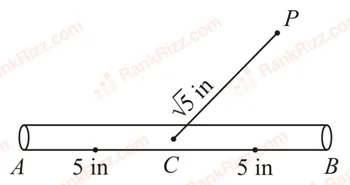
Figure for JEE Main 2021 Mathematics question on Heights and distances
  1. A

    tan⁡−1(34)\tan^{-1}\left(\frac{3}{4}\right)

  2. B

    tan⁡−1(12)\tan^{-1}\left(\frac{1}{2}\right)

  3. C

    tan⁡−1(43)\tan^{-1}\left(\frac{4}{3}\right)

  4. D

    tan⁡−1(1)\tan^{-1}(1)

Q63Trigonometric series and productsTRANSCRIBED

The value of 2sin⁡(π8)sin⁡(2π8)sin⁡(3π8)sin⁡(5π8)sin⁡(6π8)sin⁡(7π8)2\sin\left(\frac{\pi}{8}\right)\sin\left(\frac{2\pi}{8}\right)\sin\left(\frac{3\pi}{8}\right)\sin\left(\frac{5\pi}{8}\right)\sin\left(\frac{6\pi}{8}\right)\sin\left(\frac{7\pi}{8}\right)$ is:

  1. A

    142\frac{1}{4\sqrt{2}}

  2. B

    18\frac{1}{8}

  3. C

    182\frac{1}{8\sqrt{2}}

  4. D

    14\frac{1}{4}

Q64Chord with given midpoint and locus of midpointsTRANSCRIBED

A circle CC touches the line x=2yx = 2y at the point (2,1)(2, 1) and intersects the circle C1:x2+y2+2y−5=0C_1 : x^2 + y^2 + 2y - 5 = 0 at two points PP and QQ such that PQPQ is a diameter of C1C_1. Then the diameter of CC is:

  1. A

    4154\sqrt{15}

  2. B

    285\sqrt{285}

  3. C

    15

  4. D

    757\sqrt{5}

Q65Normals to a hyperbolaTRANSCRIBED

The point P(−26,3)P\left(-2\sqrt{6}, \sqrt{3}\right) lies on the hyperbola x2a2−y2b2=1\frac{x^2}{a^2} - \frac{y^2}{b^2} = 1 having eccentricity 52\frac{\sqrt{5}}{2}. If the tangent and normal at PP to the hyperbola intersect its conjugate axis at the points QQ and RR respectively, then QRQR is equal to:

  1. A

    434\sqrt{3}

  2. B

    6

  3. C

    363\sqrt{6}

  4. D

    636\sqrt{3}

Q66Locus problems in coordinate geometryTRANSCRIBED

The locus of the mid points of the chords of the hyperbola x2−y2=4x^2 - y^2 = 4, which touch the parabola y2=8xy^2 = 8x, is:

  1. A

    y2(x−2)=x3y^2(x - 2) = x^3

  2. B

    x3(x−2)=y2x^3(x - 2) = y^2

  3. C

    x2(x−2)=y3x^2(x - 2) = y^3

  4. D

    y3(x−2)=x2y^3(x - 2) = x^2

Q67Definite integral as limit of a sumTRANSCRIBED

lim⁡x→2(∑n=19xn(n+1)x2+2(2n+1)x+4)\lim_{x \to 2}\left(\sum_{n=1}^{9} \frac{x}{n(n+1)x^2 + 2(2n+1)x + 4}\right) is equal to:

  1. A

    524\frac{5}{24}

  2. B

    736\frac{7}{36}

  3. C

    15\frac{1}{5}

  4. D

    944\frac{9}{44}

Q68Logical connectives, truth tables and tautologiesTRANSCRIBED

Consider the two statements:
(S1):(p→q)∨(∼q→p)(S_1) : (p \rightarrow q) \vee (\sim q \rightarrow p) is a tautology.
(S2):(p∧∼q)∧(∼p∨q)(S_2) : (p \wedge \sim q) \wedge (\sim p \vee q) is a fallacy.
Then:

  1. A

    only (S1)(S_1) is true.

  2. B

    both (S1)(S_1) and (S2)(S_2) are false.

  3. C

    only (S2)(S_2) is true.

  4. D

    both (S1)(S_1) and (S2)(S_2) are true.

Q69Matrix multiplication, powers and matrix equationsTRANSCRIBED

Let A=[100011100]A = \begin{bmatrix} 1 & 0 & 0 \\ 0 & 1 & 1 \\ 1 & 0 & 0 \end{bmatrix}. Then A2025−A2020A^{2025} - A^{2020} is equal to:

  1. A

    A6−AA^6 - A

  2. B

    A6A^6

  3. C

    A5A^5

  4. D

    A5−AA^5 - A

Q70Classical probability and sample spacesTRANSCRIBED

Two fair dice are thrown. The numbers on them are taken as λ\lambda and μ\mu, and a system of linear equations
x+y+z=5x + y + z = 5
x+2y+3z=μx + 2y + 3z = \mu
x+3y+λz=1x + 3y + \lambda z = 1
is constructed. If pp is the probability that the system has a unique solution and qq is the probability that the system has no solution, then:

  1. A

    p=16p = \frac{1}{6} and q=536q = \frac{5}{36}

  2. B

    p=56p = \frac{5}{6} and q=136q = \frac{1}{36}

  3. C

    p=16p = \frac{1}{6} and q=136q = \frac{1}{36}

  4. D

    p=56p = \frac{5}{6} and q=536q = \frac{5}{36}

Q71Series of inverse trigonometric functionsTRANSCRIBED

If ∑r=150tan⁡−112r2=p\sum_{r=1}^{50} \tan^{-1} \frac{1}{2r^2} = p, then the value of tan⁡p\tan p is:

  1. A

    100

  2. B

    5150\frac{51}{50}

  3. C

    5051\frac{50}{51}

  4. D

    101102\frac{101}{102}

Q72Domain, range and principal valuesTRANSCRIBED

The domain of the function cosec⁡−1(1+xx)\operatorname{cosec}^{-1}\left(\frac{1+x}{x}\right) is:

  1. A

    [−12,∞)−{0}\left[-\frac{1}{2}, \infty\right) - \{0\}

  2. B

    (−1,−12]∪(0,∞)\left(-1, -\frac{1}{2}\right] \cup (0, \infty)

  3. C

    [−12,0)∪[1,∞)\left[-\frac{1}{2}, 0\right) \cup [1, \infty)

  4. D

    (−12,∞)−{0}\left(-\frac{1}{2}, \infty\right) - \{0\}

Q73Differentiability at a pointTRANSCRIBED

Let [t][t] denote the greatest integer less than or equal to tt. Let f(x)=x−[x]f(x) = x - [x], g(x)=1−x+[x]g(x) = 1 - x + [x], and h(x)=min⁡{f(x),g(x)}h(x) = \min\{f(x), g(x)\}, x∈[−2,2]x \in [-2, 2]. Then hh is:

  1. A

    continuous in [−2,2][-2, 2] but not differentiable at more than four points in (−2,2)(-2, 2)

  2. B

    Continuous in [−2,2][-2, 2] but not differentiable at exactly three points in (−2,2)(-2, 2)

  3. C

    not continuous at exactly four points in [−2,2][-2, 2]

  4. D

    not continuous at exactly three points in [−2,2][-2, 2]

Q74Local maxima and minima and concavityTRANSCRIBED

The local maximum value of the function, f(x)=(2x)x2f(x) = \left(\frac{2}{x}\right)^{x^2}, x>0x \gt 0, is:

  1. A

    1

  2. B

    (4e)e4\left(\frac{4}{\sqrt{e}}\right)^{\frac{e}{4}}

  3. C

    (e)2e(e)^{\frac{2}{e}}

  4. D

    (2e)1e(2\sqrt{e})^{\frac{1}{e}}

Q75Definite integrals: properties and King's ruleTRANSCRIBED

The value of ∫−π2π2(1+sin⁡2x1+πsin⁡x)dx\int_{-\frac{\pi}{2}}^{\frac{\pi}{2}} \left(\frac{1 + \sin^2 x}{1 + \pi^{\sin x}}\right) dx is:

  1. A

    π2\frac{\pi}{2}

  2. B

    5π2\frac{5\pi}{2}

  3. C

    3π2\frac{3\pi}{2}

  4. D

    3π4\frac{3\pi}{4}

Q76Definite integrals: properties and King's ruleTRANSCRIBED

If the value of the integral ∫05x+[x]ex−[x]dx=αe−1+β\int_0^5 \frac{x + [x]}{e^{x-[x]}} dx = \alpha e^{-1} + \beta, where α,β∈R\alpha, \beta \in R, 5α+6β=05\alpha + 6\beta = 0, and [x][x] denotes the greatest integer less than or equal to xx; then the value of (α+β)2(\alpha + \beta)^2 is equal to:

  1. A

    25

  2. B

    100

  3. C

    36

  4. D

    16

Q77Variable separable equationsTRANSCRIBED

Let y(x)y(x) be the solution of the differential equation 2x2dy+(ey−2x)dx=02x^2 dy + (e^y - 2x)dx = 0, x>0x > 0. If y(e)=1y(e) = 1, then y(1)y(1) is equal to:

  1. A

    log⁡e(2e)\log_e(2e)

  2. B

    log⁡e2\log_e 2

  3. C

    2

  4. D

    0

Q78Scalar (dot) productTRANSCRIBED

A hall has a square floor of dimension 10 m ×\times 10 m (see the figure) and vertical walls. If the angle GPH between the diagonals AG and BH is cos⁡−115\cos^{-1}\frac{1}{5}, then the height of the hall (in meters) is:
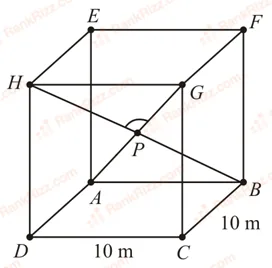
Figure for JEE Main 2021 Mathematics question on Scalar (dot) product
  1. A

    525\sqrt{2}

  2. B

    535\sqrt{3}

  3. C

    5105\sqrt{10}

  4. D

    5

Q79Distance, foot and image with respect to a planeTRANSCRIBED

Let PP be the plane passing through the point (1,2,3)(1, 2, 3) and the line of intersection of the planes r⃗⋅(i^+j^+4k^)=16\vec{r} \cdot (\hat{i} + \hat{j} + 4\hat{k}) = 16 and r⃗⋅(−i^+j^+k^)=6\vec{r} \cdot (-\hat{i} + \hat{j} + \hat{k}) = 6. Then which of the following points does NOT lie on PP?

  1. A

    (4,2,2)(4, 2, 2)

  2. B

    (6,−6,2)(6, -6, 2)

  3. C

    (−8,8,6)(-8, 8, 6)

  4. D

    (3,3,2)(3, 3, 2)

Q80Conditional probability and multiplication theoremTRANSCRIBED

A fair die is tossed until six is obtained on it. Let XX be the number of required tosses, then the conditional probability P(X≥5∣X>2)P(X \geq 5 \mid X \gt 2) is:

  1. A

    2536\frac{25}{36}

  2. B

    56\frac{5}{6}

  3. C

    1136\frac{11}{36}

  4. D

    125216\frac{125}{216}

Q81Common roots of equationsTRANSCRIBED

Let λ≠0\lambda \neq 0 be in RR. If α\alpha and β\beta are the roots of the equation x2−x+2λ=0x^2 - x + 2\lambda = 0, and α\alpha and γ\gamma are the roots of the equation 3x2−10x+27λ=03x^2 - 10x + 27\lambda = 0, then βγλ\frac{\beta\gamma}{\lambda} is equal to _________

Q82De Moivre's theorem and powers of complex numbersTRANSCRIBED

The least positive integer nn such that (2i)n(1−i)n−2\frac{(2i)^n}{(1-i)^{n-2}}, i=−1i = \sqrt{-1}, is a positive integer, is _________

Q83Arithmetic progressionTRANSCRIBED

The sum of all 3-digit numbers less than or equal to 500, that are formed without using the digit 1 and they all are multiple of 11, is _________

Q84Geometric progression and infinite GPTRANSCRIBED

Let a1,a2,…,a10a_1, a_2, \ldots, a_{10} be an A.P. with common difference −3-3 and b1,b2,…,b10b_1, b_2, \ldots, b_{10} be a G.P. with common ratio 2. Let ck=ak+bkc_k = a_k + b_k, k=1,2,…,10k = 1, 2, \ldots, 10. If c2=12c_2 = 12 and c3=13c_3 = 13, then ∑k=110ck\sum_{k=1}^{10} c_k is equal to _________

Q85Sums of binomial coefficientsTRANSCRIBED

Let (nk)\binom{n}{k} denote nCk^nC_k and [nk]={(nk),if 0≤k≤n0,otherwise\left[\frac{n}{k}\right] = \begin{cases} \binom{n}{k}, & \text{if } 0 \leq k \leq n \\ 0, & \text{otherwise} \end{cases}. If Ak=∑i=09(9i)[(1212−k+i)]+∑i=08(8i)[(1313−k+i)]A_k = \sum_{i=0}^{9} \binom{9}{i} \left[\binom{12}{12-k+i}\right] + \sum_{i=0}^{8} \binom{8}{i} \left[\binom{13}{13-k+i}\right] and A4−A3=190pA_4 - A_3 = 190p, then pp is equal to _________

Q86Variance and standard deviationTRANSCRIBED

Let the mean and variance of four numbers 3, 7, xx and yy (x>yx > y) be 5 and 10 respectively. Then the mean of four numbers 3 + 2x, 7 + 2y, x+yx + y and x−yx - y is _________

Q87Properties of determinantsTRANSCRIBED

Let AA be a 3×33 \times 3 real matrix. If det⁡(2Adj(2Adj(Adj(2A))))=241\det(2\text{Adj}(2\text{Adj}(\text{Adj}(2A)))) = 2^{41}, then the value of det⁡(A2)\det(A^2) equals _________

Q88Area between curvesTRANSCRIBED

Let aa and bb respectively be the points of local maximum and local minimum of the function f(x)=2x3−3x2−12xf(x) = 2x^3 - 3x^2 - 12x. If AA is the total area of the region bounded by y=f(x)y = f(x), the xx-axis and the lines x=ax = a and x=bx = b, then 4A is equal to _________

Q89Scalar (dot) productTRANSCRIBED

If the projection of the vector i^+2j^+k^\hat{i} + 2\hat{j} + \hat{k} on the sum of the two vectors 2i^+4j^−5k^2\hat{i} + 4\hat{j} - 5\hat{k} and −λi^+2j^+3k^-\lambda\hat{i} + 2\hat{j} + 3\hat{k} is 1, then λ\lambda is equal to _________

Q90Line and plane: intersection, coplanarity and projectionTRANSCRIBED

Let QQ be the foot of the perpendicular from the point P(7,−2,13)P(7, -2, 13) on the plane containing the lines x+16=y−17=z−38\frac{x+1}{6} = \frac{y-1}{7} = \frac{z-3}{8} and x−13=y−25=z−37\frac{x-1}{3} = \frac{y-2}{5} = \frac{z-3}{7}. Then (PQ)2(PQ)^2 is equal to _________