Q31Bohr model of hydrogen-like speciesTRANSCRIBED
Given below are two statements:
Statement I : According to Bohr's model of an atom, qualitatively the magnitude of velocity of electron increases with decrease in positive charges on the nucleus as there is no strong hold on the electron by the nucleus.
Statement II : According to Bohr's model of an atom, qualitatively the magnitude of velocity of electron increases with decrease in principle quantum number.
In the light of the above statements, choose the most appropriate answer from the options given below:
- A
Statement I is false but Statement II is true
- B
Statement I is true but Statement II is false
- C
Both Statement I and Statement II are false
- D
Both Statement I and Statement II are true
Q32pH of acids, bases and their mixturesTRANSCRIBED
Given below are two statements:
Statement I : In the titration between strong acid and weak base methyl orange is suitable as an indicator.
Statement II : For titration of acetic acid with NaOH phenolphthalein is not a suitable indicator.
In the light of the above statements, choose the most appropriate answer from the options given below:
- A
Statement I is false but Statement II is true
- B
Both Statement I and Statement II are true
- C
Both Statement I and Statement II are false
- D
Statement I is true but Statement II is false
Q33Hardness of water and its removalTRANSCRIBED
Which one of the following methods is most suitable for preparing deionized water?
- A
- B
- C
- D
Q34Compounds of alkaline earth metalsTRANSCRIBED
What are the products formed in sequence when excess of CO2 is passed in slaked lime?
- A
- B
Ca(HCO3)2, CaCO3
- C
CaCO3, Ca(HCO3)2
- D
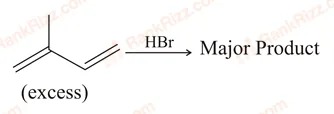
Q35Electrophilic substitution of anilineTRANSCRIBED
The major product formed in the following reaction is:
- A
- B
- C
- D
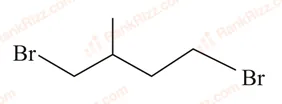
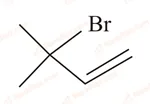
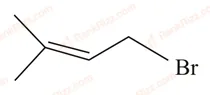
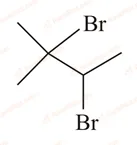
Q36Reactions of alkanesTRANSCRIBED
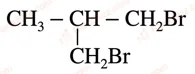
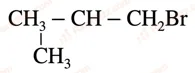
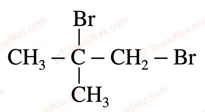
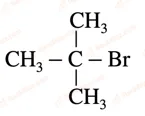
Excess of isobutane on reaction with Br2 in presence of light at 125°C gives which one of the following, as the major product?
- A
- B
- C
- D
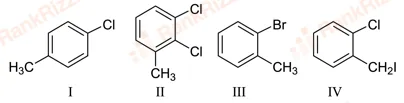
Q37HaloarenesTRANSCRIBED
Among the following compounds I - IV, which one forms a yellow precipitate on reacting sequentially with
(i) NaOH (ii) dil. HNO3 (iii) AgNO3
- A
- B
- C
- D
Q38Water pollutionTRANSCRIBED
The conversion of hydroxyapatite occurs due to presence of F− ions in water. The correct formula of hydroxyapatite is:
- A
[Ca3(PO4)2⋅CaF2]
- B
[3Ca3(PO4)2⋅Ca(OH)2]
- C
[3Ca3(PO4)2⋅CaF2]
- D
[3Ca(OH)2⋅CaF2]
Q39Defects in solidsTRANSCRIBED
Given below are two statements:
Statement I : Frenkel defects are vacancy as well as interstitial defects.
Statement II : Frenkel defect leads to colour in ionic solids due to presence of F-centres.
Choose the most appropriate answer for the statements from the options given below:
- A
Statement I is false but Statement II is true
- B
Both Statement I and Statement II are false
- C
Statement I is true but Statement II is false
- D
Both Statement I and Statement II are true
Q40Conductance, conductivity and molar conductivityTRANSCRIBED
Given below are two statements:
Statement I : The limiting molar conductivity of KCl (strong electrolyte) is higher compared to that of CH3COOH (weak electrolyte).
Statement II : Molar conductivity decreases with decrease in concentration of electrolyte.
In the light of the above statements, choose the most appropriate answer from the options given below:
- A
Statement I is false but Statement II is true
- B
Both Statement I and Statement II are true
- C
Statement I is true but Statement II is false
- D
Both Statement I and Statement II are false
Q41Classification, preparation and types of colloidsTRANSCRIBED
Which one of the following is correct for the adsorption of a gas at a given temperature on a solid surface?
- A
ΔH>0,ΔS>0
- B
ΔH<0,ΔS>0
- C
ΔH>0,ΔS<0
- D
ΔH<0,ΔS<0
Q42Thermodynamic principles and Ellingham diagramTRANSCRIBED
Given below are two statements.
Statement I: The choice of reducing agents for metals extraction can be made by using the Ellingham diagram, a plot of ΔG vs temperature.
Statement II: The value of ΔS increases from left to right in the Ellingham diagram.
In the light of the above statements, choose the most appropriate answer from the options given below:
- A
Statement I is false but Statement II is true
- B
Both Statement I and Statement II are true
- C
Statement I is true but Statement II is false
- D
Both Statement I and Statement II are false
Q43Group 17: halogens and hydrogen halidesTRANSCRIBED
The incorrect statement is:
- A
F2 is a stronger oxidizing agent than Cl2 in aqueous solution.
- B
On hydrolysis ClF forms HOCl and HF.
- C
Cl2 is more reactive than ClF.
- D
F2 is more reactive than ClF.
Q44General properties of transition elementsTRANSCRIBED
Which one of the following when dissolved in water gives coloured solution in nitrogen atmosphere?
- A
- B
- C
- D
Q45Detection of functional groupsTRANSCRIBED
Which one of the following complexes is violet in colour?
- A
Fe4[Fe(CN)6]3 ⋅ H2O
- B
[Fe(CN)5NOS]4−
- C
- D
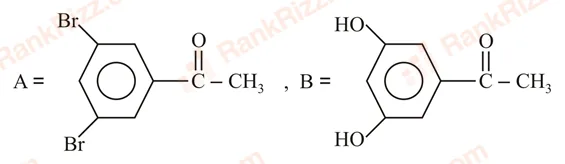
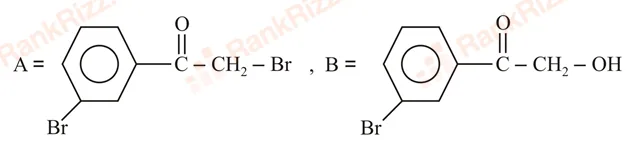
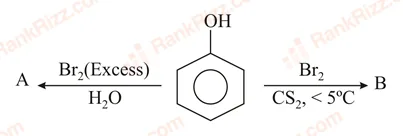
Q46Reactions of phenolsTRANSCRIBED
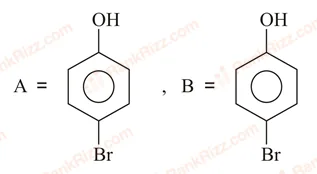
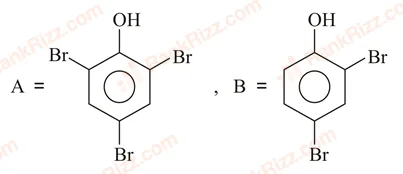
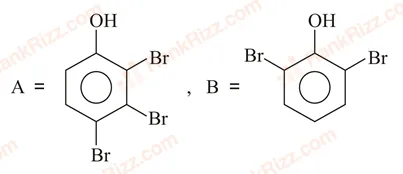
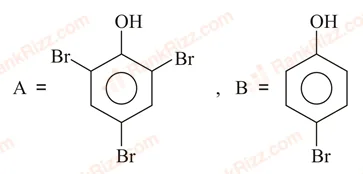
The correct options for the products A and B of the following reactions are:
- A
- B
- C
- D
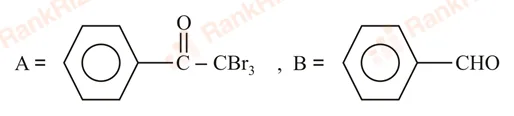
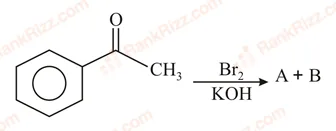
Q47Nucleophilic addition reactions of carbonyl compoundsTRANSCRIBED
The major products formed in the following reaction sequence A and B are:
- A
- B
- C
- D
Q48Reactions of alkanesTRANSCRIBED
The major product formed in the following reaction is:
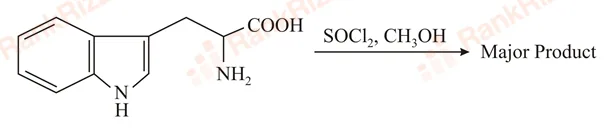
- A
- B
- C
- D
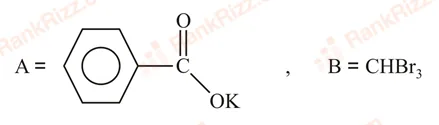
Q49Preparation of carboxylic acidsTRANSCRIBED
The correct sequential addition of reagents in the preparation of 3-nitrobenzoic acid from benzene is:
- A
Br2/AlBr3, HNO3/H2SO4, Mg/ether, CO2, H3O+
- B
Br2/AlBr3, NaCN, H3O+, HNO3/H2SO4
- C
Br2/AlBr3, HNO3/H2SO4, NaCN, H3O+
- D
HNO3/H2SO4, Br2/AlBr3, Mg/ether, CO2, H3O+
Q50Important polymers and their monomersTRANSCRIBED
The polymer formed on heating Novolac with formaldehyde is:
- A
- B
- C
- D
Q51Concentration terms and their interconversionTRANSCRIBED
An aqueous KCl solution of density 1.20 g mL−1 has a molality of 3.30 mol kg−1. The molarity of the solution in mol L−1 is _________ (The Nearest integer)
[Molar mass of KCl = 74.5 g]
Q52VSEPR theory and shapes of molecules and ionsTRANSCRIBED
AB3 is an interhalogen T-shaped molecule. The number of lone pairs of electrons on A is _________ (Integer answer)
Q53Enthalpies of reaction and Hess's lawTRANSCRIBED
The Born-Haber cycle for KCl is evaluated with the following data:
ΔfH⊖ for KCl = −436.7 kJ mol−1; ΔsubH⊖ for K = 89.2 kJ mol−1;
ΔionizationH⊖ for K = 419.0 kJ mol−1; ΔelectrongainH⊖ for Cl(g) = −348.6 kJ mol−1
ΔbondH⊖ for Cl2 = 243.0 kJ mol−1
The magnitude of lattice enthalpy of KCl in kJ mol−1 is _________ (Nearest integer)
Q54pH of acids, bases and their mixturesTRANSCRIBED
The OH− concentration in a mixture of 5.0 mL of 0.0504 M NH4Cl and 2 mL of 0.0210 M NH3 solution is x×10−6 M. The value of x is _________ (Nearest integer) [Given Kw=1×10⁻¹⁴ and Kb=1.8×10⁻⁵]
Q55Laboratory preparation of compoundsTRANSCRIBED
The ratio of number of water molecules in Mohr's salt and potash alum is _________ ×10−1. (Integer answer)
Q56Abnormal molar mass and van't Hoff factorTRANSCRIBED
Of the following four aqueous solutions, the total number of those solutions whose freezing point is lower than that of 0.10 M C2H5OH is _________ (Integer answer)
(i) 0.10 M Ba3(PO4)2
(ii) 0.10 M Na2SO4
(iii) 0.10 M KCl
(iv) 0.10 M Li3PO4
Q57Electrode potentials, electrochemical series and cell EMFTRANSCRIBED
These are physical properties of an element:
(A) Sublimation enthalpy
(B) Ionisation enthalpy
(C) Hydration enthalpy
(D) Electron gain enthalpy
The total number of above properties that affect the reduction potential is _________ (Integer answer)
Q58Methods to determine order of reactionTRANSCRIBED
The following data was obtained for chemical reaction given below at 975 K.
2NO(g)+2H2(g)→N2(g)+2H2O(g)
[NO] = 8 ×10⁻⁵, [H2] = 8 ×10⁻⁵, Rate = 7 ×10⁻⁹
[NO] = 24 ×10−5, [H2] = 8 ×10⁻⁵, Rate = 2.1 ×10⁻⁸
[NO] = 24 ×10−5, [H2] = 32 ×10−5, Rate = 8.4 ×10⁻⁸
The order of the reaction with respect to NO is _________ [Integer answer]
Q59Lanthanoids and lanthanoid contractionTRANSCRIBED
The number of 4f electrons in the ground state electronic configuration of Gd2+ is _________ [Atomic number of Gd = 64]
Q60Proteins and enzymesTRANSCRIBED
The total number of negative charge in the tetrapeptide, Gly-Glu-Asp-Tyr, at pH 12.5 will be _________ (Integer answer)