JEE MAIN 2021 · 26 AUG S1+4 / −1MEDIUMTRANSCRIBED
JEE Main 2021 Chemistry question — Nucleophilic addition reactions of carbonyl compounds
The major products formed in the following reaction sequence A and B are: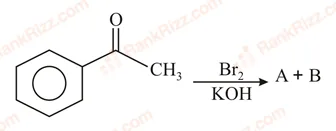
SOLUTION
Key idea: A methyl ketone with /KOH undergoes the haloform reaction.
- In base, the -H atoms of the group are replaced one by one by Br (each Br makes the next H more acidic):
- attacks the carbonyl carbon; is a good leaving group (stabilised by three Br):
- Proton transfer gives the salt and bromoform:
- A = potassium benzoate, B = (bromoform).
- No ring bromination occurs, because –COR deactivates the ring and there is no Lewis acid.
Answer: (A)
Tagged Nucleophilic addition reactions of carbonyl compounds. Machine-assigned, so read it as a strong shortlist rather than a verdict.