JEE Main 2021 Chemistry question — Electrophilic substitution of aniline
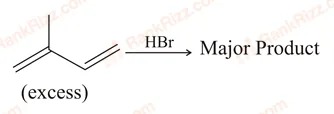
The major product formed in the following reaction is:
SOLUTION
To determine the major product of this reaction, we need to analyze the electrophilic addition of hydrogen bromide to the conjugated diene, isoprene.
The word "excess" under the diene indicates that the diene is present in large excess relative to . Therefore, only one equivalent of reacts with the diene, eliminating the possibility of double addition products. Hence, options A and D can be ruled out immediately.
The first step is protonation of the diene.
The proton adds to the terminal carbon of the methyl-substituted double bond because this generates the most stable intermediate, a tertiary allylic carbocation.
Adding the proton to the opposite end would produce only a secondary allylic carbocation, which is less stable.
The tertiary allylic carbocation formed is resonance stabilized. The positive charge is delocalized over two carbon atoms as shown below.
The bromide ion can now attack either of these positively charged centers.
Attack at the tertiary carbon gives the 1,2-addition product, 3-bromo-3-methylbut-1-ene. This product forms rapidly because the tertiary carbon bears a greater share of the positive charge. However, the resulting alkene is only monosubstituted and is therefore less stable.
Attack at the terminal carbon gives the 1,4-addition product, 1-bromo-3-methylbut-2-ene. Although this product forms more slowly, it contains a trisubstituted internal double bond, making it thermodynamically more stable.
Under normal or higher temperature conditions, electrophilic addition to conjugated dienes is thermodynamically controlled. Therefore, the more stable 1,4-addition product is formed in greater amount.
Hence, the major product is 1-bromo-3-methylbut-2-ene, corresponding to Option (C).
Tagged Electrophilic substitution of aniline. Machine-assigned, so read it as a strong shortlist rather than a verdict.