The strengths of 5.6 volume hydrogen peroxide (of density 1 g/mL) in terms of mass percentage and molarity(M) respectively, are: (Take molar mass of hydrogen peroxide as 34 g/mol)
- A
1.7 and 0.5
- B
0.85 and 0.25
- C
1.7 and 0.25
- D
0.85 and 0.5
The 25 Chemistry questions of JEE Main 03 Sep 2020, Shift 2, numbered across the whole paper. Pick an answer on any question to check it against the key. Free to read, nothing to download.
The strengths of 5.6 volume hydrogen peroxide (of density 1 g/mL) in terms of mass percentage and molarity(M) respectively, are: (Take molar mass of hydrogen peroxide as 34 g/mol)
1.7 and 0.5
0.85 and 0.25
1.7 and 0.25
0.85 and 0.5
Consider the hypothetical situation where the azimuthal quantum number, , takes values 0, 1, 2, ......... n + 1. Where n is the principal quantum number. Then, the element with atomic number:
9 is the first alkali metal
13 has a half-filled valence subshell
8 is the first noble gas
6 has a 2p-valence subshell
The five successive ionization enthalpies of an element are 800, 2427, 3658, 35024, 32824 kJ mol. The number of valence electrons in the element is:
5
4
3
2
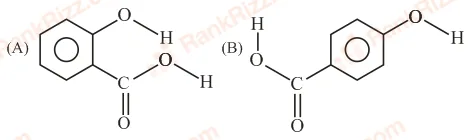
Consider the following molecules and statements related to them:
(a) (B) is more likely to be crystalline than (A)
(b) (B) has higher boiling point than (A)
(c) (B) dissolves more readily than (A) in water
Identify the correct option from below:
(a) and (b) are true
(a) and (c) are true
only (a) is true
(b) and (c) are true
A mixture of one mole each of , He and each are enclosed in a cylinder of volume V at temperature T. If the partial pressure of is 2 atm, the total pressure of the gases in the cylinder is:
6 atm
38 atm
14 atm
22 atm
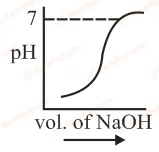
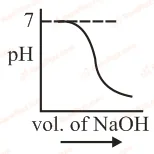
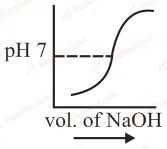
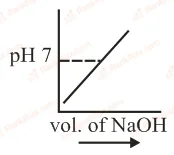
100 mL of 0.1 M HCl is taken in a beaker and to it 100 mL 0.1 M NaOH of is added in steps of 2 mL and the pH is continuously measured. Which of the following graphs correctly depicts the change in pH?


Among the statements (I - IV), the correct ones are:
(I) Be has smaller atomic radius compared to Mg.
(II) Be has higher ionization enthalpy than Al.
(III) Charge/radius ratio of Be is greater than that of Al.
(IV) Both Be and Al form mainly covalent compounds
(I), (II) and (IV)
(I), (III) and (IV)
(II), (III) and (IV)
(I), (II) and (III)
The incorrect statement(s) among (a) - (d) regarding acid rain is (are):
(a) It can corrode water pipes
(b) It can damage structures made up of stone.
(c) It cannot cause respiratory ailments in animals
(d) It is not harmful for trees
(a), (c) and (d)
(c) only
(a), (b) and (d)
(c) and (d)
For the reaction , which statement is correct?
The incorrect statement is:
Manganate and permanganate ions are tetrahedral
In manganate and permanganate ions, the -bonding takes place by overlap of p-orbitals of oxygen and d-orbitals of manganese
Manganate and permanganate ions are paramagnetic
Manganate ion is green in colour and permanganate ion is purple in colour
Complex A has a composition of . If the complex on treatment with conc. loses 13.5% of its original mass, the correct molecular formula of A is:
[Given: atomic mass of Cr = 52 amu and Cl = 35 amu]
The d-electron configuration of , and respectively are:
and
and
and
and
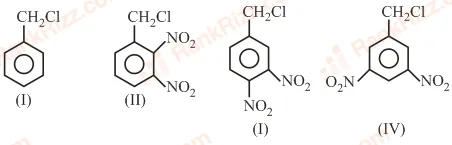
The decreasing order of reactivity of the following compounds towards nucleophilic substitution () is:

(II) > (III) > (I) > (IV)
(II) > (III) > (IV) > (I)
(III) > (II) > (IV) > (I)
(IV) > (II) > (III) > (I)
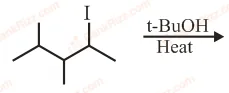
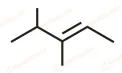
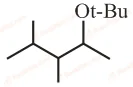
The major product in the following reaction is:


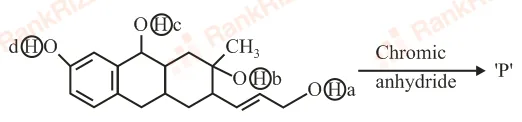
Consider the following reaction:
The product 'P' gives positive ceric ammonium nitrate test. This is because of the presence of which of these -OH group(s)?
(b) only
(c) and (d)
(d) only
(b) and (d)
The increasing order of the reactivity of the following compounds in nucleophile addition reaction is:
Propanal, Benzaldehyde, Propanone, Butanone
Benzaldehyde > Butanone < Propanone < Propanal
Butanone < Propanone < Benzaldehyde < Propanal
Propanal < Propanone < Butanone < Benzaldehyde
Benzaldehyde < Propanal < Propanone < Butanone
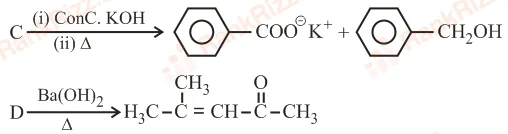
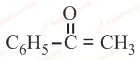
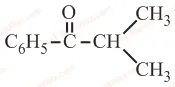
The compound A in the following reactions is:


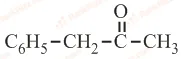
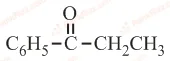
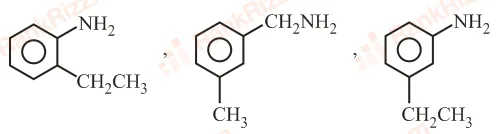
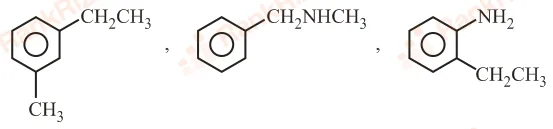
Three isomers A, B and C (mol. formula ) give the following results:
A and C P + Q R (product of A) + S (product of C)
R has lower boiling point than S
B alkali-insoluble product
A, B and C, respectively are:


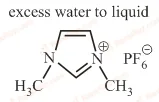
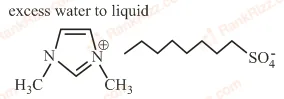
An ionic micelle is formed on the addition of:
liquid diethyl ether to aqueous NaCl solution


Sodium stearate to pure toluene
Match the following drugs with their therapeutic actions:
(i) Ranitidine (a) Antidepressant
(ii) Nardil (Phenelzine) (b) Antibiotic
(iii) Chloramphenicol (c) Antihistamine
(iv) Dimetane (Brompheniramine) (d) Antacid
(e) Analgesic
(i)-(a); (ii)-(c); (iii)-(b); (iv)-(e)
(i)-(d); (ii)-(a); (iii)-(b); (iv)-(c)
(i)-(e); (ii)-(a); (iii)-(c); (iv)-(d)
(i)-(d); (ii)-(c); (iii)-(a); (iv)-(e)
molecules are present in 10g of a substance 'x'. The molarity of a solution containing 5g of substance 'x' in 2 L solution is _________
If 250 cm of an aqueous solution containing 0.73g of a protein A is isotonic with one litre of another aqueous solution containing 1.65g of a protein B, at 298K, the ratio of the molecular masses of A and B is _________ (to the nearest integer).
An acidic solution of dichromate is electrolyzed for 8 minutes using 2 A current. As per the following equation
The amount of obtained was 0.104g. The efficiency of the process (in %) is (Take: F = 960000C, At. mass of chromium = 52)
The volume (in mL) of 0.1 N NaOH required to neutralise 10 mL of 0.1 N phosphinic acid is __________.
The number of

groups present in a tripeptide Asp - Glu - Lys is ____