JEE MAIN 2020 · 03 SEP S2+4 / −1MEDIUMTRANSCRIBED
JEE Main 2020 Chemistry question — Nucleophilic substitution (SN1 and SN2)
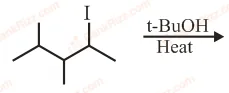
The major product in the following reaction is:
SOLUTION
Key idea: t-BuOH is a weak, bulky nucleophile and a polar protic solvent; with heat a secondary iodide reacts by E1, so the carbocation can rearrange before elimination.
- Substrate: 2-iodo-3,4-dimethylpentane, .
- Ionisation gives a 2° carbocation at C2.
- 1,2-hydride shift from C3 gives a more stable 3° carbocation at C3:
- Loss of a proton from C4 (tertiary H) gives the most substituted (tetrasubstituted) alkene – Zaitsev product:
- Product: 2,3-dimethylpent-2-ene. Option (D), the t-butyl ether, is not formed because t-BuOH is too hindered to act as a nucleophile, and (A)/(B) are less substituted alkenes.
Answer: (C)
Tagged Nucleophilic substitution (SN1 and SN2). Machine-assigned, so read it as a strong shortlist rather than a verdict.