Q18Molecular orbital theory of diatomic speciesTRANSCRIBED
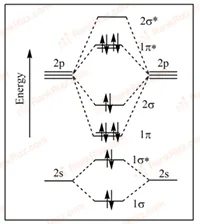
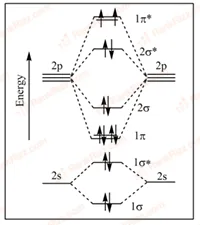
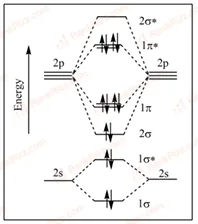
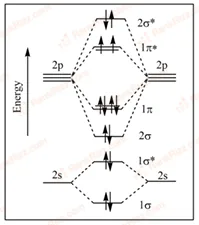
The correct molecular orbital diagram for F molecule in the ground state is
- A
- B
- C
- D
The 17 Chemistry questions of JEE Advanced 2023 Paper 2, numbered across the whole paper. Pick an answer on any question to check it against the key. Free to read, nothing to download.
The correct molecular orbital diagram for F molecule in the ground state is
Consider the following statements related to colloids.
(I) Lyophobic colloids are not formed by simple mixing of dispersed phase and dispersion medium.
(II) For emulsions, both the dispersed phase and the dispersion medium are liquid.
(III) Micelles are produced by dissolving a surfactant in any solvent at any temperature.
(IV) Tyndall effect can be observed from a colloidal solution with dispersed phase having the same refractive index as that of the dispersion medium.
The option with the correct set of statements is
(I) and (II)
(II) and (III)
(III) and (IV)
(II) and (IV)
In the following reactions, P, Q, R, and S are the major products.
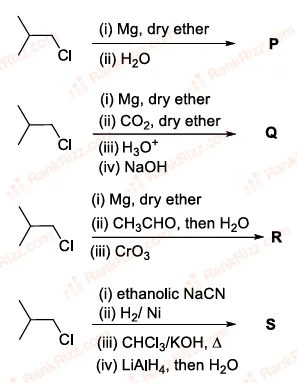
The correct statement about P, Q, R, and S is
P is a primary alcohol with four carbons.
Q undergoes Kolbe's electrolysis to give an eight-carbon product.
R has six carbons and it undergoes Cannizzaro reaction.
S is a primary amine with six carbons.
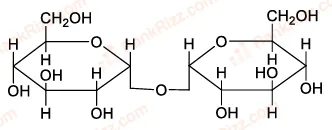
A disaccharide X cannot be oxidised by bromine water. The acid hydrolysis of X leads to a laevorotatory solution. The disaccharide X is
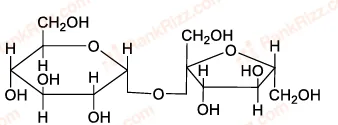
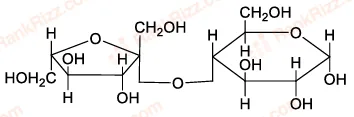
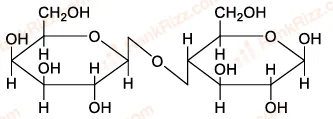
The complex(es), which can exhibit the type of isomerism shown by [Pt(NH)Br], is(are)
[en = HNCHCHNH]
[Pt(en)(SCN)]
[Zn(NH)Cl]
[Pt(NH)Cl]
[Cr(en)(HO)(SO)]
Atoms of metals x, y, and z form face-centred cubic (fcc) unit cell of edge length , body-centred cubic (bcc) unit cell of edge length , and simple cubic unit cell of edge length , respectively.
If ; ; and , then the correct statement(s) is (are)
[Given: , , and are molar masses of metals x, y, and z, respectively. , , and are atomic radii of metals x, y, and z, respectively.]
Packing efficiency of unit cell of x > Packing efficiency of unit cell of y > Packing efficiency of unit cell of z
Density of x > Density of y
In the following reactions, P, Q, R, and S are the major products.
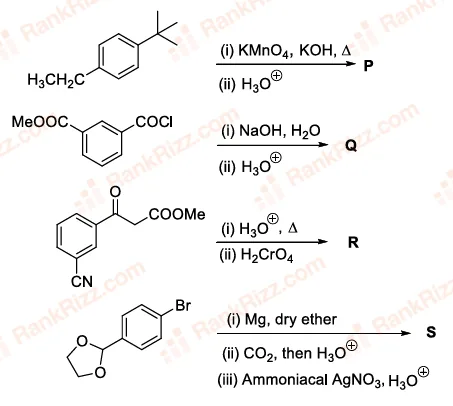
The correct statement(s) about P, Q, R, and S is (are)
P and Q are monomers of polymers dacron and glyptal, respectively.
P, Q, and R are dicarboxylic acids.
Compounds Q and R are the same.
R does not undergo aldol condensation and S does not undergo Cannizzaro reaction.
HS (5 moles) reacts completely with acidified aqueous potassium permanganate solution. In this reaction, the number of moles of water produced is x, and the number of moles of electrons involved is y. The value of (x + y) is ____.
Among [I], [SiO], SOCl, XeF, SF, ClF, Ni(CO), XeOF, [PtCl], XeF, and SOCl, the total number of species having hybridised central atom is ____.
Consider the following molecules: BrO, FO, HSO, HSO, and CO.
Count the number of atoms existing in their zero oxidation state in each molecule. Their sum is ____.
For He, a transition takes place from the orbit of radius 105.8 pm to the orbit of radius 26.45 pm. The wavelength (in nm) of the emitted photon during the transition is ____.
[Use: Bohr radius, pm; Rydberg constant, J; Planck's constant, J s; Speed of light, m s]
50 mL of 0.2 molal urea solution (density = 1.012 g mL at 300 K) is mixed with 250 mL of a solution containing 0.06 g of urea. Both the solutions were prepared in the same solvent. The osmotic pressure (in Torr) of the resulting solution at 300 K is ____.
[Use: Molar mass of urea = 60 g mol; gas constant, R = 62 L Torr K mol; Assume, , ]
The reaction of 4-methyloct-1-ene (P, 2.52 g) with HBr in the presence of (CHCO)O gives two isomeric bromides in a 9 : 1 ratio, with combined yield of 50%. Of these, the entire amount of the primary alkyl bromide was reacted with an appropriate amount of diethylamine followed by treatment with eq. KCO to give a non-ionic product S in 100% yield.
The mass (in mg) of S obtained is ____.
[Use molar mass (in g mol): H = 1, C = 12, N = 14, Br = 80]
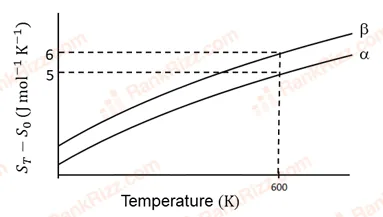
The value of entropy change, (in J mol K), at 300 K is ____.
[Use: ln 2 = 0.69]
[Given: at 0 K]
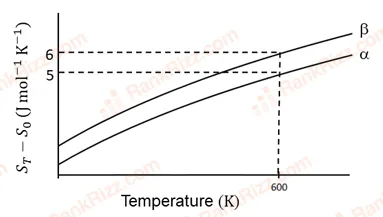
The value of enthalpy change, (in J mol), at 300 K is ____.
The number of heteroatoms present in one molecule of R is ____.
[Use: Molar mass (in g mol): H = 1, C = 12, N = 14, O = 16, Br = 80, Cl = 35.5
Atoms other than C and H are considered as heteroatoms]
The total number of carbon atoms and heteroatoms present in one molecule of S is ____.
[Use: Molar mass (in g mol): H = 1, C = 12, N = 14, O = 16, Br = 80, Cl = 35.5
Atoms other than C and H are considered as heteroatoms]