Q20Preparation of aminesTRANSCRIBED
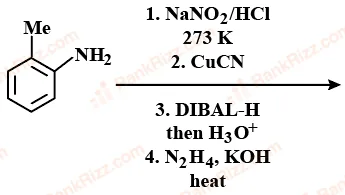
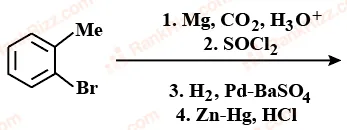
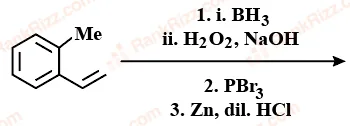
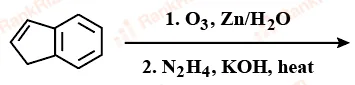
The reaction sequence(s) that would lead to o-xylene as the major product is(are)
- A
- B
- C
- D
The 19 Chemistry questions of JEE Advanced 2021 Paper 2, numbered across the whole paper. Pick an answer on any question to check it against the key. Free to read, nothing to download.
The reaction sequence(s) that would lead to o-xylene as the major product is(are)
Correct option(s) for the following sequence of reactions is(are)
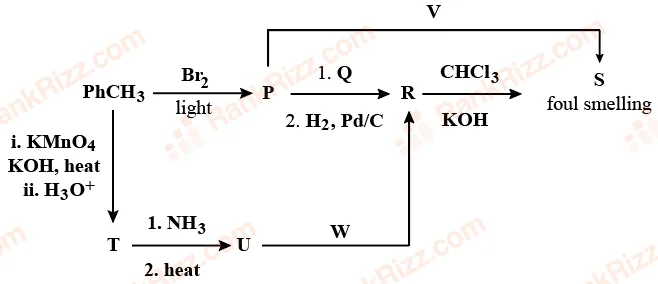
R = benzenamine, V = KCN
, R = phenylmethanamine
For the following reaction
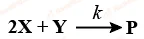
the rate of reaction is . Two moles of X are mixed with one mole of Y to make 1.0 L of solution. At 50 s, 0.5 mole of Y is left in the reaction mixture. The correct statement(s) about the reaction is(are)
(Use: ln 2 = 0.693)
The rate constant, k, of the reaction is .
Half-life of X is 50 s.
At 50 s,
At 100 s,
Some standard electrode potentials at 298 K are given below:
Pb/Pb -0.13 V
Ni/Ni -0.24 V
Cd/Cd -0.40 V
Fe/Fe -0.44 V
To a solution containing 0.001 M of X and 0.1 M of Y, the metal rods X and Y are inserted (at 298 K) and connected by a conducting wire. This resulted in dissolution of X. The correct combination(s) of X and Y, respectively, is(are)
(Given: Gas constant, R = 8.314 J K mol, Faraday constant, F = 96500 C mol)
Cd and Ni
Cd and Fe
Ni and Pb
Ni and Fe
The pair(s) of complexes wherein both exhibit tetrahedral geometry is(are)
(Note: py = pyridine
Given: Atomic numbers of Fe, Co, Ni and Cu are 26, 27, 28 and 29, respectively)
and
and
and
and
The correct statement(s) related to oxoacids of phosphorous is(are)
Upon heating, H3PO3 undergoes disproportionation reaction to produce and .
While can act as reducing agent, cannot.
is a monobasic acid.
The H atom of P-H bond in is not ionizable in water.
The value of is ___.
The value of y is ___.
The value of x is _________.
The value of y is _________.
The value of x is _________.
The value of y is _________.
Correct match of the C-H bonds (shown in bold) in Column J with their BDE in Column K is
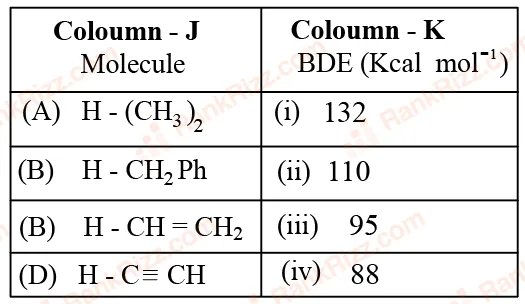
P - iii, Q - iv, R - ii, S - i
P - i, Q - ii, R - iii, S - iv
P - iii, Q - ii, R - i, S - iv
P - ii, Q - i, R - iv, S - iii
F or the following reaction

the correct statement is
Initiation step is exothermic with kcal mol.
Propagation step involving formation is exothermic with kcal mol
Propagation step involving formation is endothermic with kcal mol.
The reaction is exothermic with kcal mol
Precipitate X is
Among the following, the brown ring is due to the formation of
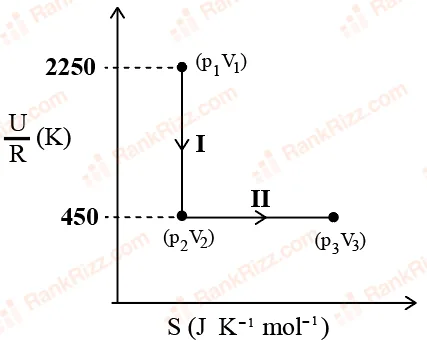
One mole of an ideal gas at 900 K, undergoes two reversible processes, I followed by II, as shown below. If the work done by the gas in the two processes are same, the value of is ___.
(U: internal energy, S: entropy, p: pressure, V: volume, R: gas constant)
(Given: molar heat capacity at constant volume, of the gas is )
Consider a helium (He) atom that absorbs a photon of wavelength 330 nm. The change in the velocity (in cm s) of He atom after the photon absorption is ___.
(Assume: Momentum is conserved when photon is absorbed.
Use: Planck constant = J s, Avogadro number = , Molar mass of He = 4 g mol)
Ozonolysis of produces an oxide of chlorine. The average oxidation state of chlorine in this oxide is ___.