Q41Linear first-order differential equationsTRANSCRIBED
The function y = f(x) is the solution of the differential equation
in (−1, 1) satisfying f(0) = 0. Then
is
- A
- B
- C
- D
The 20 Maths questions of JEE Advanced 2014 Paper 2, numbered across the whole paper. Pick an answer on any question to check it against the key. Free to read, nothing to download.
The function y = f(x) is the solution of the differential equation
in (−1, 1) satisfying f(0) = 0. Then
is
The following integral
is equal to
Coefficient of in the expansion of is
1051
1106
1113
1120
Let be a function which is continuous on [0, 2] and is differentiable on (0, 2) with f(0) = 1. Let
for If for all then F(2) equals
The common tangents to the circle and the parabola touch the circle at the points P, Q and the parabola at the points R, S. Then the area of the quadrilateral PQRS is
3
6
9
15
For , the equation has
infinitely many solutions
three solutions
one solution
no solution
In a triangle the sum of two sides is x and the product of the same two sides is y. If where c is the third side of the triangle, then the ratio of the in-radius to the circum-radius of the triangle is
Six cards and six envelopes are numbered 1, 2, 3, 4, 5, 6 and cards are to be placed in envelopes so that each envelope contains exactly one card and no card is placed in the envelope bearing the same number and moreover the card numbered 1 is always placed in envelope numbered 2. Then the number of ways it can be done is
264
265
53
67
Three boys and two girls stand in a queue. The probability, that the number of boys ahead of every girl is at least one more than the number of girls ahead of her, is
The quadratic equation p(x) = 0 with real coefficients has purely imaginary roots. Then the equation p(p(x)) = 0 has
only purely imaginary roots
all real roots
two real and two purely imaginary roots
neither real nor purely imaginary roots
The value of r is
Choices:
If st = 1, then the tangent at P and the normal at S to the parabola meet at a point whose ordinate is
The value of is
The value of is
0
The probability that is odd, is
The probability that are in an arithmetic progression, is
Let
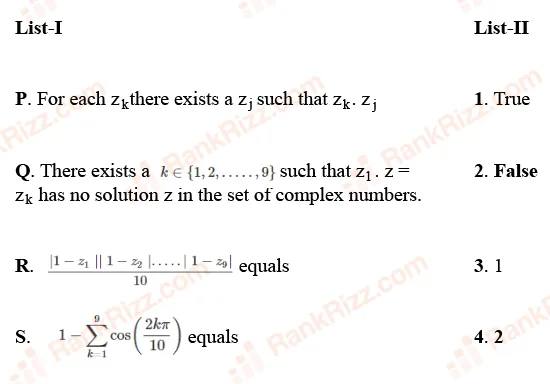
P - 1, Q - 2, R - 4, S - 3
P - 2, Q - 1, R - 3, S - 4
P - 1, Q - 2, R - 3, S - 4
P - 2, Q - 1, R - 4, S - 3
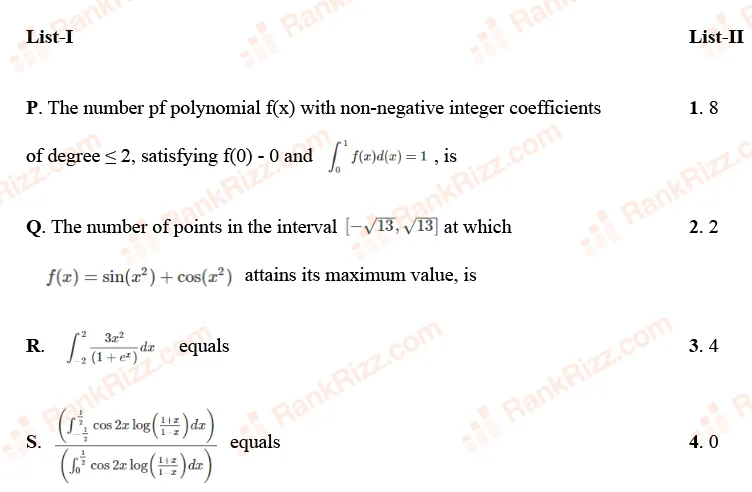
P - 3, Q - 2, R - 4, S - 1
P - 2, Q - 3, R - 4, S - 1
P - 3, Q - 2, R - 1, S - 4
P - 2, Q - 3, R - 1, S - 4
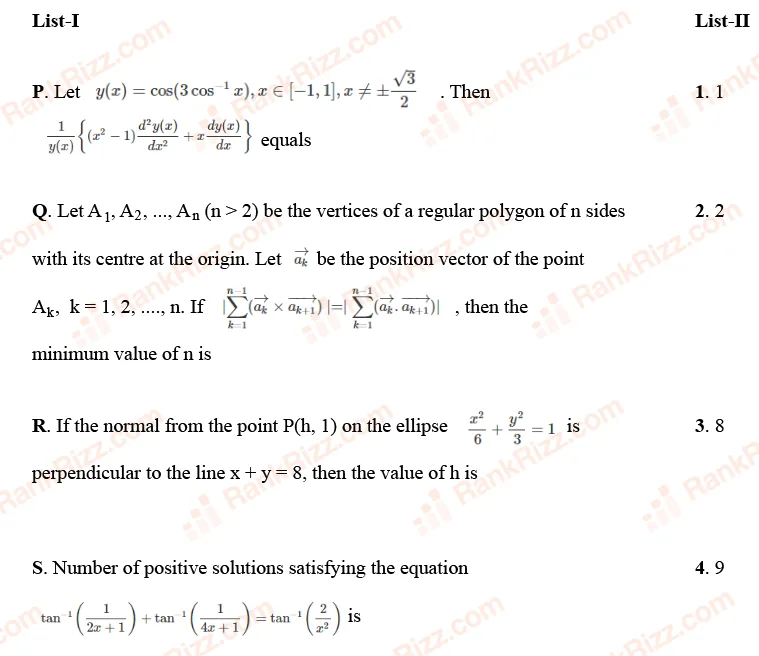
P - 4, Q - 3, R - 2, S - 1
P - 2, Q - 4, R - 3, S - 1
P - 4, Q - 3, R - 1, S - 2
P - 2, Q - 4, R - 1, S - 3
Let and be defined by
and
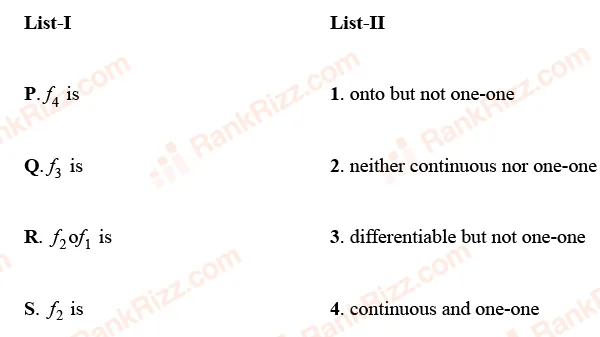
P - 3, Q - 1, R - 4, S - 2
P - 1, Q - 3, R - 4, S - 2
P - 3, Q - 1, R - 2, S - 4
P - 1, Q - 3, R - 2, S - 4