RankRizz

JEE Advanced 2014 Paper 2: Chemistry

The 20 Chemistry questions of JEE Advanced 2014 Paper 2, numbered across the whole paper. Pick an answer on any question to check it against the key. Free to read, nothing to download.

Chemistry

Q21EthersTRANSCRIBED

The acidic hydrolysis of ether (X) shown below is fastest when
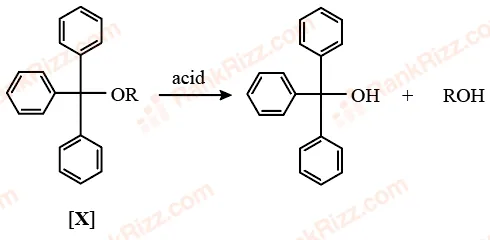
Figure for JEE Advanced 2014 Chemistry question on Ethers
  1. A

    one phenyl group is replaced by a methyl group.

  2. B

    one phenyl group is replaced by a para-methoxyphenyl group.

  3. C

    two phenyl groups are replaced by two para-methoxyphenyl groups.

  4. D

    no structural change is made to X.
Q22Structural isomerismTRANSCRIBED

Isomers of hexane, based on their branching, can be divided into three distinct classes as shown in the figure.

Figure for JEE Advanced 2014 Chemistry question on Structural isomerism


The correct order of their boiling point is

  1. A

    I > II > III

  2. B

    III > II > I

  3. C

    II > III > I

  4. D

    III > I > II

Q23Aldol condensation, Cannizzaro and related reactionsTRANSCRIBED

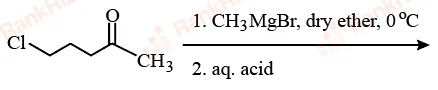
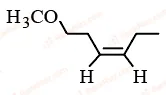
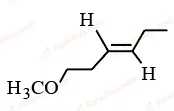
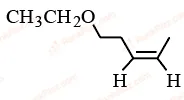
The major product in the following reaction is

Figure for JEE Advanced 2014 Chemistry question on Aldol condensation, Cannizzaro and related reactions
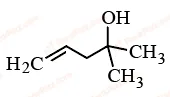
  1. A
    Figure for JEE Advanced 2014 Chemistry question on Aldol condensation, Cannizzaro and related reactions
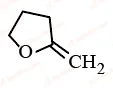
  2. B
    Figure for JEE Advanced 2014 Chemistry question on Aldol condensation, Cannizzaro and related reactions
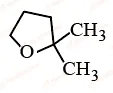
  3. C
    Figure for JEE Advanced 2014 Chemistry question on Aldol condensation, Cannizzaro and related reactions
  4. D
    Figure for JEE Advanced 2014 Chemistry question on Aldol condensation, Cannizzaro and related reactions
Q24Hydrogen peroxideTRANSCRIBED

Hydrogen peroxide in its reaction with KIO4KIO_4 and NH2OHNH_2OH respectively, is acting as a

  1. A

    reducing agent, oxidising agent

  2. B

    reducing agent, reducing agent

  3. C

    oxidising agent, oxidising agent

  4. D

    oxidising agent, reducing agent

Q25Phosphorus and its compoundsTRANSCRIBED

The product formed in the reaction of SOCl2SOCl_2 with white phosphorous is

  1. A

    PCl3PCl_3

  2. B

    SO2Cl2SO_2Cl_2

  3. C

    SCl2SCl_2

  4. D

    POCl3POCl_3

Q26Group 18: noble gases and xenon compoundsTRANSCRIBED

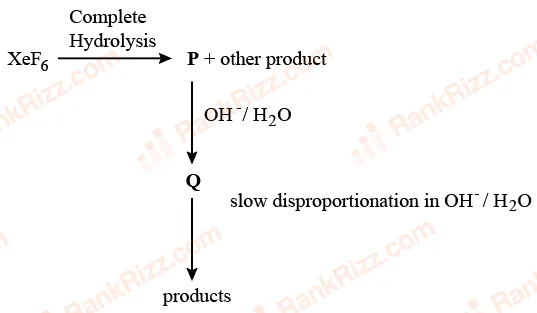
Under ambient conditions, the total number of gases released as products in the final step of the reaction scheme shown below is

Figure for JEE Advanced 2014 Chemistry question on Group 18: noble gases and xenon compounds
  1. A

    0

  2. B

    1

  3. C

    2

  4. D

    3

Q27Reactions of phenolsTRANSCRIBED

For the identification of β\beta-naphthol using dye test, it is necessary to use

  1. A

    dichloromethane solution of β\beta-naphthol

  2. B

    acidic solution of β\beta-naphthol

  3. C

    neutral solution of β\beta-naphthol

  4. D

    alkaline solution of β\beta-naphthol

Q28Methods to determine order of reactionTRANSCRIBED

For the elementary reaction M→NM \rightarrow N, the rate of disappearance of M increases by a factor of 8 upon doubling the concentration of M. The order of the reaction with respect to M is

  1. A

    4

  2. B

    3

  3. C

    2

  4. D

    1

Q29Gibbs energy and spontaneityTRANSCRIBED

For the process
H2O(l)→H2O(g)H_2O (l) \rightarrow H_2O (g)
at T=100∘CT = 100^\circ C and 1 atmosphere pressure, the correct choice is

  1. A

    △Ssystem>0\triangle S_{system} > 0 and △Ssurroundings>0\triangle S_{surroundings} > 0

  2. B

    △Ssystem>0\triangle S_{system} > 0 and △Ssurroundings<0\triangle S_{surroundings} < 0

  3. C

    △Ssystem<0\triangle S_{system} < 0 and △Ssurroundings>0\triangle S_{surroundings} > 0

  4. D

    △Ssystem<0\triangle S_{system} < 0 and △Ssurroundings<0\triangle S_{surroundings} < 0

Q30Molecular orbital theory of diatomic speciesTRANSCRIBED

Assuming 2s-2p mixing is NOT operative, the paramagnetic species among the following is

  1. A

    Be2Be_2

  2. B

    B2B_2

  3. C

    C2C_2

  4. D

    N2N_2

Q32Reactions of alkynesTRANSCRIBED

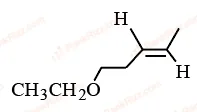
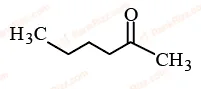
The correct statement with respect to product Y is

  1. A

    It gives a positive Tollens test and is a functional isomer of X.

  2. B

    It gives a positive Tollens test and is a geometrical isomer of X.

  3. C

    It gives a positive iodoform test and is a functional isomer of X.

  4. D

    It gives a positive iodoform test and is a geometrical isomer of X.

Q33Group analysis and confirmatory tests of cationsTRANSCRIBED

M1, Q and R, respectively are

  1. A

    Zn2+Zn^{2+}, KCN and HCl

  2. B

    Ni2+Ni^{2+}, HCl and KCN

  3. C

    Cd2+Cd^{2+}, KCN and HCl

  4. D

    Co2+Co^{2+}, HCl, and KCN

Q34Group analysis and confirmatory tests of cationsTRANSCRIBED

Reagent S is

  1. A

    K4[Fe(CN)6]K_4[Fe(CN)_6]

  2. B

    Na2HPO4Na_2HPO_4

  3. C

    K2CrO4K_2CrO_4

  4. D

    KOHKOH

Q35Graham's law of diffusion and effusionTRANSCRIBED

The value of d in cm (shown in the figure), as estimated from Graham’s law, is

  1. A

    8

  2. B

    12

  3. C

    16

  4. D

    20

Q36Kinetic theory of gases and molecular speedsTRANSCRIBED

The experimental value of d is found to be smaller than the estimate obtained using Graham’s law. This is due to

  1. A

    larger mean free path for X as compared to that of Y.

  2. B

    larger mean free path for Y as compared to that of X.

  3. C

    increased collision frequency of Y with the inert gas as compared to that of X with the inert gas.

  4. D

    increased collision frequency of X with the inert gas as compared to that of Y with the inert gas.

Q37Reactive intermediates and rearrangementsTRANSCRIBED

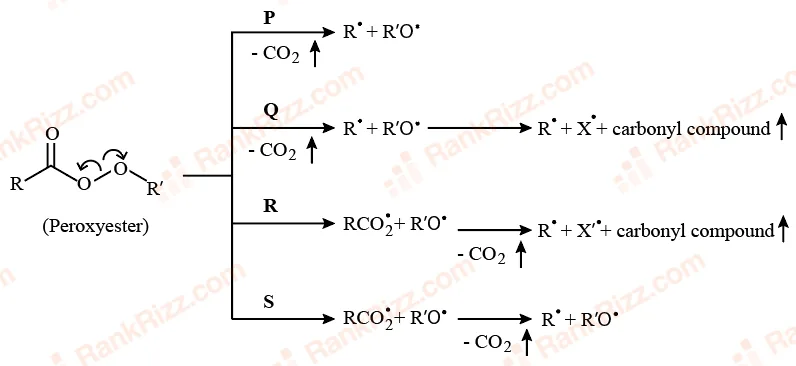
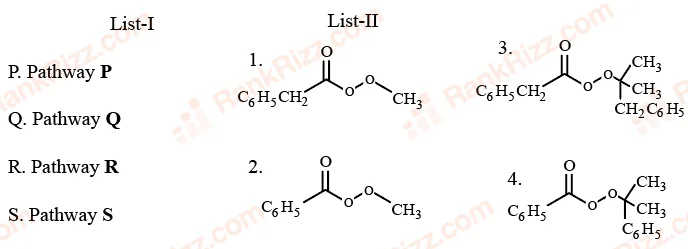
Different possible thermal decomposition pathways for peroxyesters are shown below. Match each pathway from List I with an appropriate structure from List II and select the correct answer using the code given below the lists.

Figure for JEE Advanced 2014 Chemistry question on Reactive intermediates and rearrangementsFigure for JEE Advanced 2014 Chemistry question on Reactive intermediates and rearrangements

Codes:

  1. A

    P - 1, Q - 3, R - 4, S - 2

  2. B

    P - 2, Q - 4, R - 3, S - 1

  3. C

    P - 4, Q - 1, R - 2, S - 3

  4. D

    P - 3, Q - 2, R - 1, S - 4

Q38Diazonium saltsTRANSCRIBED

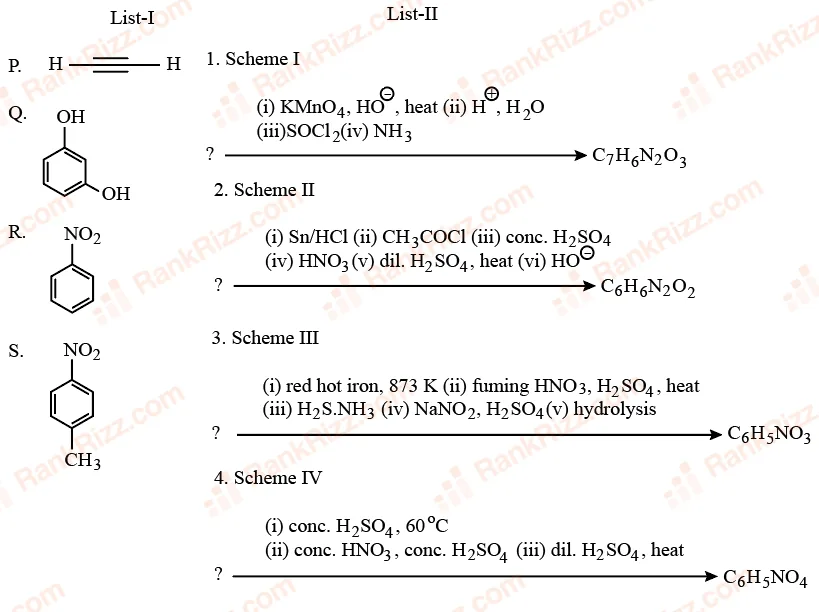
Match the four starting materials (P, Q, R, S) given in List I with the corresponding reaction schemes (I, II, III, IV) provided in List II and select the correct answer using the code given below the lists.

Figure for JEE Advanced 2014 Chemistry question on Diazonium salts


Codes:

  1. A

    P - 1, Q - 4, R - 2, S - 3

  2. B

    P - 3, Q - 1, R - 4, S - 2

  3. C

    P - 3, Q - 4, R - 2, S - 1

  4. D

    P - 4, Q - 1, R - 3, S - 2

Q39Geometrical and optical isomerism in complexesTRANSCRIBED

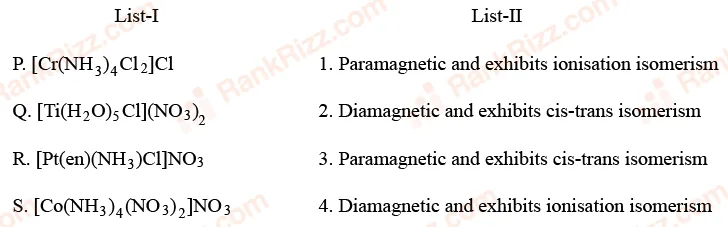
Match each coordination compound in List-I with an appropriate pair of characteristics from List-II and select the correct answer using the code given below the lists.
{en = H2NCH2CH2NH2H_2NCH_2CH_2NH_2; atomic numbers: Ti = 22; Cr = 24; Co = 27; Pt = 78}

Figure for JEE Advanced 2014 Chemistry question on Geometrical and optical isomerism in complexes
  1. A

    P - 4, Q - 2, R - 3, S - 1

  2. B

    P - 3, Q - 1, R - 4, S - 2

  3. C

    P - 2, Q - 1, R - 3, S - 4

  4. D

    P - 1, Q - 3, R - 4, S - 2

Q40Valence bond theory, orbital overlap and sigma/pi bondsTRANSCRIBED

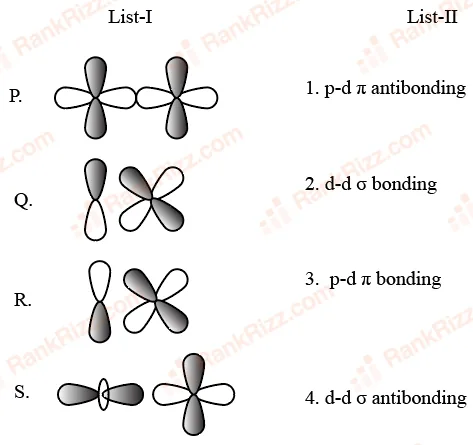
Match the orbital overlap figures shown in List-I with the description given in List-II and select the correct answer using the code given below the lists.

Figure for JEE Advanced 2014 Chemistry question on Valence bond theory, orbital overlap and sigma/pi bonds
  1. A

    P - 2, Q - 1, R - 3, S - 4

  2. B

    P - 4, Q - 3, R - 1, S - 2

  3. C

    P - 2, Q - 3, R - 1, S - 4

  4. D

    P - 4, Q - 1, R - 3, S - 2

NEXT IN THIS PAPER →Maths, Q41 onwards