JEE ADVANCED 2014 · PAPER 2+3 / −1HARDTRANSCRIBED
JEE Advanced 2014 Mathematics question — Composite functions
Let and be defined by
and
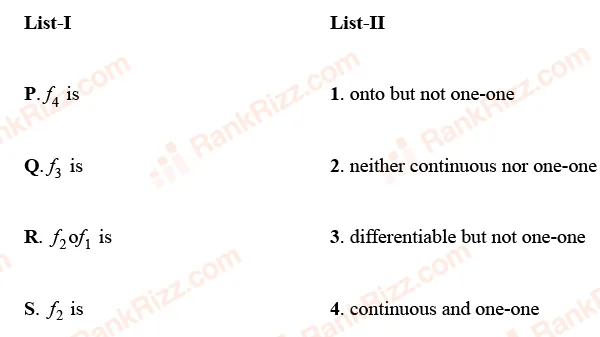
SOLUTION
Key idea: Write each composite out piece by piece, then check continuity, differentiability, injectivity and range one function at a time.
- : for and for . It is continuous at 0 but not differentiable there (left derivative 0, right derivative 2). Its range is , so it is onto. It is not one-one: and both give positive values. P → 1.
- : for and for . Both one-sided derivatives at 0 equal 1, so it is differentiable. It is not one-one, because repeats for . Q → 3.
- : for and for . It jumps at 0 (left limit 0, value 1), so it is not continuous. It is not one-one either (e.g. and both give 4). R → 2.
- on : continuous and strictly increasing, so one-one. S → 4.
Answer: (D)
Tagged Composite functions. Machine-assigned, so read it as a strong shortlist rather than a verdict.