RankRizz

JEE Advanced 2008 Paper 2: Maths

The 22 Maths questions of JEE Advanced 2008 Paper 2, numbered across the whole paper. Pick an answer on any question to check it against the key. Free to read, nothing to download.

Maths

Q45Locus and regions in the Argand planeTRANSCRIBED

A particle P starts from the point z0=1+2iz_0 = 1 + 2i, where i−−1i - \sqrt{-1}. It moves first horizontally away from origin by 5 units and then vertically away from origin by 3 units to reach a point z1z_1. From z1z_1 the particle moves 2\sqrt{2} units in the direction of the vector i^+j^\hat{i} + \hat{j} and then it moves through an angle π2\frac{\pi}{2} in anticlockwise direction on a circle with center at origin, to reach a point z2z_2. The point z2z_2 is given by

  1. A

    6+7i6 + 7i

  2. B

    −7+6i-7 + 6i

  3. C

    7+6i7 + 6i

  4. D

    −6+7i-6 + 7i

Q46Monotonicity and intervals of increase/decreaseTRANSCRIBED

Let the function g:(−∞,∞)→(−π2,π2)g : (-\infty, \infty)\rightarrow \left(-\frac{\pi}{2}, \frac{\pi}{2}\right) be given by g(u)=2tan⁡−1(eu)−π2g(u) = 2 \tan^{-1}(e^u) - \frac{\pi}{2}. Then, g is

  1. A

    even and is strictly increasing in (0,∞)(0, \infty)

  2. B

    odd and is strictly decreasing in (−∞,∞)(-\infty, \infty)

  3. C

    odd and is strictly increasing in (−∞,∞)(-\infty, \infty)

  4. D

    neither even nor odd, but is strictly increasing in (−∞,∞)(-\infty, \infty)

Q47Standard hyperbola and basic propertiesTRANSCRIBED

Consider a branch of the hyperbola
x2−2y2−22x−42y−6=0x^2 - 2y^2 - 2\sqrt{2}x - 4\sqrt{2}y - 6 = 0
with vertex at the point A. Let B be oneof the endpoints of its latus rectum. If C is the focus of the hyperbola nearest to the point A, then the area of the triangle ABC is

  1. A

    1−231 - \sqrt{\frac{2}{3}}

  2. B

    32−1\sqrt{\frac{3}{2}} - 1

  3. C

    1+231 + \sqrt{\frac{2}{3}}

  4. D

    32+1\sqrt{\frac{3}{2}} + 1

Q48Area between curvesTRANSCRIBED

The area of the region between the curves y=1+sin⁡xcos⁡xy = \sqrt{\frac{1 + \sin x}{\cos x}} and y=1−sin⁡xcos⁡xy = \sqrt{\frac{1 - \sin x}{\cos x}} bounded by the lines x = 0 and x=π4x = \frac{\pi}{4} is

  1. A

    ∫02−1t(1+t2)1−t2dt\int_{0}^{\sqrt{2}-1}\frac{t}{(1+t^2)\sqrt{1-t^2}}dt

  2. B

    ∫02−14t(1+t2)1−t2dt\int_{0}^{\sqrt{2}-1}\frac{4t}{(1+t^2)\sqrt{1-t^2}}dt

  3. C

    ∫02+14t(1+t2)1−t2dt\int_{0}^{\sqrt{2}+1}\frac{4t}{(1+t^2)\sqrt{1-t^2}}dt

  4. D

    ∫02+1t(1+t2)1−t2dt\int_{0}^{\sqrt{2}+1}\frac{t}{(1+t^2)\sqrt{1-t^2}}dt

Q49Area of triangle and collinearityTRANSCRIBED

Consider three points P=(−sin⁡(β−α),−cos⁡β),Q=(cos⁡(β−α),sin⁡β)P = (-\sin (\beta - \alpha), -\cos \beta), Q = (\cos(\beta - \alpha), \sin \beta) and R=(cos⁡(β−α+θ),sin⁡(β−θ))R = (\cos(\beta - \alpha + \theta), \sin(\beta - \theta)), where 0<α,β,θ<π40 < \alpha, \beta, \theta < \frac{\pi}{4}. Then,

  1. A

    P lies on the line segment RQ

  2. B

    Q lies on the line segment PR

  3. C

    R lies on the line segment QP

  4. D

    P, Q, R are non-collinear

Q50Conditional probability and multiplication theoremTRANSCRIBED

An experiment has 10 equally likely outcomes. Let A and B be two non-empty events of the experiment. If A consists of 4 outcomes, the number of outcomes that B must have so that A and B are independent, is

  1. A

    2, 4 or 8

  2. B

    3, 6 or 9

  3. C

    4 or 8

  4. D

    5 or 10

Q51Scalar (dot) productTRANSCRIBED

Let two non-collinear unit vectors a^\hat{a} and b^\hat{b} form an acute angle. A point P moves so that at any time t the position vector OP→\overrightarrow{OP}(where O is the origin) is given by a^cos⁡t+b^sin⁡t\hat{a} \cos t + \hat{b} \sin t. When is farthest from origin O, let M be the length of OP→\overrightarrow{OP} and u^\hat{u} be the unit vector along OP→\overrightarrow{OP} . Then

  1. A

    u^=a^+b^∣a^+b^∣\hat{u} = \frac{\hat{a} + \hat{b}}{\mid \hat{a} + \hat{b} \mid} and M=(1+a^.b^)12M = (1 + \hat{a}.\hat{b})^{\frac{1}{2}}

  2. B

    u^=a^−b^∣a^−b^∣\hat{u} = \frac{\hat{a} - \hat{b}}{\mid \hat{a} - \hat{b} \mid} and M=(1+a^.b^)12M = (1 + \hat{a}.\hat{b})^{\frac{1}{2}}

  3. C

    u^=a^+b^∣a^+b^∣\hat{u} = \frac{\hat{a} + \hat{b}}{\mid \hat{a} + \hat{b} \mid} and M=(1+2a^.b^)12M = (1 + 2\hat{a}.\hat{b})^{\frac{1}{2}}

  4. D

    u^=a^−b^∣a^−b^∣\hat{u} = \frac{\hat{a} - \hat{b}}{\mid \hat{a} - \hat{b} \mid} and M=(1+2a^.b^)12M = (1 + 2\hat{a}.\hat{b})^{\frac{1}{2}}

Q52Integration by substitutionTRANSCRIBED

Let
I=∫exe4x+e2x+1dx,J=∫e−xe−4x+e−2x+1dxI = \int\frac{e^x}{e^{4x}+e^{2x}+1}dx, J = \int\frac{e^{-x}}{e^{-4x}+e^{-2x}+1}dx.
Then, for an arbitrary constant C, the value of J - I equals

  1. A

    12log⁡(e4x−e2x+1e4x+e2x+1)+C\frac{1}{2}\log\left(\frac{e^{4x} - e^{2x} + 1}{e^{4x} + e^{2x} + 1}\right)+C

  2. B

    12log⁡(e2x+ex+1e2x−ex+1)+C\frac{1}{2}\log\left(\frac{e^{2x} + e^{x} + 1}{e^{2x} - e^{x} + 1}\right)+C

  3. C

    12log⁡(e2x−ex+1e2x+ex+1)+C\frac{1}{2}\log\left(\frac{e^{2x} - e^{x} + 1}{e^{2x} + e^{x} + 1}\right)+C

  4. D

    12log⁡(e4x+e2x+1e4x−e2x+1)+C\frac{1}{2}\log\left(\frac{e^{4x} + e^{2x} + 1}{e^{4x} - e^{2x} + 1}\right)+C

Q53Higher order derivativesTRANSCRIBED

Let g(x)=log⁡f(x)g(x) = \log f(x) where f(x)f(x) is a twice differentiable positive function on (0,∞)(0, \infty) such that f(x+1)=xf(x)f(x + 1) = x f(x). Then, for N=1,2,3,...,N = 1, 2, 3,...,
g′′(N+12)−g′′(12)=g''\left(N + \frac{1}{2}\right) - g''\left(\frac{1}{2}\right) =

  1. A

    −4{1+19+125+...+1(2N−1)2}-4\left\{1 + \frac{1}{9} + \frac{1}{25} + ... + \frac{1}{(2N - 1)^2}\right\}

  2. B

    4{1+19+125+...+1(2N−1)2}4\left\{1 + \frac{1}{9} + \frac{1}{25} + ... + \frac{1}{(2N - 1)^2}\right\}

  3. C

    −4{1+19+125+...+1(2N+1)2}-4\left\{1 + \frac{1}{9} + \frac{1}{25} + ... + \frac{1}{(2N + 1)^2}\right\}

  4. D

    4{1+19+125+...+1(2N+1)2}4\left\{1 + \frac{1}{9} + \frac{1}{25} + ... + \frac{1}{(2N + 1)^2}\right\}

Q54Geometric progression and infinite GPTRANSCRIBED

Suppose four distinct positive numbers a1,a2,a3,a4a_1, a_2, a_3, a_4 are in G.P. Let b1=a1,b2=b1+a2,b3=b2+a3b_1 = a_1, b_2 = b_1 + a_2, b_3 = b_2 + a_3 and b4=b3+a4b_4 = b_3 + a_4.
STATEMENT-1: The numbers b1,b2,b3,b4b_1, b_2, b_3, b_4 are neither in A.P. nor in G.P.
and
STATEMENT-2: The numbers b1,b2,b3,b4b_1, b_2, b_3, b_4 are in H.P.

  1. A

    STATEMENT-1 is True, STATEMENT-2 is True; STATEMENT-2 is a correct explanation for STATEMENT-1

  2. B

    STATEMENT-1 is True, STATEMENT-2 is True; STATEMENT-2 is NOT a correct explanation for STATEMENT-1

  3. C

    STATEMENT-1 is True, STATEMENT-2 is False

  4. D

    STATEMENT-1 is False, STATEMENT-2 is True

Q55Relation between roots and coefficientsTRANSCRIBED

Let a, b, c, p, q be real numbers. Suppose α,β\alpha, \beta are the roots of the equation x2+2px+q=0x^2 + 2px + q = 0 and α,1β\alpha, \frac{1}{\beta} are the roots of the equation ax2+2bx+c=0ax^2 + 2bx + c = 0, where β2∉{−1,0,1}\beta^2 \notin \left\{-1, 0, 1\right\}.
STATEMENT-1 : (p2−q)(b2−ac)≥0\left(p^2 - q\right)\left(b^2 - ac\right)\geq 0
and
STATEMENT-2 : b≠pab \neq pa or c≠qac \neq qa

  1. A

    STATEMENT-1 is True, STATEMENT-2 is True; STATEMENT-2 is a correct explanation for STATEMENT-1

  2. B

    STATEMENT-1 is True, STATEMENT-2 is True; STATEMENT-2 is NOT a correct explanation for STATEMENT-1

  3. C

    STATEMENT-1 is True, STATEMENT-2 is False

  4. D

    STATEMENT-1 is False, STATEMENT-2 is True

Q56Equation of a circle in various formsTRANSCRIBED

Consider
L1:2x+3y+p−3=0L_1: 2x + 3y + p - 3 = 0
L2:2x+3y+p+3=0L_2: 2x + 3y + p + 3 = 0
where p is a real number, and C:x2+y2+6x−10y+30=0C : x^2 + y^2 + 6x - 10y + 30 = 0.
STATEMENT-1: If line L1L_1 is a chord of circle C, then line L2L_2 is not always a diameter of circle C.
and
STATEMENT-2: If line L1L_1 is a diameterof circle C, then line L2L_2 is not a chord of circle C.

  1. A

    STATEMENT-1 is True, STATEMENT-2 is True; STATEMENT-2 is a correct explanation for STATEMENT-1

  2. B

    STATEMENT-1 is True, STATEMENT-2 is True; STATEMENT-2 is NOT a correct explanation for STATEMENT-1

  3. C

    STATEMENT-1 is True, STATEMENT-2 is False

  4. D

    STATEMENT-1 is False, STATEMENT-2 is True

Q57Variable separable equationsTRANSCRIBED

Letasolution y = y(x) of the differential equation
xx2−1dy−yy2−1dx=0x\sqrt{x^2 - 1} dy - y\sqrt{y^2 - 1}dx = 0 satisfy y(2)=23y(2) = \frac{2}{\sqrt{3}}
STATEMENT-1: y(x)=sec⁡(sec⁡−1x−π6)y(x) = \sec\left(\sec^{-1}x - \frac{\pi}{6}\right)
STATEMENT-2: y(x) is given by 1y=23x−1−1x2\frac{1}{y} = \frac{2\sqrt{3}}{x} - \sqrt{1 - \frac{1}{x^2}}

  1. A

    STATEMENT-1 is True, STATEMENT-2 is True; STATEMENT-2 is a correct explanation for STATEMENT-1

  2. B

    STATEMENT-1 is True, STATEMENT-2 is True; STATEMENT-2 is NOT a correct explanation for STATEMENT-1

  3. C

    STATEMENT-1 is True, STATEMENT-2 is False

  4. D

    STATEMENT-1 is False, STATEMENT-2 is True

Q58Higher order derivativesTRANSCRIBED

Which of the following is true?

  1. A

    (2+a)2f′′(1)+(2−a)2f′′(−1)=0(2 + a)^2f''(1) + (2 - a)^2f''(-1) = 0

  2. B

    (2−a)2f′′(1)−(2+a)2f′′(−1)=0(2 - a)^2f''(1) - (2 + a)^2f''(-1) = 0

  3. C

    f′(a)f′′(−1)=(2−a)2f'(a)f''(-1) = (2 - a)^2

  4. D

    f′(a)f′′(−1)=−(2+a)2f'(a)f''(-1) = -(2 + a)^2

Q59Monotonicity and intervals of increase/decreaseTRANSCRIBED

Which of the following is true?

  1. A

    f(x) is decreasing on (—1, 1) and has a local minimum at x = 1

  2. B

    f(x) is increasing on (-1, 1) and has a local maximum at x = 1

  3. C

    f(x) is increasing on (—1, 1) but has neither a local maximum nor a local minimum at x = 1

  4. D

    f(x) is decreasing on (-1, 1) but has neither a local maximum nor a local minimum at x = 1

Q60Leibniz rule for differentiating integralsTRANSCRIBED

Let
g(x)=∫0exf′(1)1+t2dtg(x) = \int_{0}^{e^x}\frac{f'(1)}{1 + t^2} dt.
Which of the following is true?

  1. A

    g′(x)g'(x) is positive on (−∞,0)(-\infty, 0) and negative on (0,∞)(0, \infty)

  2. B

    g′(x)g'(x) is negative on (−∞,0)(-\infty, 0) and positive on (0,∞)(0, \infty)

  3. C

    g′(x)g'(x) changes sign on both (−∞,0)(-\infty, 0) and (0,∞)(0, \infty)

  4. D

    g′(x)g'(x) does not change sign on (−∞,∞)(-\infty, \infty)

Q61Vector (cross) product and areaTRANSCRIBED

The unit vector perpendicular to both L1L_1 and L2L_2 is

  1. A

    −i^+7j^+7k^99\frac{-\hat{i} + 7\hat{j} + 7\hat{k}}{\sqrt{99}}

  2. B

    −i^−7j^+5k^53\frac{-\hat{i} - 7\hat{j} + 5\hat{k}}{5\sqrt{3}}

  3. C

    −i^+7j^+5k^53\frac{-\hat{i} + 7\hat{j} + 5\hat{k}}{5\sqrt{3}}

  4. D

    7i^−7j^−k^99\frac{7\hat{i} - 7\hat{j} - \hat{k}}{\sqrt{99}}

Q62Foot of perpendicular, image and distance from a lineTRANSCRIBED

The shortest distance between L1L_1 and L2L_2 is

  1. A

    0

  2. B

    173\frac{17}{\sqrt{3}}

  3. C

    4153\frac{41}{5\sqrt{3}}

  4. D

    1753\frac{17}{5\sqrt{3}}

Q63Line and plane: intersection, coplanarity and projectionTRANSCRIBED

The distance of the point (1,1, 1) from the plane passing through the point (-1, -2, -1) and whose normalis perpendicularto both the lines L1L_1 and L2L_2 is

  1. A

    275\frac{2}{\sqrt{75}}

  2. B

    775\frac{7}{\sqrt{75}}

  3. C

    1375\frac{13}{\sqrt{75}}

  4. D

    2375\frac{23}{\sqrt{75}}

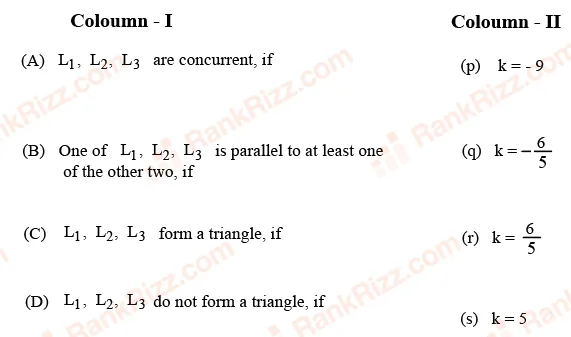
Q64Concurrency and family of linesTRANSCRIBED

Consider the lines given by
L1:x+3y−5=0L_1: x + 3y - 5 = 0
L2:3x−ky−1=0L_2: 3x - ky - 1 = 0
L3:5x+2y−12=0L_3: 5x + 2y - 12 = 0
Match the Statements / Expressions in Column I with the Statements / Expressions in Column II and indicate your answer by darkening the appropriate bubbles in the 4×44 \times 4 matrix given in the ORS.

Figure for JEE Advanced 2008 Mathematics question on Concurrency and family of lines
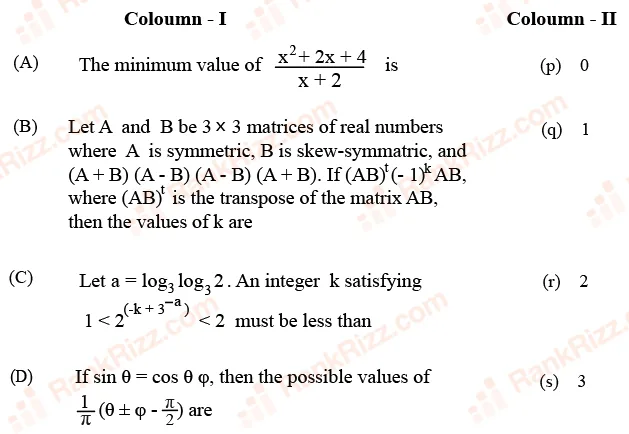
Q65Equation of a circle in various formsTRANSCRIBED

Match the Statements / Expressions in Column I with the Statements / Expressions in Column II and indicate your answer by darkening the appropriate bubbles in the 4×44 \times 4 matrix given in the ORS.

Figure for JEE Advanced 2008 Mathematics question on Equation of a circle in various forms
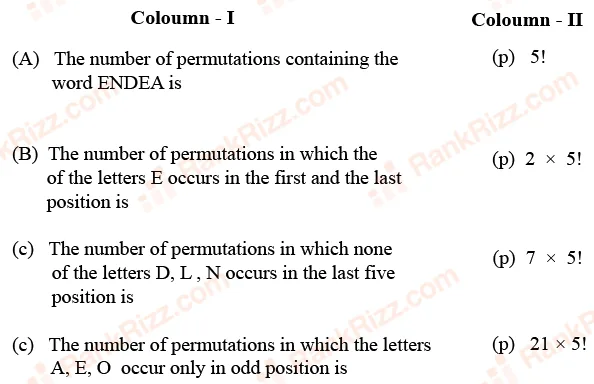
Q66Arrangements with restrictionsTRANSCRIBED

Consider all possible permutations  of the letters of the word ENDEANOEL. Match the Statements / Expressions in Column I with the Statements / Expressions in Column II and indicate your answer by darkening the appropriate bubbles in the 4×44 \times 4 matrix given in the ORS.

Figure for JEE Advanced 2008 Mathematics question on Arrangements with restrictions