RankRizzStart free

JEE Advanced 2008 Paper 2 Question Paper

All 66 questions of JEE Advanced 2008 Paper 2, in the order they were asked. Pick an answer on any question to check it against the key. Free to read, nothing to download.

Questions

66

Mathematics · Physics · Chemistry

Answer key

57

questions with a checked key

Under review

9

key not yet trusted

Price

Free

no sign-up

Mathematics

Q1JEE ADVANCED 2008 · PAPER 2Locus and regions in the Argand planeTRANSCRIBED

A particle P starts from the point , where . It moves first horizontally away from origin by 5 units and then vertically away from origin by 3 units to reach a point . From the particle moves units in the direction of the vector and then it moves through an angle in anticlockwise direction on a circle with center at origin, to reach a point . The point is given by

  1. A

  2. B

  3. C

  4. D

Q2JEE ADVANCED 2008 · PAPER 2Monotonicity and intervals of increase/decreaseTRANSCRIBED

Let the function be given by . Then, g is

  1. A

    even and is strictly increasing in

  2. B

    odd and is strictly decreasing in

  3. C

    odd and is strictly increasing in

  4. D

    neither even nor odd, but is strictly increasing in

Q3JEE ADVANCED 2008 · PAPER 2Standard hyperbola and basic propertiesTRANSCRIBED

Consider a branch of the hyperbola

with vertex at the point A. Let B be oneof the endpoints of its latus rectum. If C is the focus of the hyperbola nearest to the point A, then the area of the triangle ABC is

  1. A

  2. B

  3. C

  4. D

Q4JEE ADVANCED 2008 · PAPER 2Area between curvesTRANSCRIBED

The area of the region between the curves and bounded by the lines x = 0 and is

  1. A

  2. B

  3. C

  4. D

Q5JEE ADVANCED 2008 · PAPER 2Area of triangle and collinearityTRANSCRIBED

Consider three points and , where 0 < \alpha, \beta, \theta < \frac{\pi}{4}. Then,

  1. A

    P lies on the line segment RQ

  2. B

    Q lies on the line segment PR

  3. C

    R lies on the line segment QP

  4. D

    P, Q, R are non-collinear

Q6JEE ADVANCED 2008 · PAPER 2Conditional probability and multiplication theoremTRANSCRIBED

An experiment has 10 equally likely outcomes. Let A and B be two non-empty events of the experiment. If A consists of 4 outcomes, the number of outcomes that B must have so that A and B are independent, is

  1. A

    2, 4 or 8

  2. B

    3, 6 or 9

  3. C

    4 or 8

  4. D

    5 or 10

Q7JEE ADVANCED 2008 · PAPER 2Scalar (dot) productTRANSCRIBED

Let two non-collinear unit vectors and form an acute angle. A point P moves so that at any time t the position vector (where O is the origin) is given by . When is farthest from origin O, let M be the length of and be the unit vector along . Then

  1. A

    and

  2. B

    and

  3. C

    and

  4. D

    and

Q8JEE ADVANCED 2008 · PAPER 2Integration by substitutionTRANSCRIBED

Let
.
Then, for an arbitrary constant C, the value of J - I equals

  1. A

  2. B

  3. C

  4. D

Q9JEE ADVANCED 2008 · PAPER 2Higher order derivativesTRANSCRIBED

Let where is a twice differentiable positive function on such that . Then, for

  1. A

  2. B

  3. C

  4. D

Q10JEE ADVANCED 2008 · PAPER 2Geometric progression and infinite GPTRANSCRIBED

Suppose four distinct positive numbers are in G.P. Let and .
STATEMENT-1: The numbers are neither in A.P. nor in G.P.
and
STATEMENT-2: The numbers are in H.P.

  1. A

    STATEMENT-1 is True, STATEMENT-2 is True; STATEMENT-2 is a correct explanation for STATEMENT-1

  2. B

    STATEMENT-1 is True, STATEMENT-2 is True; STATEMENT-2 is NOT a correct explanation for STATEMENT-1

  3. C

    STATEMENT-1 is True, STATEMENT-2 is False

  4. D

    STATEMENT-1 is False, STATEMENT-2 is True

Q11JEE ADVANCED 2008 · PAPER 2Relation between roots and coefficientsTRANSCRIBED

Let a, b, c, p, q be real numbers. Suppose are the roots of the equation and are the roots of the equation , where .
STATEMENT-1 :
and
STATEMENT-2 : or

  1. A

    STATEMENT-1 is True, STATEMENT-2 is True; STATEMENT-2 is a correct explanation for STATEMENT-1

  2. B

    STATEMENT-1 is True, STATEMENT-2 is True; STATEMENT-2 is NOT a correct explanation for STATEMENT-1

  3. C

    STATEMENT-1 is True, STATEMENT-2 is False

  4. D

    STATEMENT-1 is False, STATEMENT-2 is True

Q12JEE ADVANCED 2008 · PAPER 2Equation of a circle in various formsTRANSCRIBED

Consider


where p is a real number, and .
STATEMENT-1: If line is a chord of circle C, then line is not always a diameter of circle C.
and
STATEMENT-2: If line is a diameterof circle C, then line is not a chord of circle C.

  1. A

    STATEMENT-1 is True, STATEMENT-2 is True; STATEMENT-2 is a correct explanation for STATEMENT-1

  2. B

    STATEMENT-1 is True, STATEMENT-2 is True; STATEMENT-2 is NOT a correct explanation for STATEMENT-1

  3. C

    STATEMENT-1 is True, STATEMENT-2 is False

  4. D

    STATEMENT-1 is False, STATEMENT-2 is True

Q13JEE ADVANCED 2008 · PAPER 2Variable separable equationsTRANSCRIBED

Letasolution y = y(x) of the differential equation
satisfy
STATEMENT-1:
STATEMENT-2: y(x) is given by

  1. A

    STATEMENT-1 is True, STATEMENT-2 is True; STATEMENT-2 is a correct explanation for STATEMENT-1

  2. B

    STATEMENT-1 is True, STATEMENT-2 is True; STATEMENT-2 is NOT a correct explanation for STATEMENT-1

  3. C

    STATEMENT-1 is True, STATEMENT-2 is False

  4. D

    STATEMENT-1 is False, STATEMENT-2 is True

Q14JEE ADVANCED 2008 · PAPER 2Higher order derivativesTRANSCRIBED

Which of the following is true?

  1. A

  2. B

  3. C

  4. D

Q15JEE ADVANCED 2008 · PAPER 2Monotonicity and intervals of increase/decreaseTRANSCRIBED

Which of the following is true?

  1. A

    f(x) is decreasing on (—1, 1) and has a local minimum at x = 1

  2. B

    f(x) is increasing on (-1, 1) and has a local maximum at x = 1

  3. C

    f(x) is increasing on (—1, 1) but has neither a local maximum nor a local minimum at x = 1

  4. D

    f(x) is decreasing on (-1, 1) but has neither a local maximum nor a local minimum at x = 1

Q16JEE ADVANCED 2008 · PAPER 2Leibniz rule for differentiating integralsTRANSCRIBED

Let
.
Which of the following is true?

  1. A

    is positive on and negative on

  2. B

    is negative on and positive on

  3. C

    changes sign on both and

  4. D

    does not change sign on

Q17JEE ADVANCED 2008 · PAPER 2Vector (cross) product and areaTRANSCRIBED

The unit vector perpendicular to both and is

  1. A

  2. B

  3. C

  4. D

Q18JEE ADVANCED 2008 · PAPER 2Foot of perpendicular, image and distance from a lineTRANSCRIBED

The shortest distance between and is

  1. A

    0

  2. B

  3. C

  4. D

Q19JEE ADVANCED 2008 · PAPER 2Line and plane: intersection, coplanarity and projectionTRANSCRIBED

The distance of the point (1,1, 1) from the plane passing through the point (-1, -2, -1) and whose normalis perpendicularto both the lines and is

  1. A

  2. B

  3. C

  4. D

Q20JEE ADVANCED 2008 · PAPER 2Concurrency and family of linesTRANSCRIBED

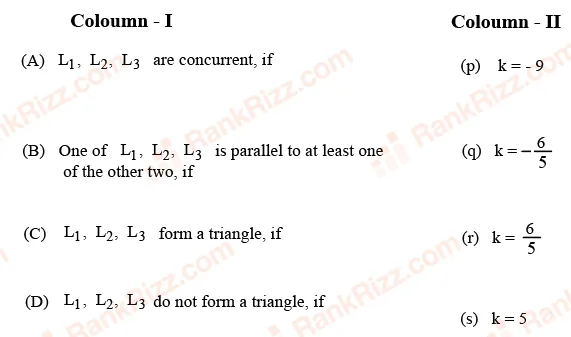
Consider the lines given by


Match the Statements / Expressions in Column I with the Statements / Expressions in Column II and indicate your answer by darkening the appropriate bubbles in the matrix given in the ORS.

Q21JEE ADVANCED 2008 · PAPER 2Equation of a circle in various formsTRANSCRIBED

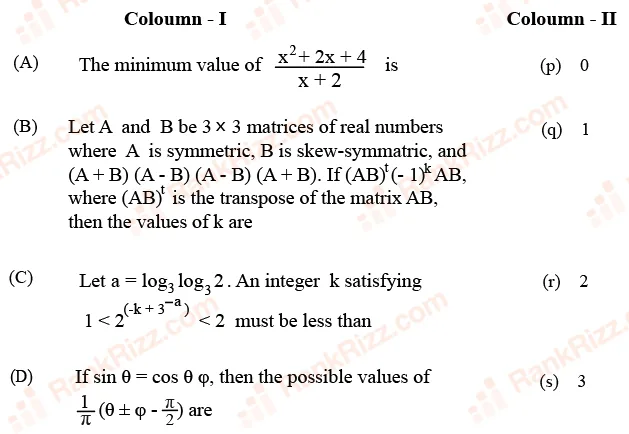
Match the Statements / Expressions in Column I with the Statements / Expressions in Column II and indicate your answer by darkening the appropriate bubbles in the matrix given in the ORS.

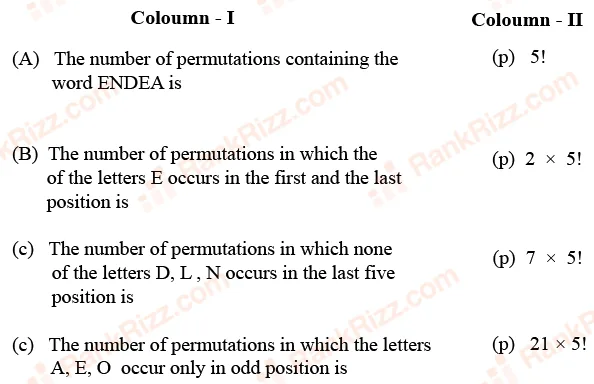
Q22JEE ADVANCED 2008 · PAPER 2Arrangements with restrictionsTRANSCRIBED

Consider all possible permutations  of the letters of the word ENDEANOEL. Match the Statements / Expressions in Column I with the Statements / Expressions in Column II and indicate your answer by darkening the appropriate bubbles in the matrix given in the ORS.

Physics

Q23JEE ADVANCED 2008 · PAPER 2Relation between field and potential, equipotential surfacesTRANSCRIBED

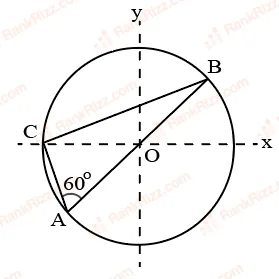
Consider a system of three charges and placed at points A, B and C, respectively, as shown in the figure. Take O to be the centre of the circle of radius R and angle

  1. A

    The electric field at point O is directed along the negative x-axis

  2. B

    The potential energy of the system is zero

  3. C

    The magnitude of the force between the charges at C and B is

  4. D

    The potential at point O is

Q24JEE ADVANCED 2008 · PAPER 2Radioactivity: decay law, half-life and decay modesTRANSCRIBED

A radioactive sample S1 having an activity of has twice the number of nuclei as another sample S2 which has anactivity of . The half lives of S1 and S2
can be

  1. A

    20 years and 5 years, respectively

  2. B

    20 years and 10 years, respectively

  3. C

    10 years each

  4. D

    5 years each

Q25JEE ADVANCED 2008 · PAPER 2Progressive waves: wave equation, phase and intensityTRANSCRIBED

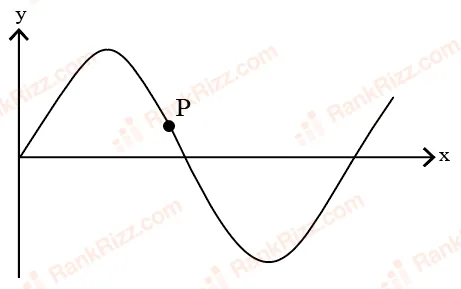
A transverse sinusoidal wave moves along a string in the positive x-direction at a speed of 10 cm/s. The wavelength of the waveis 0.5 m and its amplitude is 10 cm. At a particular time t, the snap-shot of the wave is shown in figure. The velocity of point P when its displacement is 5 cm is

  1. A

    m/s

  2. B

    m/s

  3. C

    m/s

  4. D

    m/s

Q26JEE ADVANCED 2008 · PAPER 2Potential energy, conservative forces and energy curvesTRANSCRIBED

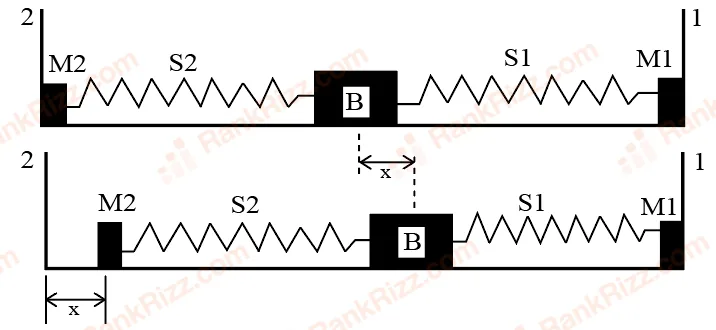
A block (B) is attached to two unstretched springs S1 and S2 with spring constants k and 4k, respectively (see figure I). The other ends are attached to identical supports M1 and M2 not attached to the walls. The springs and supports have negligible mass. There is no friction anywhere. The block B is displaced towards wall 1 by a small distance x (figure II) and released. The block returns and moves a maximum distance y towards wall 2. Displacements x and y are measured with respect to the equilibrium position of the block B. The ratio is

  1. A

    4

  2. B

    2

  3. C

  4. D

Q27JEE ADVANCED 2008 · PAPER 2Potential energy, conservative forces and energy curvesTRANSCRIBED

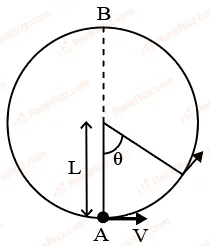
A bob of mass M is suspended by a massless string of length L. The horizontal velocity V at position A is just sufficient to make it reach the point B. The angle at which the speed of the bob is half of that at A, satisfies 

  1. A

  2. B

    \frac{\pi}{4} < \theta < \frac{\pi}{2}

  3. C

    \frac{\pi}{2} < \theta < \frac{3 \pi}{4}

  4. D

    \frac{3 \pi}{4} < \theta < \pi

Q28JEE ADVANCED 2008 · PAPER 2Surface tension and surface energyTRANSCRIBED

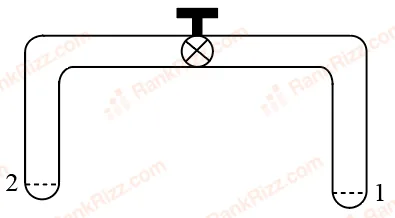
A glass tube of uniform internal radius (r) has a valve separating the two identical ends. Initially, the valve is in a tightly closed position. End 1 has a hemispherical soap bubble of radius r. End 2 has sub-hemispherical soap bubble as shown in figure. Just after opening the valve,

  1. A

    air from end 1 flows towards end 2. No change in the volumeof the soap bubbles

  2. B

    air from end 1 flows towards end 2. Volumeof the soap bubble at end 1 decreases

  3. C

    no change occurs

  4. D

    air from end 2 flows towards end 1. Volume of the soap bubble at end 1 increases

Q29JEE ADVANCED 2008 · PAPER 2Superposition, interference and beatsTRANSCRIBED

A vibrating string of certain length l under a tension T resonates with a mode corresponding to the first overtone (third harmonic) of an air column of length 75 cm inside a tube closed at one end. The string also generates 4 beats per second when excited along with a tuning fork of frequency n. Now when the tension ofthe string is slightly increased the numberof beats reduces to 2 per second. Assuming the velocity of soundin air to be 340 m/s, the frequency n of the tuning fork in Hz is

  1. A

    344

  2. B

    336

  3. C

    117.3

  4. D

    109.3

Q30JEE ADVANCED 2008 · PAPER 2Capacitors with dielectricsTRANSCRIBED

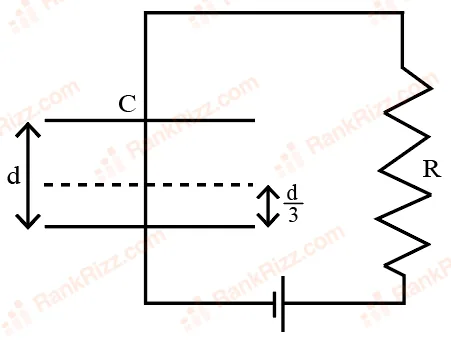
A parallel plate capacitor C with plates of unit area and separation is filled with a liquid of dielectric constant K = 2. The level of liquid is initially. Suppose the liquid level decreases at a constant speed V, the time constant as a function of time t is

  1. A

  2. B

  3. C

  4. D

Q31JEE ADVANCED 2008 · PAPER 2Prism: deviation and dispersionTRANSCRIBED

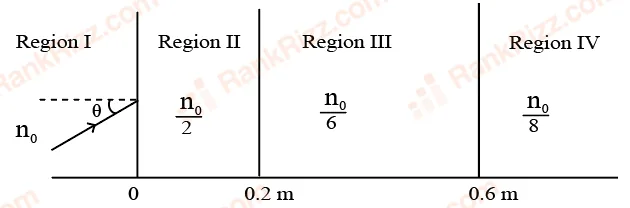
A light beam is traveling from Region I to Region IV (Refer Figure). The refractive index in Regions I, II, III and IV are and , respectively. The angle of incidence for which the beam just misses entering Region IV is 

  1. A

  2. B

  3. C

  4. D

Q32JEE ADVANCED 2008 · PAPER 2Relative motion in one dimensionTRANSCRIBED

STATEMENT-1
For an observer looking out through the window of a fast moving train, the nearby objects appear to movein the opposite direction to the train, while the distant objects appearto be stationary.
and
STATEMENT-2
If the observer and the object are moving at velocities and respectively with reference to a laboratory frame, the velocity of the object with respect to the observer is .

  1. A

    STATEMENT-1 is True, STATEMENT-2 is True; STATEMENT-2 is a correct explanation for STATEMENT-1

  2. B

    STATEMENT-1 is True, STATEMENT-2 is True; STATEMENT-2 is NOT a correct explanation for STATEMENT-1

  3. C

    STATEMENT-1 is True, STATEMENT-2 is False

  4. D

    STATEMENT-1 is False, STATEMENT-2 is True

Q33JEE ADVANCED 2008 · PAPER 2Static and kinetic frictionTRANSCRIBED

STATEMENT-1
It is easier to pull a heavy object than to pushit on a level ground.
and
STATEMENT-2
The magnitude of frictional force depends on the nature of the two surfaces in contact.

  1. A

    STATEMENT-1 is True, STATEMENT-2 is True; STATEMENT-2 is a correct explanation for STATEMENT-1

  2. B

    STATEMENT-1 is True, STATEMENT-2 is True; STATEMENT-2 is NOT a correct explanation for STATEMENT-1

  3. C

    STATEMENT-1 is True, STATEMENT-2 is False

  4. D

    STATEMENT-1 is False, STATEMENT-2 is True

Q34JEE ADVANCED 2008 · PAPER 2Relation between field and potential, equipotential surfacesTRANSCRIBED

STATEMENT-1
For practical purposes, the earth is used as a reference at zero potential in electrical circuits.
and
STATEMENT-2
The electrical potential of a sphere of radius R with charge Q uniformly distributed on the surface is given by .

  1. A

    STATEMENT-1 is True, STATEMENT-2 is True; STATEMENT-2 is a correct explanation for STATEMENT-1

  2. B

    STATEMENT-1 is True, STATEMENT-2 is True; STATEMENT-2 is NOT a correct explanation for STATEMENT-1

  3. C

    STATEMENT-1 is True, STATEMENT-2 is False

  4. D

    STATEMENT-1 is False, STATEMENT-2 is True

Q35JEE ADVANCED 2008 · PAPER 2Moving coil galvanometerTRANSCRIBED

STATEMENT-1
The sensitivity of a moving coil galvanometer is increased by placing a suitable magnetic material as a core inside the coil.
and
STATEMENT-2
Soft iron has a high magnetic permeability and cannot be easily magnetized or demagnetized.

  1. A

    STATEMENT-1 is True, STATEMENT-2 is True; STATEMENT-2 is a correct explanation for STATEMENT-1

  2. B

    STATEMENT-1 is True, STATEMENT-2 is True; STATEMENT-2 is NOT a correct explanation for STATEMENT-1

  3. C

    STATEMENT-1 is True, STATEMENT-2 is False

  4. D

    STATEMENT-1 is False, STATEMENT-2 is True

Q36JEE ADVANCED 2008 · PAPER 2Electric field of continuous charge distributionsTRANSCRIBED

The electric field at r = R is

  1. A

    independent of a

  2. B

    directly proportional to a

  3. C

    directly proportional to

  4. D

    inversely proportional to a

Q37JEE ADVANCED 2008 · PAPER 2Electric charge and Coulomb's lawTRANSCRIBED

For a = 0, the value of d (maximum value of as shown in the figure) is

  1. A

  2. B

  3. C

  4. D

Q38JEE ADVANCED 2008 · PAPER 2Electric field of continuous charge distributionsTRANSCRIBED

The electric field within the nucleus is generally observed to be linearly dependent on r. This implies

  1. A

    a = 0

  2. B

  3. C

    a = R

  4. D

Q39JEE ADVANCED 2008 · PAPER 2Rolling with friction, slipping and impulsive forcesTRANSCRIBED

The net external force acting on the disk whenits centre of mass is at displacement x with respect to its equilibrium position is

  1. A

    -kx

  2. B

    -2kx

  3. C

  4. D

Q40JEE ADVANCED 2008 · PAPER 2Rolling with friction, slipping and impulsive forcesTRANSCRIBED

The centre of mass of the disk undergoes simple harmonic motion with angular frequency equal to

  1. A

  2. B

  3. C

  4. D

Q41JEE ADVANCED 2008 · PAPER 2Rolling with friction, slipping and impulsive forcesTRANSCRIBED

The maximum value of for which the disk will roll without slipping is

  1. A

  2. B

  3. C

  4. D

Q42JEE ADVANCED 2008 · PAPER 2Spring-block oscillationsTRANSCRIBED

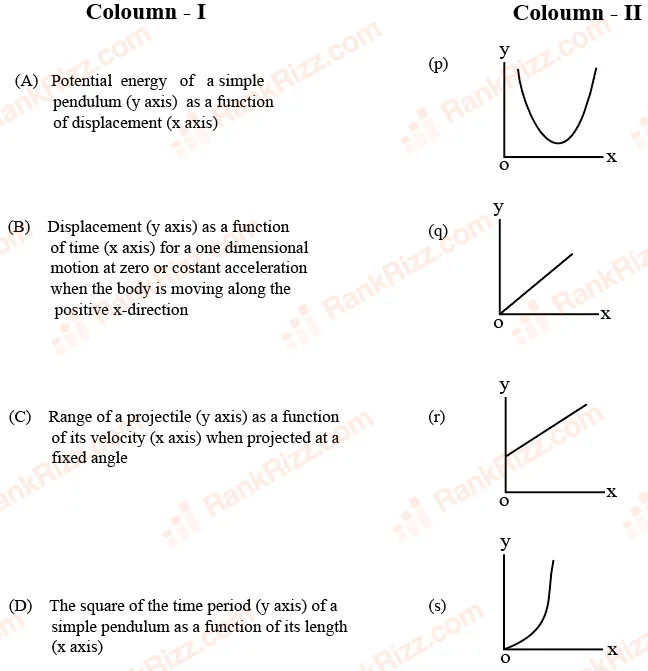
Column I gives a list of possible set of parameters measured in some experiments. The variations of the parameters in the form of graphs are shown in Column II. Match the set of parameters given in Column I with the graphs given in Column II. Indicate your answer by darkening the appropriate bubbles of the matrix given in the ORS.

Q43JEE ADVANCED 2008 · PAPER 2Combinations of lenses and mirrorsTRANSCRIBED

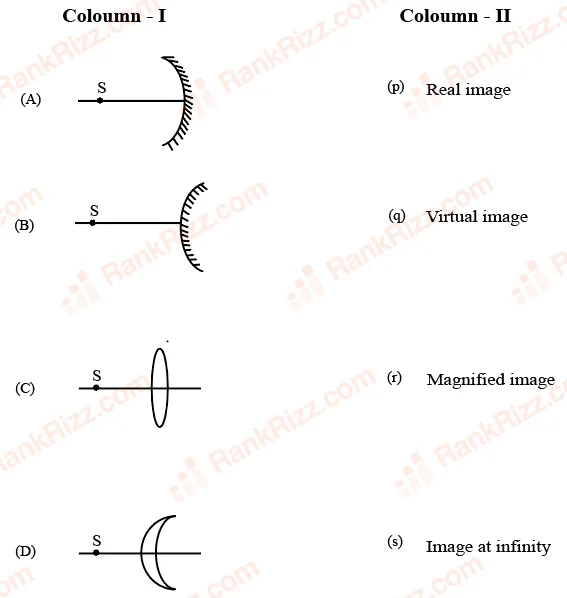
An optical component and an object S placed along its optic axis are given in Column I. The distance between the object and the component can be varied. The properties of images are given in Column II. Match all the properties of images from Column II with the appropriate components given in Column I. Indicate your answer by darkening the appropriate bubbles of the matrix given in the ORS.

Q44JEE ADVANCED 2008 · PAPER 2Multi-step processes and gas-piston-spring systemsTRANSCRIBED

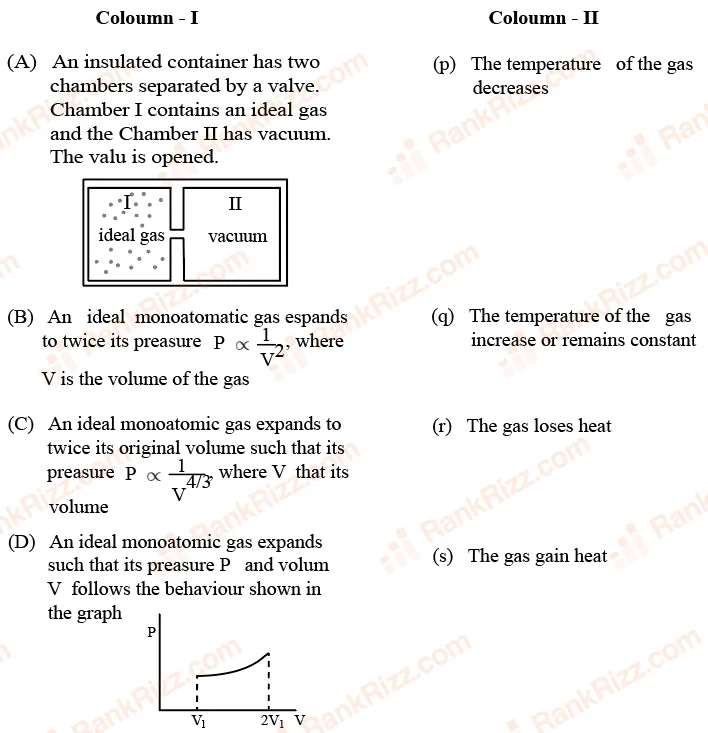
Column I contains a list of processes involving expansion of an ideal gas. Match this with Column II describing the thermodynamic change during this process. Indicate your answer by darkening the appropriate bubbles of the 4 x 4 matrix given in the ORS.

Chemistry

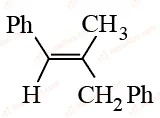
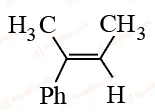
Q45JEE ADVANCED 2008 · PAPER 2Reactive intermediates and rearrangementsTRANSCRIBED

The correct stability order for the following species is

  1. A

    (II) > (IV) > (I) > (III)

  2. B

    (I) > (II) > (III) > (IV)

  3. C

    (II) > (I) > (IV) > (III)

  4. D

    (I) > (III) > (II) > (IV)

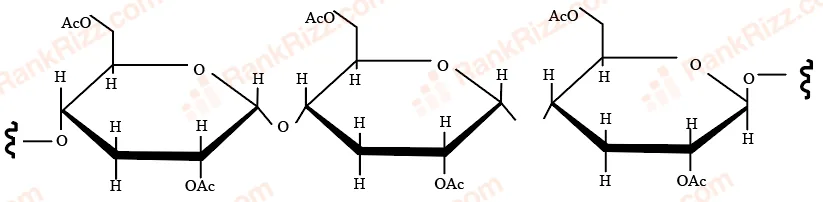
Q46JEE ADVANCED 2008 · PAPER 2Carbohydrates: classification and monosaccharidesTRANSCRIBED

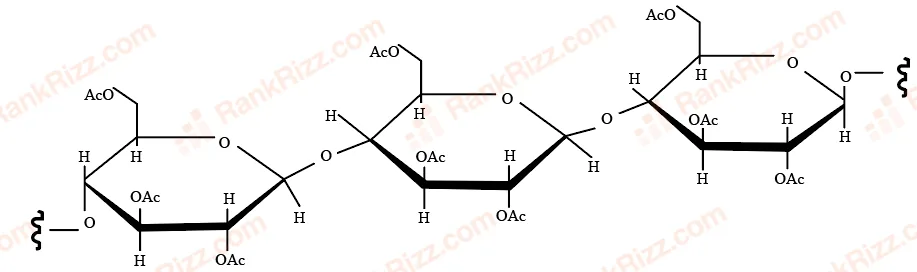
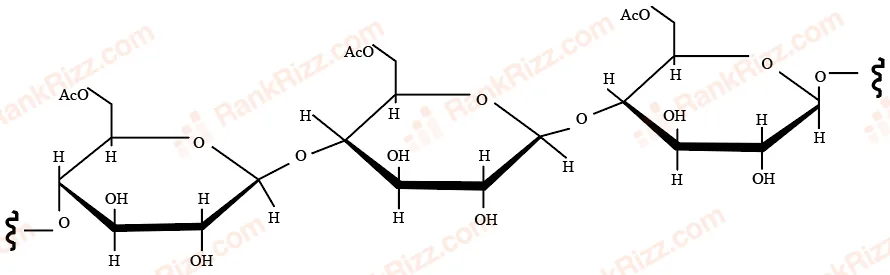
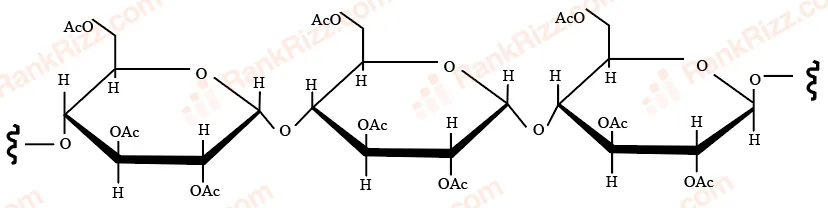
Cellulose upon acetylation with excess acetic anhydride/ (catalytic) gives cellulose triacetate whose structure is

  1. A
  2. B
  3. C
  4. D
Q47JEE ADVANCED 2008 · PAPER 2Aldol condensation, Cannizzaro and related reactionsTRANSCRIBED

In the following reaction sequence, the correct structures of E, F and G are 


(* implies labelled carbon)

  1. A
  2. B
  3. C
  4. D
Q48JEE ADVANCED 2008 · PAPER 2Colour and magnetic behaviour of complexes from CFTTRANSCRIBED

Among the following, the coloured compound is

  1. A

  2. B

  3. C

  4. D

Q49JEE ADVANCED 2008 · PAPER 2Valence bond theory of complexesTRANSCRIBED

Both and are diamagnetic. The hybridisations of nickel in these complexes, respectively, are

  1. A

  2. B

  3. C

  4. D

Q50JEE ADVANCED 2008 · PAPER 2IUPAC nomenclature of coordination compoundsTRANSCRIBED

The IUPAC name of is

  1. A

    Tetrachloronickel(II) - tetraamminenickel(II)

  2. B

    Tetraamminenickel(II) - tetrachloronickel (II)

  3. C

    Tetraamminenickel(II) - tetrachloronickelate (II)

  4. D

    Tetrachloronickel (II) - tetraamminenickelate (0)

Q51JEE ADVANCED 2008 · PAPER 2Conductance, conductivity and molar conductivityTRANSCRIBED

Electrolysis of dilute aqueous NaCl solution was carried out by passing 10 milli ampere current. The time required to liberate 0.01 mol of H, gas at the cathode is (1 Faraday = 96500 C mol)

  1. A

    sec

  2. B

    sec

  3. C

    sec

  4. D

    sec

Q52JEE ADVANCED 2008 · PAPER 2Properties of colloids and coagulationTRANSCRIBED

Among the following, the surfactant that will form micelles in aqueous solution at the lowest molar concentration at ambient conditions is

  1. A

  2. B

  3. C

  4. D

Q53JEE ADVANCED 2008 · PAPER 2Solubility product and common ion effectTRANSCRIBED

Solubility product constants of salts of types and at temperature ‘T’ are and , respectively. Solubilities (mol dm) of the salts at temperature 'T' are in the order

  1. A

    MX > MX_2 > M_3X

  2. B

    M_3X > MX_2 > MX

  3. C

    MX_2 > M_3X > MX

  4. D

    MX > M_3X > MX_2

Q54JEE ADVANCED 2008 · PAPER 2Diazonium saltsTRANSCRIBED

STATEMENT-1: Aniline on reaction with at followed by coupling with - naphthol gives a dark blue coloured precipitate.
and
STATEMENT-2: The colour of the compound formed in the reaction of aniline with at followed by coupling with - naphthol is due to the extended conjugation.

  1. A

    STATEMENT-1 is True, STATEMENT-2 is True; STATEMENT-2 is a correct explanation for STATEMENT-1

  2. B

    STATEMENT-1 is True, STATEMENT-2 is True; STATEMENT-2 is NOT a correct explanation for STATEMENT-1

  3. C

    STATEMENT-1 is True, STATEMENT-2 is False

  4. D

    STATEMENT-1 is False, STATEMENT-2 is True

Q55JEE ADVANCED 2008 · PAPER 2Colour and magnetic behaviour of complexes from CFTTRANSCRIBED

STATEMENT-1: is paramagnetic.
and
STATEMENT-2: The Fe in has three unpaired electrons.

  1. A

    STATEMENT-1 is True, STATEMENT-2 is True; STATEMENT-2 is a correct explanation for STATEMENT-1

  2. B

    STATEMENT-1 is True, STATEMENT-2 is True; STATEMENT-2 is NOT a correct explanation for STATEMENT-1

  3. C

    STATEMENT-1 is True, STATEMENT-2 is False

  4. D

    STATEMENT-1 is False, STATEMENT-2 is True

Q56JEE ADVANCED 2008 · PAPER 2Geometrical and optical isomerism in complexesTRANSCRIBED

STATEMENT-1: The geometrical isomers of the complex are optically inactive.
and
STATEMENT-2: Both geometrical isomers of the complex possess axis of symmetry.

  1. A

    STATEMENT-1 is True, STATEMENT-2 is True; STATEMENT-2 is a correct explanation for STATEMENT-1

  2. B

    STATEMENT-1 is True, STATEMENT-2 is True; STATEMENT-2 is NOT a correct explanation for STATEMENT-1

  3. C

    STATEMENT-1 is True, STATEMENT-2 is False

  4. D

    STATEMENT-1 is False, STATEMENT-2 is True

Q57JEE ADVANCED 2008 · PAPER 2Entropy and the second lawTRANSCRIBED

STATEMENT-1: There is a natural asymmetry between converting work to heat and converting heat to work.
and
STATEMENT-2: Noprocessis possible in which the sole result is the absorption of heat from a reservoir and its complete conversion into work.

  1. A

    STATEMENT-1 is True, STATEMENT-2 is True; STATEMENT-2 is a correct explanation for STATEMENT-1

  2. B

    STATEMENT-1 is True, STATEMENT-2 is True; STATEMENT-2 is NOT a correct explanation for STATEMENT-1

  3. C

    STATEMENT-1 is True, STATEMENT-2 is False

  4. D

    STATEMENT-1 is False, STATEMENT-2 is True

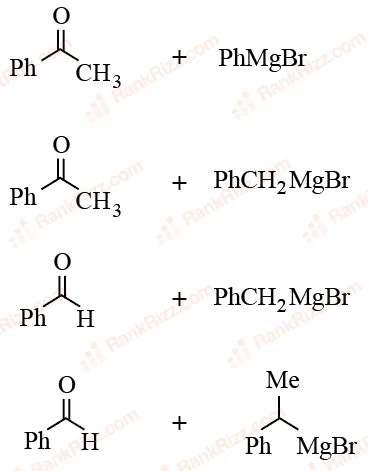
Q58JEE ADVANCED 2008 · PAPER 2Properties and reactions of alcoholsTRANSCRIBED

Compound H is formed by the reaction of 

  1. A

    Figure 1

  2. B

    Figure 2

  3. C

    Figure 3

  4. D

    Figure 4

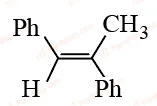
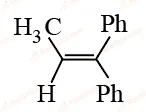
Q59JEE ADVANCED 2008 · PAPER 2Properties and reactions of alcoholsTRANSCRIBED

The structure of compound I is

  1. A
  2. B
  3. C
  4. D
Q60JEE ADVANCED 2008 · PAPER 2Aldol condensation, Cannizzaro and related reactionsTRANSCRIBED

The structures of compounds J, K and L, respectively, are

  1. A

    and

  2. B

    and

  3. C

    and

  4. D

    and

Q61JEE ADVANCED 2008 · PAPER 2Voids, radius ratio and structures of ionic solidsTRANSCRIBED

The number of atoms in this HCP unitcell is

  1. A

    4

  2. B

    6

  3. C

    12

  4. D

    17

Q62JEE ADVANCED 2008 · PAPER 2Voids, radius ratio and structures of ionic solidsTRANSCRIBED

The volume of this HCP unitcell is

  1. A

  2. B

  3. C

  4. D

Q63JEE ADVANCED 2008 · PAPER 2Voids, radius ratio and structures of ionic solidsTRANSCRIBED

The emptyspace in this HCP unit cell is

  1. A

    74%

  2. B

    47.6%

  3. C

    32%

  4. D

    26%

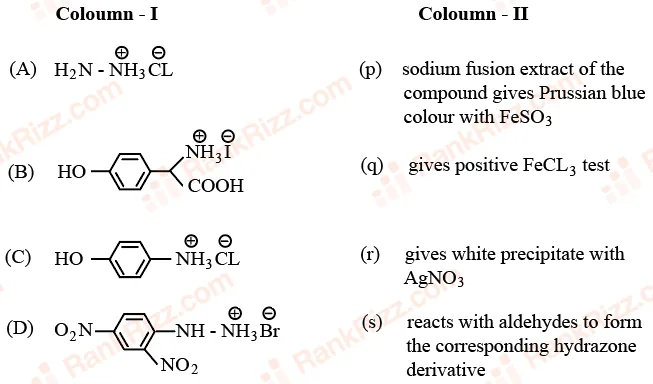
Q64JEE ADVANCED 2008 · PAPER 2Diazonium saltsTRANSCRIBED

Match the compounds in Column I with their characteristic test(s)/reaction(s) given in Column II. Indicate your answer by darkening the appropriate bubbles of the matrix given in the ORS.

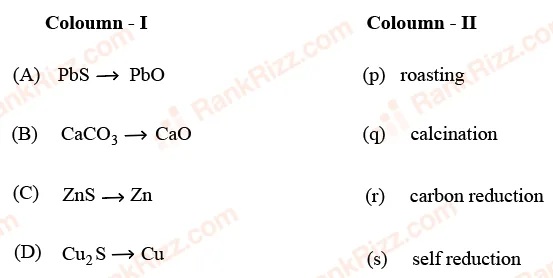
Q65JEE ADVANCED 2008 · PAPER 2Extraction of Fe, Cu, Zn, Al, Ag and AuTRANSCRIBED

Match the conversions in Column I with the type(s) of reaction(s) given in Column II. Indicate your answer by darkening the appropriate bubbles of the matrix given in the ORS

Q66JEE ADVANCED 2008 · PAPER 2Quantum numbers and shapes of orbitalsTRANSCRIBED

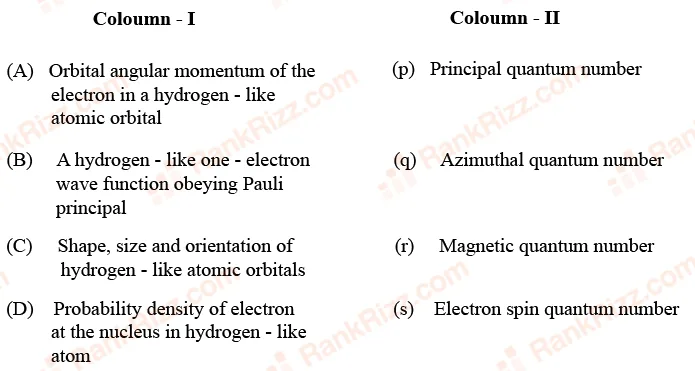
Match the entries in Column  I with the correctly related quantum number(s) in Column II. Indicate your answer by darkening the appropriate bubbles of the matrix given in the ORS