RankRizz
UNIQUE CONCEPTS · MATHS

Vector Algebra: 332 past questions, 7 ideas

Every idea JEE has asked in Vector Algebra, one past question each — the most recently set — with how many times the examiner has come back to it. Do these 7; where one goes wrong, practise every question on that idea.

Past questions

332

Ideas

7

Set again later

0

Years

2004–26

Download PDFEvery Vector Algebra question

How these ideas are grouped

An idea here is one syllabus topic — the finest tag our past questions carry. A topic can hold more than one technique, so treat each question as the door into an idea, not the whole of it. Every topic in Vector Algebra has at least one past question, so none is missing from this sheet.

The 7 ideas, most asked first

01

Vector (cross) product and area

ASKED 131× · 2004–2026, 20 DIFFERENT YEARS · 120 MAIN, 11 ADVANCED

set 131×
JEE ADVANCED 2026 · PAPER 2MOST RECENTLY SETTRANSCRIBED

Let a⃗,b⃗\vec{a},\vec{b} be two vectors, and let P,QP,Q and RR be the points with position vectors a⃗\vec{a}, b⃗\vec{b} and a⃗+b⃗\vec{a}+\vec{b}, respectively, with respect to the origin OO. If ∣a⃗+b⃗∣=21|\vec{a}+\vec{b}|=\sqrt{21}, ∣a⃗−b⃗∣=3|\vec{a}-\vec{b}|=3, and a⃗\vec{a} and (a⃗−b⃗)(\vec{a}-\vec{b}) are perpendicular to each other, then the area of the triangle OPROPR is

  1. A

    3\sqrt{3}

  2. B

    32\dfrac{\sqrt{3}}{2}

  3. C

    332\dfrac{3\sqrt{3}}{2}

  4. D

    32\dfrac{3}{2}

02

Scalar (dot) product

ASKED 76× · 2004–2026, 20 DIFFERENT YEARS · 64 MAIN, 12 ADVANCED

set 76×
JEE MAIN 2026 · 04 APR S2MOST RECENTLY SETTRANSCRIBED

Let u^\hat{u} and v^\hat{v} be unit vectors inclined at acute angle such that ∣u^×v^∣=32|\hat{u} \times \hat{v}| = \frac{\sqrt{3}}{2}. If A⃗=λu^+v^+(u^×v^)\vec{A} = \lambda\hat{u} + \hat{v} + (\hat{u} \times \hat{v}), then λ\lambda is equal to :

  1. A

    43(A⃗⋅u^)−23(A⃗⋅v^)\frac{4}{3}(\vec{A} \cdot \hat{u}) - \frac{2}{3}(\vec{A} \cdot \hat{v})

  2. B

    23(A⃗⋅u^)−13(A⃗⋅v^)\frac{2}{3}(\vec{A} \cdot \hat{u}) - \frac{1}{3}(\vec{A} \cdot \hat{v})

  3. C

    43(A⃗⋅u^)+23(A⃗⋅v^)\frac{4}{3}(\vec{A} \cdot \hat{u}) + \frac{2}{3}(\vec{A} \cdot \hat{v})

  4. D

    (A⃗⋅u^)−12(A⃗⋅v^)(\vec{A} \cdot \hat{u}) - \frac{1}{2}(\vec{A} \cdot \hat{v})

03

Scalar triple product and coplanarity

ASKED 74× · 2004–2026, 20 DIFFERENT YEARS · 60 MAIN, 14 ADVANCED

set 74×
JEE ADVANCED 2026 · PAPER 1MOST RECENTLY SETTRANSCRIBED

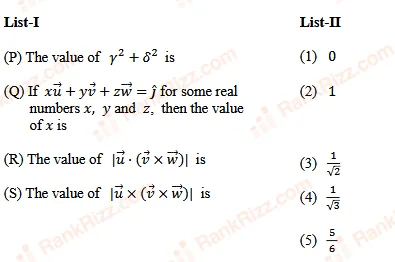
For real numbers α,β,γ,δ\alpha,\beta,\gamma,\delta and μ\mu, consider the matrix M=[α12−1213β13γδμ].M=\begin{bmatrix}\alpha&\tfrac{1}{\sqrt{2}}&-\tfrac{1}{\sqrt{2}}\\[2pt]\tfrac{1}{\sqrt{3}}&\beta&\tfrac{1}{\sqrt{3}}\\[2pt]\gamma&\delta&\mu\end{bmatrix}.

Suppose that MMT=IMM^{T}=I, where MTM^{T} is the transpose of MM and II is the 3×33\times 3 identity matrix. Let u⃗=αi^+13j^+γk^,v⃗=12i^+βj^+δk^,w⃗=−12i^+13j^+μk^.\vec{u}=\alpha\hat{i}+\tfrac{1}{\sqrt{3}}\hat{j}+\gamma\hat{k},\quad \vec{v}=\tfrac{1}{\sqrt{2}}\hat{i}+\beta\hat{j}+\delta\hat{k},\quad \vec{w}=-\tfrac{1}{\sqrt{2}}\hat{i}+\tfrac{1}{\sqrt{3}}\hat{j}+\mu\hat{k}.

Match each entry in List-I to the correct entry in List-II and choose the correct option.

Figure for JEE Advanced 2026 Mathematics question on Scalar triple product and coplanarity
  1. A

    (P)→\to(5), (Q)→\to(4), (R)→\to(2), (S)→\to(1)

  2. B

    (P)→\to(4), (Q)→\to(5), (R)→\to(1), (S)→\to(2)

  3. C

    (P)→\to(5), (Q)→\to(3), (R)→\to(2), (S)→\to(1)

  4. D

    (P)→\to(5), (Q)→\to(4), (R)→\to(1), (S)→\to(2)

04

Vector algebra, components and section formula

ASKED 40× · 2004–2026, 19 DIFFERENT YEARS · 37 MAIN, 3 ADVANCED

set 40×
JEE MAIN 2026 · 05 APR S2MOST RECENTLY SETTRANSCRIBED

Let OO be the origin, OP→=a⃗\overrightarrow{OP} = \vec{a} and OQ→=b⃗\overrightarrow{OQ} = \vec{b}.If RR is the point on OP→\overrightarrow{OP} such that OP→=5OR→\overrightarrow{OP} = 5\overrightarrow{OR}, and MM is the point such that OQ→=5RM→\overrightarrow{OQ} = 5\overrightarrow{RM}. Then PM→\overrightarrow{PM} is equal to :

  1. A

    15(a⃗−4b⃗)\frac{1}{5}(\vec{a} - 4\vec{b})

  2. B

    15(b⃗−4a⃗)\frac{1}{5}(\vec{b} - 4\vec{a})

  3. C

    15(−a⃗+4b⃗)\frac{1}{5}(-\vec{a} + 4\vec{b})

  4. D

    15(−b⃗+4a⃗)\frac{1}{5}(-\vec{b} + 4\vec{a})

05

Vector triple product and vector equations

ASKED 6× · 2004–2012, 5 DIFFERENT YEARS

set 6×
JEE MAIN 2012MOST RECENTLY SETTRANSCRIBED

A unit vector which is perpendicular to the vector 2i^−j^+2k^2\hat{i} - \hat{j} + 2\hat{k} and is coplanar with the vectors i^+j^−k^\hat{i} + \hat{j} - \hat{k} and 2i^+2j^−k^2\hat{i} + 2\hat{j} - \hat{k} is

  1. A

    2j^+k^5\dfrac{2\hat{j} + \hat{k}}{\sqrt{5}}

  2. B

    3i^+2j^−2k^17\dfrac{3\hat{i} + 2\hat{j} - 2\hat{k}}{\sqrt{17}}

  3. C

    3i^+2j^+2k^17\dfrac{3\hat{i} + 2\hat{j} + 2\hat{k}}{\sqrt{17}}

  4. D

    2i^+2j^−k^3\dfrac{2\hat{i} + 2\hat{j} - \hat{k}}{3}

06

Projection and resolution of vectors

ASKED 3× · 2004, 2012

set 3×
JEE MAIN 2012MOST RECENTLY SETTRANSCRIBED

Let ABCDABCD be a parallelogram such that AB⃗=q⃗\vec{AB} = \vec{q}, AD⃗=p⃗\vec{AD} = \vec{p} and ∠BAD\angle BAD be an acute angle. If r⃗\vec{r} is the vector that coincides with the altitude directed from the vertex BB to the side ADAD, then r⃗\vec{r} is given by

  1. A

    r⃗=3q⃗−3(p⃗⋅q⃗)(p⃗⋅p⃗)p⃗\vec{r} = 3\vec{q} - \frac{3(\vec{p} \cdot \vec{q})}{(\vec{p} \cdot \vec{p})}\vec{p}

  2. B

    r⃗=−q⃗+(p⃗⋅q⃗p⃗⋅p⃗)p⃗\vec{r} = -\vec{q} + \left(\frac{\vec{p} \cdot \vec{q}}{\vec{p} \cdot \vec{p}}\right)\vec{p}

  3. C

    r⃗=q⃗−(p⃗⋅q⃗p⃗⋅p⃗)p⃗\vec{r} = \vec{q} - \left(\frac{\vec{p} \cdot \vec{q}}{\vec{p} \cdot \vec{p}}\right)\vec{p}

  4. D

    r⃗=−3q⃗+3(p⃗⋅q⃗)(p⃗⋅p⃗)p⃗\vec{r} = -3\vec{q} + \frac{3(\vec{p} \cdot \vec{q})}{(\vec{p} \cdot \vec{p})}\vec{p}

07

Vectors in geometry

ASKED 2× · 2004, 2006

set 2×
JEE MAIN 2006MOST RECENTLY SETTRANSCRIBED

ABCABC is a triangle, right angled at AA. The resultant of the forces acting along AB→,AC→\overrightarrow{AB}, \overrightarrow{AC} with magnitudes 1AB\dfrac{1}{AB} and 1AC\dfrac{1}{AC} respectively is the force along AD→\overrightarrow{AD}, where DD is the foot of the perpendicular from AA onto BCBC. The magnitude of the resultant is

  1. A

    AB2+AC2(AB)2(AC)2\dfrac{AB^2 + AC^2}{(AB)^2(AC)^2}

  2. B

    (AB)(AC)AB+AC\dfrac{(AB)(AC)}{AB + AC}

  3. C

    1AB+1AC\dfrac{1}{AB} + \dfrac{1}{AC}

  4. D

    1AD\dfrac{1}{AD}

Got one wrong? Practise that idea, graded.

A free account opens every past question on an idea with the answer checked as you go, and files your mistakes by idea.

Not ready? Get new sheets by email

A note when a chapter’s sheet changes or a new one is added. No account, no spam, one click to leave.

OTHER MATHS SHEETS