RankRizz
UNIQUE CONCEPTS · MATHS

Complex Numbers: 254 past questions, 7 ideas

Every idea JEE has asked in Complex Numbers, one past question each — the most recently set — with how many times the examiner has come back to it. Do these 7; where one goes wrong, practise every question on that idea.

Past questions

254

Ideas

7

Set again later

1

Years

2004–26

Download PDFEvery Complex Numbers question

How these ideas are grouped

An idea here is one syllabus topic — the finest tag our past questions carry. A topic can hold more than one technique, so treat each question as the door into an idea, not the whole of it. Every topic in Complex Numbers has at least one past question, so none is missing from this sheet.

The 7 ideas, most asked first

01

Locus and regions in the Argand plane

ASKED 69× · 2004–2026, 18 DIFFERENT YEARS · 57 MAIN, 12 ADVANCED

set 69×
JEE ADVANCED 2026 · PAPER 2MOST RECENTLY SETTRANSCRIBED

Let R\mathbb{R} denote the set of all real numbers and let i=−1i=\sqrt{-1}. Consider the matrices

S=[0−110]andT=[1101].S=\begin{bmatrix}0&-1\\1&0\end{bmatrix}\quad\text{and}\quad T=\begin{bmatrix}1&1\\0&1\end{bmatrix}.

Let a,b,c,da,b,c,d be real numbers such that

ST=[abcd].ST=\begin{bmatrix}a&b\\c&d\end{bmatrix}.

Let

H={ x+iy:  x,y∈R  and  y>0 }.H=\{\,x+iy:\;x,y\in\mathbb{R}\;\text{and}\;y>0\,\}.

Then which of the following statements is (are) TRUE?

  1. A

    b+iad+ic=i\dfrac{b+ia}{d+ic}=i

  2. B

    If ω=−1+i32\omega=\dfrac{-1+i\sqrt{3}}{2}, then aω+bcω+d=ω\dfrac{a\omega+b}{c\omega+d}=\omega

  3. C

    If mm is an integer greater than 22 such that (ST)2=(ST)m(ST)^2=(ST)^m, then mm is an integer multiple of 88

  4. D

    If z∈Hz\in H, then az+bcz+d∈H\dfrac{az+b}{cz+d}\in H

02

Modulus and conjugate

ASKED 62× · 2005–2026, 16 DIFFERENT YEARS · 52 MAIN, 10 ADVANCED

set 62×
JEE MAIN 2026 · 06 APR S1MOST RECENTLY SETTRANSCRIBED

Let the set of all values of k∈Rk \in \mathbb{R} such that the equation z(zˉ+2+i)+k(2+3i)=0z(\bar{z} + 2 + i) + k(2 + 3i) = 0, z∈Cz \in \mathbb{C}, has at least one solution, be the interval [α,β][\alpha, \beta]. Then 9(α+β)9(\alpha + \beta) is equal to:

  1. A

    −10-10

  2. B

    −8-8

  3. C

    101310\sqrt{13}

  4. D

    8138\sqrt{13}

03

Algebra of complex numbers and square roots

ASKED 56× · 2004–2026, 16 DIFFERENT YEARS · 53 MAIN, 3 ADVANCED

set 56×
JEE MAIN 2026 · 06 APR S2MOST RECENTLY SETTRANSCRIBED

Let S={z∈C:z2+6 iz−3=0}S = \{z \in \mathbb{C} : z^2 + \sqrt{6}\,iz - 3 = 0\}. Then ∑z∈Sz8\displaystyle\sum_{z \in S} z^8 is equal to :

  1. A

    162

  2. B

    184

  3. C

    262

  4. D

    324

04

Argument, polar and Euler form

ASKED 23× · 2004–2026, 14 DIFFERENT YEARS · 17 MAIN, 6 ADVANCED

set 23×
JEE MAIN 2026 · 21 JAN S2MOST RECENTLY SETTRANSCRIBED

Let zz be the complex number satisfying ∣z−5∣≤3|z-5|\leq 3 and having maximum positive principal argument. Then 34∣5z−125iz+16∣234|\frac{5z-12}{5iz+16}|^2 is equal to :

  1. A

    20

  2. B

    12

  3. C

    26

  4. D

    16

05

Cube roots and nth roots of unity

ASKED 22× · 2005–2026, 11 DIFFERENT YEARS · 18 MAIN, 4 ADVANCED

set 22×
JEE ADVANCED 2026 · PAPER 1MOST RECENTLY SETTRANSCRIBED

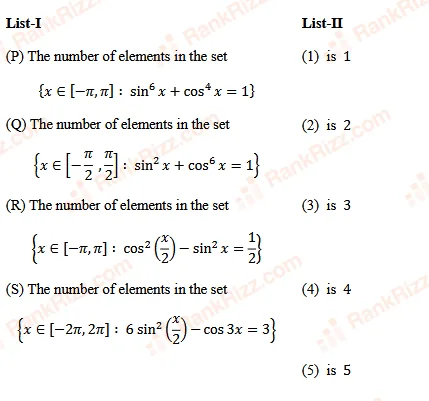
Match each entry in List-I to the correct entry in List-II and choose the correct option.

Figure for JEE Advanced 2026 Mathematics question on Cube roots and nth roots of unity
  1. A

    (P)→\to(2), (Q)→\to(5), (R)→\to(3), (S)→\to(4)

  2. B

    (P)→\to(5), (Q)→\to(3), (R)→\to(2), (S)→\to(4)

  3. C

    (P)→\to(5), (Q)→\to(4), (R)→\to(1), (S)→\to(3)

  4. D

    (P)→\to(4), (Q)→\to(3), (R)→\to(2), (S)→\to(5)

06

De Moivre's theorem and powers of complex numbers

ASKED 21× · 2009–2026, 12 DIFFERENT YEARS · 17 MAIN, 4 ADVANCED

set 21×
JEE MAIN 2026 · 23 JAN S2MOST RECENTLY SETTRANSCRIBED

If z=32+i2,i=−1, then (z201−i)8 is equal to z = \frac{\sqrt{3}}{2}+\frac{i}{2},i=\sqrt{-1},\text{ then }(z^{201}-i)^{8}\text{ is equal to }

  1. A

    0

  2. B

    1

  3. C

    256

  4. D

    -1

07

Rotation and geometry with complex numbers

ASKED 1× · 2012

set 1×
JEE MAIN 2012MOST RECENTLY SETTRANSCRIBED

The area of the triangle whose vertices are complex numbers z,iz,z+izz, iz, z + iz in the Argand diagram is

  1. A

    2∣z∣22|z|^2

  2. B

    12∣z∣2\dfrac{1}{2}|z|^2

  3. C

    4∣z∣24|z|^2

  4. D

    ∣z∣2|z|^2

Got one wrong? Practise that idea, graded.

A free account opens every past question on an idea with the answer checked as you go, and files your mistakes by idea.

Not ready? Get new sheets by email

A note when a chapter’s sheet changes or a new one is added. No account, no spam, one click to leave.

OTHER MATHS SHEETS