In the print dialog choose “Save as PDF”. Turn off the browser’s own headers and footers; the sheet has its own.

RankRizzUNIQUE CONCEPTS

Vector Algebra

MATHS · 7 IDEAS · 332 PAST QUESTIONS · JEE MAIN + ADVANCED · 2004–2026

HOW TO USE THIS SHEET

One past question per idea, most-asked idea first; each is the most recent time the examiner set it. Answer it cold. Check your answer at the address printed beside it — there is no key in this sheet. An idea here is one syllabus topic — the finest tag our past questions carry. A topic can hold more than one technique, so treat each question as the door into an idea, not the whole of it.

  1. 01Vector (cross) product and areaset 131×

    ASKED 131× · 2004–2026, 20 DIFFERENT YEARS · THIS ONE: JEE ADVANCED 2026 · PAPER 2

    Let a⃗,b⃗\vec{a},\vec{b} be two vectors, and let P,QP,Q and RR be the points with position vectors a⃗\vec{a}, b⃗\vec{b} and a⃗+b⃗\vec{a}+\vec{b}, respectively, with respect to the origin OO. If ∣a⃗+b⃗∣=21|\vec{a}+\vec{b}|=\sqrt{21}, ∣a⃗−b⃗∣=3|\vec{a}-\vec{b}|=3, and a⃗\vec{a} and (a⃗−b⃗)(\vec{a}-\vec{b}) are perpendicular to each other, then the area of the triangle OPROPR is

    1. (A)

      3\sqrt{3}

    2. (B)

      32\dfrac{\sqrt{3}}{2}

    3. (C)

      332\dfrac{3\sqrt{3}}{2}

    4. (D)

      32\dfrac{3}{2}

    CHECK IT: rankrizz.com/jee-advanced/maths/vector-algebra/q/2026-paper-2-q37

  2. 02Scalar (dot) productset 76×

    ASKED 76× · 2004–2026, 20 DIFFERENT YEARS · THIS ONE: JEE MAIN 2026 · 04 APR S2

    Let u^\hat{u} and v^\hat{v} be unit vectors inclined at acute angle such that ∣u^×v^∣=32|\hat{u} \times \hat{v}| = \frac{\sqrt{3}}{2}. If A⃗=λu^+v^+(u^×v^)\vec{A} = \lambda\hat{u} + \hat{v} + (\hat{u} \times \hat{v}), then λ\lambda is equal to :

    1. (A)

      43(A⃗⋅u^)−23(A⃗⋅v^)\frac{4}{3}(\vec{A} \cdot \hat{u}) - \frac{2}{3}(\vec{A} \cdot \hat{v})

    2. (B)

      23(A⃗⋅u^)−13(A⃗⋅v^)\frac{2}{3}(\vec{A} \cdot \hat{u}) - \frac{1}{3}(\vec{A} \cdot \hat{v})

    3. (C)

      43(A⃗⋅u^)+23(A⃗⋅v^)\frac{4}{3}(\vec{A} \cdot \hat{u}) + \frac{2}{3}(\vec{A} \cdot \hat{v})

    4. (D)

      (A⃗⋅u^)−12(A⃗⋅v^)(\vec{A} \cdot \hat{u}) - \frac{1}{2}(\vec{A} \cdot \hat{v})

    CHECK IT: rankrizz.com/jee-main/maths/vector-algebra/q/4-apr-2026-s2-q15

  3. 03Scalar triple product and coplanarityset 74×

    ASKED 74× · 2004–2026, 20 DIFFERENT YEARS · THIS ONE: JEE ADVANCED 2026 · PAPER 1

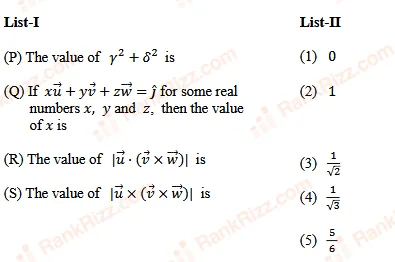
    For real numbers α,β,γ,δ\alpha,\beta,\gamma,\delta and μ\mu, consider the matrix M=[α12−1213β13γδμ].M=\begin{bmatrix}\alpha&\tfrac{1}{\sqrt{2}}&-\tfrac{1}{\sqrt{2}}\\[2pt]\tfrac{1}{\sqrt{3}}&\beta&\tfrac{1}{\sqrt{3}}\\[2pt]\gamma&\delta&\mu\end{bmatrix}.

    Suppose that MMT=IMM^{T}=I, where MTM^{T} is the transpose of MM and II is the 3×33\times 3 identity matrix. Let u⃗=αi^+13j^+γk^,v⃗=12i^+βj^+δk^,w⃗=−12i^+13j^+μk^.\vec{u}=\alpha\hat{i}+\tfrac{1}{\sqrt{3}}\hat{j}+\gamma\hat{k},\quad \vec{v}=\tfrac{1}{\sqrt{2}}\hat{i}+\beta\hat{j}+\delta\hat{k},\quad \vec{w}=-\tfrac{1}{\sqrt{2}}\hat{i}+\tfrac{1}{\sqrt{3}}\hat{j}+\mu\hat{k}.

    Match each entry in List-I to the correct entry in List-II and choose the correct option.
    image
    1. (A)

      (P)→\to(5), (Q)→\to(4), (R)→\to(2), (S)→\to(1)

    2. (B)

      (P)→\to(4), (Q)→\to(5), (R)→\to(1), (S)→\to(2)

    3. (C)

      (P)→\to(5), (Q)→\to(3), (R)→\to(2), (S)→\to(1)

    4. (D)

      (P)→\to(5), (Q)→\to(4), (R)→\to(1), (S)→\to(2)

    CHECK IT: rankrizz.com/jee-advanced/maths/vector-algebra/q/2026-paper-1-q47

  4. 04Vector algebra, components and section formulaset 40×

    ASKED 40× · 2004–2026, 19 DIFFERENT YEARS · THIS ONE: JEE MAIN 2026 · 05 APR S2

    Let OO be the origin, OP→=a⃗\overrightarrow{OP} = \vec{a} and OQ→=b⃗\overrightarrow{OQ} = \vec{b}.If RR is the point on OP→\overrightarrow{OP} such that OP→=5OR→\overrightarrow{OP} = 5\overrightarrow{OR}, and MM is the point such that OQ→=5RM→\overrightarrow{OQ} = 5\overrightarrow{RM}. Then PM→\overrightarrow{PM} is equal to :

    1. (A)

      15(a⃗−4b⃗)\frac{1}{5}(\vec{a} - 4\vec{b})

    2. (B)

      15(b⃗−4a⃗)\frac{1}{5}(\vec{b} - 4\vec{a})

    3. (C)

      15(−a⃗+4b⃗)\frac{1}{5}(-\vec{a} + 4\vec{b})

    4. (D)

      15(−b⃗+4a⃗)\frac{1}{5}(-\vec{b} + 4\vec{a})

    CHECK IT: rankrizz.com/jee-main/maths/vector-algebra/q/5-apr-2026-s2-q16

  5. 05Vector triple product and vector equationsset 6×

    ASKED 6× · 2004–2012, 5 DIFFERENT YEARS · THIS ONE: JEE MAIN 2012

    A unit vector which is perpendicular to the vector 2i^−j^+2k^2\hat{i} - \hat{j} + 2\hat{k} and is coplanar with the vectors i^+j^−k^\hat{i} + \hat{j} - \hat{k} and 2i^+2j^−k^2\hat{i} + 2\hat{j} - \hat{k} is

    1. (A)

      2j^+k^5\dfrac{2\hat{j} + \hat{k}}{\sqrt{5}}

    2. (B)

      3i^+2j^−2k^17\dfrac{3\hat{i} + 2\hat{j} - 2\hat{k}}{\sqrt{17}}

    3. (C)

      3i^+2j^+2k^17\dfrac{3\hat{i} + 2\hat{j} + 2\hat{k}}{\sqrt{17}}

    4. (D)

      2i^+2j^−k^3\dfrac{2\hat{i} + 2\hat{j} - \hat{k}}{3}

    CHECK IT: rankrizz.com/jee-main/maths/vector-algebra/q/2012-maths-499466

  6. 06Projection and resolution of vectorsset 3×

    ASKED 3× · 2004, 2012 · THIS ONE: JEE MAIN 2012

    Let ABCDABCD be a parallelogram such that AB⃗=q⃗\vec{AB} = \vec{q}, AD⃗=p⃗\vec{AD} = \vec{p} and ∠BAD\angle BAD be an acute angle. If r⃗\vec{r} is the vector that coincides with the altitude directed from the vertex BB to the side ADAD, then r⃗\vec{r} is given by

    1. (A)

      r⃗=3q⃗−3(p⃗⋅q⃗)(p⃗⋅p⃗)p⃗\vec{r} = 3\vec{q} - \frac{3(\vec{p} \cdot \vec{q})}{(\vec{p} \cdot \vec{p})}\vec{p}

    2. (B)

      r⃗=−q⃗+(p⃗⋅q⃗p⃗⋅p⃗)p⃗\vec{r} = -\vec{q} + \left(\frac{\vec{p} \cdot \vec{q}}{\vec{p} \cdot \vec{p}}\right)\vec{p}

    3. (C)

      r⃗=q⃗−(p⃗⋅q⃗p⃗⋅p⃗)p⃗\vec{r} = \vec{q} - \left(\frac{\vec{p} \cdot \vec{q}}{\vec{p} \cdot \vec{p}}\right)\vec{p}

    4. (D)

      r⃗=−3q⃗+3(p⃗⋅q⃗)(p⃗⋅p⃗)p⃗\vec{r} = -3\vec{q} + \frac{3(\vec{p} \cdot \vec{q})}{(\vec{p} \cdot \vec{p})}\vec{p}

    CHECK IT: rankrizz.com/jee-main/maths/vector-algebra/q/2012-maths-499114

  7. 07Vectors in geometryset 2×

    ASKED 2× · 2004, 2006 · THIS ONE: JEE MAIN 2006

    ABCABC is a triangle, right angled at AA. The resultant of the forces acting along AB→,AC→\overrightarrow{AB}, \overrightarrow{AC} with magnitudes 1AB\dfrac{1}{AB} and 1AC\dfrac{1}{AC} respectively is the force along AD→\overrightarrow{AD}, where DD is the foot of the perpendicular from AA onto BCBC. The magnitude of the resultant is

    1. (A)

      AB2+AC2(AB)2(AC)2\dfrac{AB^2 + AC^2}{(AB)^2(AC)^2}

    2. (B)

      (AB)(AC)AB+AC\dfrac{(AB)(AC)}{AB + AC}

    3. (C)

      1AB+1AC\dfrac{1}{AB} + \dfrac{1}{AC}

    4. (D)

      1AD\dfrac{1}{AD}

    CHECK IT: rankrizz.com/jee-main/maths/vector-algebra/q/2006-maths-500112

Past questions are reproduced with their sitting. Not affiliated with NTA or the IITs. Every question on each idea: rankrizz.com/jee-main/maths/vector-algebra