RankRizz

Progressive waves: wave equation, phase and intensity — JEE Main Previous Year Questions

Every JEE Main question on Progressive waves: wave equation, phase and intensity, one of the ideas inside Waves: 68 questions from 2004–2026, 36 of them in the last five years. Newest first, answer key on every one. Free to read.

Questions

68

Years asked

18

Since

2004

Of the chapter

40%

Every Progressive waves: wave equation, phase and intensity question

41–60 OF 68 · NEWEST FIRST

JEE MAIN 2020 · 07 JAN S1Progressive waves: wave equation, phase and intensityTRANSCRIBED

Speed of a transverse wave on a straight wire (mass 6.0 g, length 60 cm and area of cross-section 1.0 mm2^2) is 90 m s−1^{-1}. If the Young's modulus of wire is 16×101116 \times 10^{11} N m−2^{-2}, the extension of wire over its natural length is:

  1. A

    0.03 mm

  2. B

    0.02 mm

  3. C

    0.04 mm

  4. D

    0.01 mm

JEE MAIN 2020 · 03 SEP S1Progressive waves: wave equation, phase and intensityTRANSCRIBED

A uniform thin rope of length 12 m and mass 6 kg hangs vertically from a rigid support and a block of mass 2 kg is attached to its free end. A transverse short wave train of wavelength 6 cm is produced at the lower end of the rope. What is the wavelength of the wave train (in cm) when it reaches the top of the rope?

  1. A

    3

  2. B

    6

  3. C

    12

  4. D

    9

JEE MAIN 2020 · 04 SEP S1Progressive waves: wave equation, phase and intensityTRANSCRIBED

For a transverse wave travelling along a straight line, the distance between two peaks (crests) is 5 m, while the distance between one crest and one trough is 1.5 m. The possible wavelengths (in m) of the waves are:

  1. A

    1, 3, 5

  2. B

    11,13,15,…\frac{1}{1}, \frac{1}{3}, \frac{1}{5}, \ldots

  3. C

    1, 2, 3, ....

  4. D

    12,14,16,…\frac{1}{2}, \frac{1}{4}, \frac{1}{6}, \ldots

JEE MAIN 2020 · 05 SEP S1Progressive waves: wave equation, phase and intensityTRANSCRIBED

Assume that the displacement (s) of air is proportional to the pressure difference (Δp)(\Delta p) created by a sound wave. Displacement (s) further depends on the speed of sound (v), density of air (ρ\rho) and the frequency (f). If Δp∼10 Pa\Delta p \sim 10\,\text{Pa}, v∼300 m/sv \sim 300\,\text{m/s}, ρ∼1 kg/m3\rho \sim 1\,\text{kg/m}^3, f∼1000 Hzf \sim 1000\,\text{Hz}, then ss will be of the order of (take the multiplicative constant to be 1):

  1. A

    3100 mm\frac{3}{100}\,\text{mm}

  2. B

    10 mm10\,\text{mm}

  3. C

    110 mm\frac{1}{10}\,\text{mm}

  4. D

    1 mm1\,\text{mm}

JEE MAIN 2020 · 08 JAN S2Progressive waves: wave equation, phase and intensityTRANSCRIBED

A transverse wave travels on a taut steel wire with a velocity of vv when tension in it is 2.06×1042.06 \times 10^4 N. When the tension is changed to T, the velocity changed to v2\frac{v}{2}. The value of T is close to:

  1. A

    2.50×1042.50 \times 10^4 N

  2. B

    5.15×1035.15 \times 10^3 N

  3. C

    30.5×10430.5 \times 10^4 N

  4. D

    10.2×10210.2 \times 10^2 N

JEE MAIN 2020 · 02 SEP S1Progressive waves: wave equation, phase and intensityTRANSCRIBED

Two identical strings X and Z made of same material have tension TXT_X and TZT_Z in them. If their fundamental frequencies are 450 Hz and 300 Hz, respectively, then the ratio TX/TZT_X/T_Z is:

  1. A

    2.25

  2. B

    0.44

  3. C

    1.25

  4. D

    1.5

JEE MAIN 2019 · 09 JAN S1Progressive waves: wave equation, phase and intensityTRANSCRIBED

A heavy ball of mass MM is suspended from the ceiling of a car by a light string of mass mm (m≪Mm \ll M). When the car is at rest, the speed of transverse waves in the string is 60 ms−1^{-1}. When the car has acceleration aa, the wave-speed increases to 60.5 ms−1^{-1}. The value of aa, in terms of gravitational acceleration gg, is closest to:

  1. A

    g10\frac{g}{10}

  2. B

    g20\frac{g}{20}

  3. C

    g5\frac{g}{5}

  4. D

    g30\frac{g}{30}

JEE MAIN 2019 · 12 JAN S1Progressive waves: wave equation, phase and intensityTRANSCRIBED

A travelling harmonic wave is represented by the equation y(x,t)=10−3sin⁡(50t+2x)y(x, t) = 10^{-3} \sin(50t + 2x), where x and y are in meter and t is in seconds. Which of the following is a correct statement about the wave?

  1. A

    The wave is propagating along the positive x-axis with speed 25 m s−1^{-1}

  2. B

    The wave is propagating along the positive x-axis with speed 100 m s−1^{-1}

  3. C

    The wave is propagating along the negative x-axis with speed 25 m s−1^{-1}

  4. D

    The wave is propagating along the negative x-axis with speed 100 m s−1^{-1}

JEE MAIN 2019 · 11 JAN S1Progressive waves: wave equation, phase and intensityTRANSCRIBED

Equation of travelling wave on a stretched string of linear density 5 g/m is y=0.03sin⁡(450t−9x)y = 0.03 \sin(450t - 9x) where distance and time are measured in SI units. The tension in the string is:

  1. A

    10 N

  2. B

    7.5 N

  3. C

    12.5 N

  4. D

    5 N

JEE MAIN 2019 · 10 JAN S1Progressive waves: wave equation, phase and intensityTRANSCRIBED

A string of length 1 m and mass 5 g is fixed at both ends. The tension in the string is 8.0 N. The string is set into vibration using an external vibrator of frequency 100 Hz. The separation between successive nodes on the string is close to:

  1. A

    20.0 cm

  2. B

    10.0 cm

  3. C

    16.6 cm

  4. D

    33.3 cm

JEE MAIN 2019 · 12 APR S1Progressive waves: wave equation, phase and intensityTRANSCRIBED

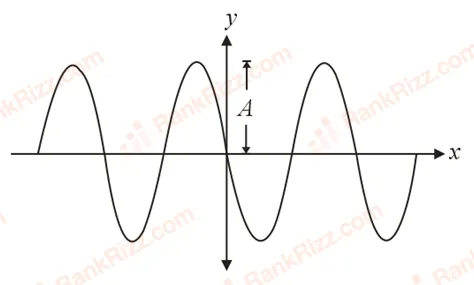
A progressive wave travelling along the positive x-direction is represented by y(x,t)=Asin⁡(kx−ωt+ϕ)y(x, t) = A\sin(kx - \omega t + \phi). Its snapshot at t = 0 is given in the figure.

Figure for JEE Main 2019 Physics question on Progressive waves: wave equation, phase and intensity

For this wave, the phase ϕ\phi is:

  1. A

    π2\frac{\pi}{2}

  2. B

    0

  3. C

    π\pi

  4. D

    −π2-\frac{\pi}{2}

JEE MAIN 2019 · 12 APR S2Progressive waves: wave equation, phase and intensityTRANSCRIBED

A small speaker delivers 2 W of audio output. At what distance from the speaker will one detect 120 dB intensity sound? [Given reference intensity of sound as 10−1210^{-12} W/m2^2]

  1. A

    40 cm

  2. B

    20 cm

  3. C

    10 cm

  4. D

    30 cm

JEE MAIN 2019 · 09 APR S1Progressive waves: wave equation, phase and intensityTRANSCRIBED

The pressure wave, P=0.01sin⁡[1000t−3x]P = 0.01 \sin[1000t - 3x] N m−2^{-2}, corresponds to the sound produced by a vibrating blade on a day when atmospheric temperature is 0°C. On some other day when temperature is T, the speed of sound produced by the same blade and at the same frequency is found to be 336 m s−1^{-1}. Approximate value of T is:

  1. A

    12°C

  2. B

    15°C

  3. C

    4°C

  4. D

    11°C

JEE MAIN 2018 · 15 APR S1Progressive waves: wave equation, phase and intensityTRANSCRIBED

A tuning fork vibrates with frequency 256 Hz and gives one beat per second with the third normal mode of vibration of an open pipe. What is the length of the pipe? (Speed of sound in air is 340 ms−1^{-1})

  1. A

    190 cm

  2. B

    180 cm

  3. C

    220 cm

  4. D

    200 cm

JEE MAIN 2018 · 16 APR ONLINEProgressive waves: wave equation, phase and intensityTRANSCRIBED

The end correction of a resonance column is 1 cm. If the shortest length resonating with the tuning fork is 10 cm, the next resonating length should be:

  1. A

    32 cm

  2. B

    40 cm

  3. C

    28 cm

  4. D

    36 cm

JEE MAIN 2017 · 08 APR ONLINEProgressive waves: wave equation, phase and intensityTRANSCRIBED

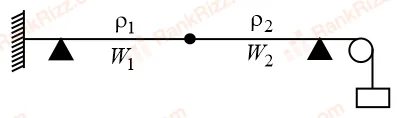
Two wires W1W_1 and W2W_2 have the same radius rr and respective densities ρ1\rho_1 and ρ2\rho_2, such that ρ2=4ρ1\rho_2 = 4\rho_1. They are joined together at the point OO, as shown in the figure. The combination is used as a sonometer wire and kept under tension TT. The point OO is midway between the two bridges. When a stationary wave is set up in the composite wire, the joint is found to be a node. The ratio of the number of antinodes formed in W1W_1 to W2W_2 is:

Figure for JEE Main 2017 Physics question on Progressive waves: wave equation, phase and intensity
  1. A

    4 : 1

  2. B

    1 : 2

  3. C

    1 : 1

  4. D

    1 : 3

JEE MAIN 2017 · 09 APR ONLINEProgressive waves: wave equation, phase and intensityTRANSCRIBED

A standing wave is formed by the superposition of two waves travelling in opposite directions. The transverse displacement is given by, y(x,t)=0.5sin⁡(5π4x)cos⁡(200πt)y(x, t) = 0.5 \sin\left(\frac{5\pi}{4}x\right) \cos(200\pi t). What is the speed of the travelling wave moving in the positive xx direction? (xx and tt are in meter and second, respectively)

  1. A

    120 m s−1^{-1}

  2. B

    90 m s−1^{-1}

  3. C

    160 m s−1^{-1}

  4. D

    180 m s−1^{-1}

JEE MAIN 2016 · 03 APR OFFLINEProgressive waves: wave equation, phase and intensityTRANSCRIBED

A uniform string of length 20 m is suspended from a rigid support. A short wave pulse is introduced at its lowest end. It starts moving up the string. The time taken to reach the support is (Take, g=10g = 10 m s−2^{-2})

  1. A

    222\sqrt{2} s

  2. B

    2\sqrt{2} s

  3. C

    2π22\pi\sqrt{2} s

  4. D

    2 s

JEE MAIN 2014 · 09 APR ONLINEProgressive waves: wave equation, phase and intensityTRANSCRIBED

A transverse wave is represented by: y=10πsin⁡(2πTt−2πλx)y = \frac{10}{\pi} \sin\left(\frac{2\pi}{T}t - \frac{2\pi}{\lambda}x\right). For what value of the wavelength the wave velocity is twice the maximum particle velocity?

  1. A

    40 cm

  2. B

    60 cm

  3. C

    10 cm

  4. D

    20 cm

JEE MAIN 2013 · 25 APR ONLINEProgressive waves: wave equation, phase and intensityTRANSCRIBED

In a transverse wave the distance between a crest and neighbouring trough at the same instant is 4.0 cm and the distance between a crest and trough at the same place is 1.0 cm. The next crest appears at the same place after a time interval of 0.4 s. The maximum speed of the vibrating particles in the medium is:

  1. A

    3π2\frac{3\pi}{2} cm/s

  2. B

    5π2\frac{5\pi}{2} cm/s

  3. C

    π2\frac{\pi}{2} cm/s

  4. D

    2π2\pi cm/s