JEE MAIN 2019 · 10 APR S2Organ pipes and resonance columnsTRANSCRIBED
The correct figure that shows, schematically, the wave pattern produced by the superposition of two waves of frequencies 9 Hz and 11 Hz, is
- A
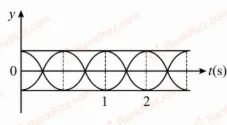
- B
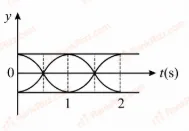
- C
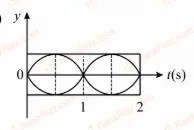
- D
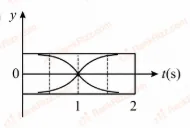
Every Waves question JEE Main has set, grouped by the idea it tests rather than the order of the syllabus. 169 questions across 6 distinct ideas. Free to read, answer key on every one.
Questions
169
Distinct ideas
6
Share of marks
2.2%
Difficulty
MEDIUM
A chapter is not one subject — it is a handful of procedures the examiner reuses. These are the ones Waves questions actually test.
121–140 OF 169 · NEWEST FIRST
The correct figure that shows, schematically, the wave pattern produced by the superposition of two waves of frequencies 9 Hz and 11 Hz, is
A tuning fork of frequency 480 Hz is used in an experiment for measuring speed of sound (v) in air by resonance tube method. Resonance is observed to occur at two successive lengths of the air column, l = 30 cm and l = 70 cm. Then, v is equal to:
384 m s
332 m s
338 m s
379 m s
A tuning fork vibrates with frequency 256 Hz and gives one beat per second with the third normal mode of vibration of an open pipe. What is the length of the pipe? (Speed of sound in air is 340 ms)
190 cm
180 cm
220 cm
200 cm
The end correction of a resonance column is 1 cm. If the shortest length resonating with the tuning fork is 10 cm, the next resonating length should be:
32 cm
40 cm
28 cm
36 cm
A granite rod of 60 cm length is clamped at its middle point and is set into longitudinal vibrations. The density of granite is kg m and its Young's modulus is Pa. What will be the fundamental frequency of the longitudinal vibrations?
7.5 kHz
5 kHz
2.5 kHz
10 kHz
5 beats/second are heard when a turning fork is sounded with a sonometer wire under tension, when the length of the sonometer wire is either 0.95 m or 1 m. The frequency of the fork will be:
195 Hz
251 Hz
150 Hz
300 Hz
Two sitar strings, A and B playing the note 'Dha' are slightly out of tune and produce beats of frequency 5 Hz. The tension of the string B is slightly increased and the beat frequency is found to decrease by 3 Hz. If the frequency of A is 425 Hz. The original frequency of B is:
428 Hz
430 Hz
422 Hz
420 Hz
An observer is moving with half the speed of light towards a stationary microwave source emitting waves at frequency 10 GHz. What is the frequency of the microwave measured by the observer? (speed of light = m s)
15.3 GHz
10.1 GHz
12.1 GHz
17.3 GHz
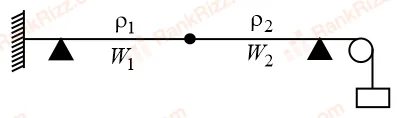
Two wires and have the same radius and respective densities and , such that . They are joined together at the point , as shown in the figure. The combination is used as a sonometer wire and kept under tension . The point is midway between the two bridges. When a stationary wave is set up in the composite wire, the joint is found to be a node. The ratio of the number of antinodes formed in to is:
4 : 1
1 : 2
1 : 1
1 : 3
A standing wave is formed by the superposition of two waves travelling in opposite directions. The transverse displacement is given by, . What is the speed of the travelling wave moving in the positive direction? ( and are in meter and second, respectively)
120 m s
90 m s
160 m s
180 m s
A pipe open at both ends has a fundamental frequency in air. The pipe is dipped vertically in water so that half of it is in water. The fundamental frequency of the air column is now:
2
A uniform string of length 20 m is suspended from a rigid support. A short wave pulse is introduced at its lowest end. It starts moving up the string. The time taken to reach the support is (Take, m s)
s
s
s
2 s
Two engines pass each other moving in opposite directions with uniform speed of 30 m/s. One of them is blowing a whistle of frequency 540 Hz. Calculate the frequency heard by driver of second engine before they pass each other. Speed of sound is 330 m/sec:
450 Hz
540 Hz
270 Hz
648 Hz
A toy-car, blowing its horn, is moving with a steady speed of 5 m s, away from a wall. An observer, towards whom the toy car is moving, is able to hear 5 beats per second. If the velocity of sound in air is 340 m s, the frequency of the horn of the toy car is close to
680 Hz
510 Hz
340 Hz
170 Hz
A train is moving on a straight track with speed 20 m s. It is blowing its whistle at the frequency of 1000 Hz. The percentage change in the frequency heard by a person standing near the track as the train passes him is (speed of sound = 320 m s) close to:
24%
6%
12%
18%
A bat moving at 10 m s towards a wall sends a sound signal of 8000 Hz towards it. On reflection, it hears a sound of frequency . The value of in Hz is close to (speed of sound = 320 m s)
8258
8424
8000
8516
A source of sound emits sound waves at frequency . It is moving towards an observer with fixed speed (v_s < v), where is the speed of sound in air. If the observer were to move towards the source with speed , one of the following two graphs (A and B) will give the correct variation of the frequency heard by the observer as is changed.
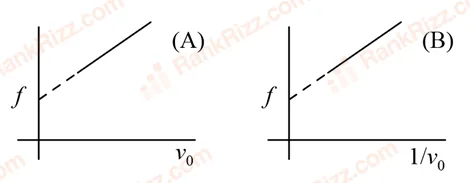
The variation of with is given correctly by:
Graph A with slope =
Graph A with slope =
Graph B with slope =
Graph B with slope =
A pipe of length 85 cm is closed from one end. Find the number of possible natural oscillations of air column in the pipe whose frequencies lie below 1250 Hz. The velocity of sound in air is 340 m/s.
12
8
6
4
A transverse wave is represented by: . For what value of the wavelength the wave velocity is twice the maximum particle velocity?
40 cm
60 cm
10 cm
20 cm
Two factories are sounding their sirens at 800 Hz. A man goes from one factory to other at a speed of 2 m/s. The velocity of sound is 320 m/s. The number of beats heard by the person in one second will be:
2
4
8
10
OTHER PHYSICS CHAPTERS